
Uganda workforce hits 9.3 million as formal jobs, safety standards improve — report
Employers are also increasingly contributing to the National Social Security Fund (NSSF), alongside adopting policies addressing HIV/AIDS, disability and gender equality.
Chris Mukiza, the Executive Director UBOS, appending his signature on the dummy report as Stephen Birahwa Mukitale, the Deputy Chairperson National Planning Authority (NPA), looks on. This was during the dissemination of the National Human Resource Survey Report at Uganda Bureau of Statistics (UBOS)offices in Kampala on April 23, 2026. (Credit: Nancy Nanyonga)
KAMPALA - Uganda’s workforce has grown to about 9.38 million people, with notable gains in formal employment and workplace safety, a new government report has revealed.
The findings, contained in the National Human Resource Survey 2023/24 released on Thursday at Statistics House in Kampala, show steady expansion in both formal and informal sectors over the past decade.
According to the Uganda Bureau of Statistics (UBOS), formal employment now stands at 2,204,918 workers. Men still dominate the sector at about 1.32 million, but women account for a significant 878,000 jobs.
The report attributes part of this growth to increased output from tertiary institutions. A total of 1,459 training institutions were covered in the survey, of which 1,010 are privately owned.
These institutions continue to supply skilled labour needed to meet demand in the economy.
Despite gains in formal employment, the informal non-household sector remains the largest employer, accounting for 7,183,414 workers.
Workplace safety
The survey also points to significant progress in occupational health and safety.
The proportion of workplaces with Occupational Health and Safety (OSH) policies has risen sharply from 19% in 2016/17 to 53% in 2024.
UBOS notes that more employees are now aware of workplace risks and the measures required to manage them.
Employers are also increasingly contributing to the National Social Security Fund (NSSF), alongside adopting policies addressing HIV/AIDS, disability and gender equality.
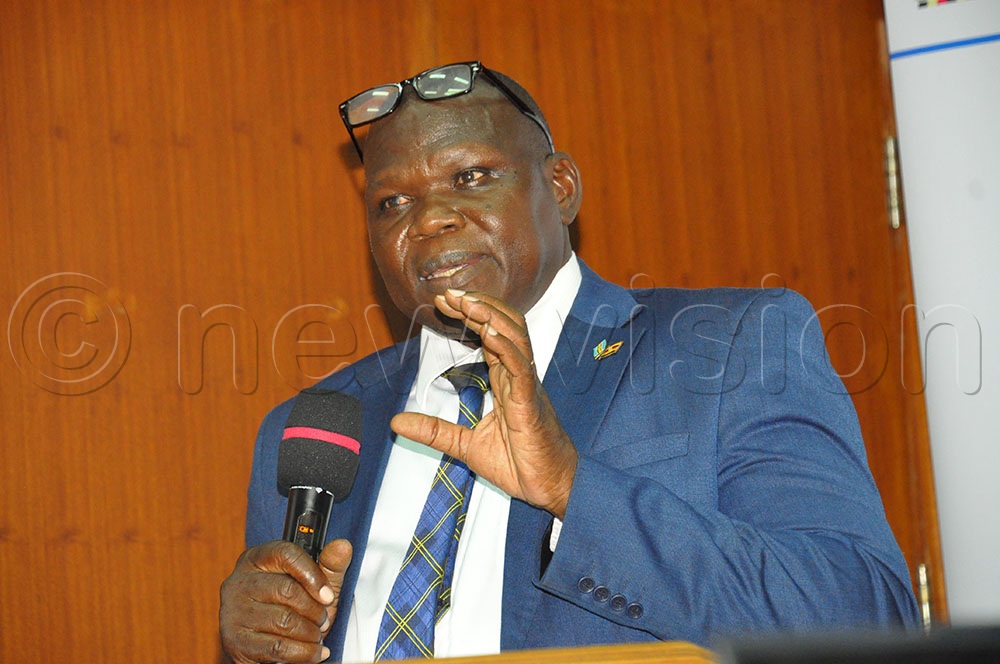
Stephen Birahwa Mukitale, the Deputy Chairperson National Planning Authority (NPA) remarks during the dissemination of the National human resource survey report at Uganda Bureau of Statistics (UBOS)offices Kampala on April 23, 2026. (Credit: Nancy Nanyonga)
Skills gaps persist
However, the report highlights persistent skills gaps across several occupations.
Managers were found to struggle most with customer care (14.6%) and managerial competencies (14.3%), while professionals showed gaps in information technology skills (14.1%).
Among service and sales workers, communication (11.4%) and language skills (9.4%) remain key weaknesses.
Data challenges
UBOS said the survey achieved a 99.9% response rate from training institutions, although delays from some formal establishments required follow-ups, including validation visits and use of non-disclosure agreements.
The bureau plans a follow-up survey targeting small establishments employing between one and four people, which were not covered in the current study.
The 2023/24 report is the second edition of the National Human Resource Survey, following the inaugural survey conducted in 2016/17.