
Uganda students challenge global inequalities at Aga Khan Model UN
The deputy head of the European Union Delegation to Uganda, Eole Sury, said the session aimed to groom students into excellent researchers, public speakers and debaters, while equipping them with leadership and writing skills.
Some of the students from various schools who participated in the 12th session of Aga Khan High School Model United Nations (UN) debate. (Photo by Wilfred Sanya)
________________
More than 800 students from 20 high schools gathered at Aga Khan High School for the 12th session of its annual Model United Nations (UN) debate.
The deputy head of the European Union Delegation to Uganda, Eole Sury, said the session aimed to groom students into excellent researchers, public speakers and debaters, while equipping them with leadership and writing skills.
Sury made the remarks during the 12th session of the Aga Khan annual Model United Nations debate, held under the theme “Peace, dignity, and equality on a healthy planet”. The event took place at Aga Khan High School on Muammar Gaddafi Road, Old Kampala, on November 13, 2026.
Sury explained, “You are not simply taking part in a school activity; you are practising skills. The world urgently needs dialogue, cooperation, critical thinking, and the ability to find common ground despite differences”.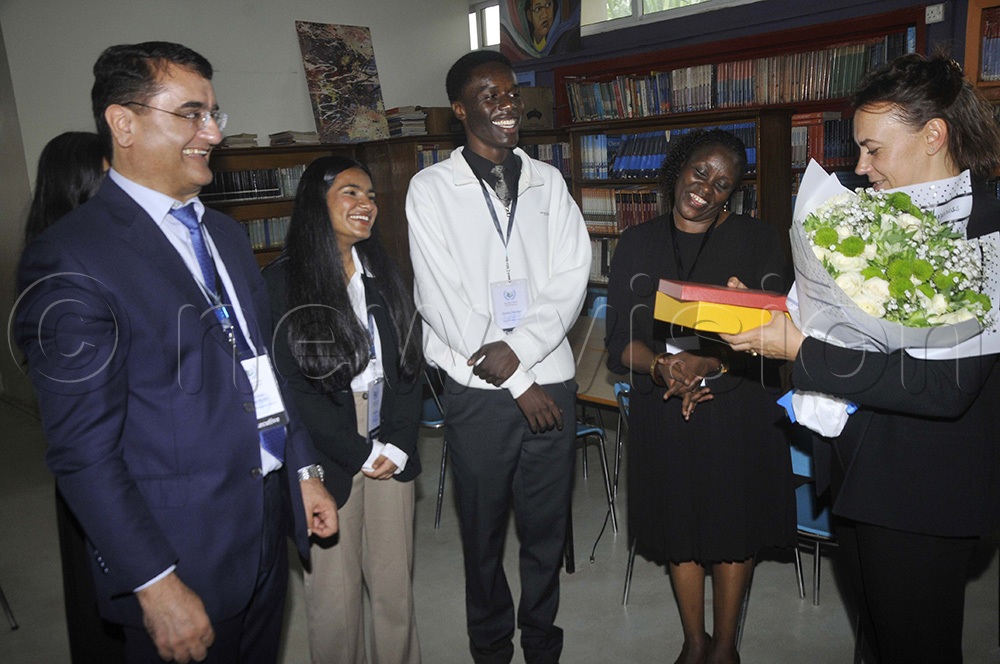
Head of Aga Khan School Development, Zuloby Mamadfozilov (left), after presenting a gift to Ecole Sury, the Deputy Head of Mission, European Union (right), after opening the 13th session of the Aga Khan Model United Nations debate. (Photo by Wilfred Sanya)
“We live in a world facing profound challenges; conflicts continue to affect millions of people. Climate change threatens livelihoods, communities, inequalities persist, and too many young people still face barriers to education and opportunities,” added Sury.
Sury said these challenges did not stop at national borders and that no country could address them alone, making international cooperation important.
“Today, the EU brings together 27 countries each with its own history, languages and traditions, working together to address common challenges. Reaching agreement is not always easy because there are disagreements and, at some level, compromises to be reached,” Sury said.
She added that this was precisely what diplomacy was about, with negotiations aimed at achieving win-win outcomes.
She said the educational simulation helped learners understand diplomacy, international relations and the operations of the UN, while giving them an opportunity to engage in academic competition.
Some of the participating schools included Mengo Senior School, Light Academy Boys' School, Quality International School, Acorns International School, British School of Kampala, Grace Community International School, Kobojja International School, Vienna College Namugongo, Horizon International School, Pine International School and Shree SSU International School, among others.
Michael Musaazi, the head teacher of Aga Khan High School, said the event was global in nature and gave students an opportunity to simulate the UN, debate issues and explore ways of resolving complex challenges.
“This debate helps students to find solutions, particularly on current issues that are trending globally. And with such debates, the resolutions will be shared at the UN meetings,” Musaazi said.
He said the delegates were assigned roles representing UN member countries. He added that the debates built students' confidence and helped them learn new skills from their peers.
During the debates, students examined the roles and challenges of the UN Security Council, disarmament and international security, the role of the World Health Organisation (WHO), UN human rights issues and counterterrorism.
Delegates speak out
A delegate from Vienna College Namugongo who preferred anonymity said one of the body's main challenges was that its five permanent members, the United States, China, France, Russia and the United Kingdom, had the power to veto decisions.
She said that although Africa had 54 countries, the continent had very little influence compared with the wealthy states holding permanent membership.
Kirstaina Kirabo, a delegate from British School of Kampala, said international human trafficking caused severe physical, psychological, economic and social harm to individuals, communities and global systems, and needed to be addressed.
Kirabo explained that survivors frequently experienced long-term physical injuries, malnutrition, exhaustion and severe trauma resulting from physical or sexual violence.
She said these experiences exposed victims to high risks of sexually transmitted infections (STIs), unwanted pregnancies, forced abortions and reproductive complications.
She added that traffickers often stripped victims of legal documents, isolated them from their families and support networks, and deprived them of their identities, making safe reintegration difficult.
“Trafficked individuals frequently encounter legal vulnerability, penalties or detention for crimes forced upon them by traffickers, or struggle with interrupted education and lack of vocational skills,” she noted.