
Uganda steps up fight against drowning as 3,000 lives are lost every year
According to Namanya, about 70% of all reported drowning incidents occur in lakeside districts, particularly around Lake Victoria and other major inland water bodies.
Senior Policy Analyst, Ministry of Works and Transport, Ronald Reagan Namanya makes a presentation as Justinian Kateerea, the country coordinator for the Prevent Epidemics program GHAI, ACP Richard Okullu, 2nd in command, Marine Unit, and the Drowning Prevention Programme Coordinator, Marine Unit, Bashiri Siriba during a consultative meeting at the Four Points Sheraton in Kampala recently. (Photos by Juliet Waiswa)
________________
Uganda has stepped up the fight against drowning with a new five-year strategy aimed at reducing the number of 3,000 people who die of drowning every year.
This is the equivalent of nearly eight lives lost everyday, making it one of the country's most pressing but often overlooked public safety challenges, Ronald Reagan Namanya, a Senior Policy Analyst at the Ministry of Works and Transport, revealed.
Speaking during a national stakeholder meeting at Four Points by Sheraton Hotel in Kampala on Thursday, Namanya said transport-related drowning remains one of Uganda's most significant yet under-addressed transport safety challenges.
According to Namanya, about 70% of all reported drowning incidents occur in lakeside districts, particularly around Lake Victoria and other major inland water bodies.
"Records from the Ministry of Works and Transport indicate that approximately 95% of people who drowned in boat-related incidents were not wearing life jackets," he said while presenting the Ministry of Works and Transport Drowning Prevention Strategy (2025/26–2029/30).
He added that many drowning incidents go unreported, resulting in weak national surveillance systems and an underestimation of the true burden of drowning in Uganda.
Namanya said government aims to reduce drowning and maritime-related fatalities on Uganda's inland waterways by 25% by 2030.
The growing concern comes at a time when the World Health Organisation (WHO) has urged countries to develop and implement national drowning prevention strategies following the release of its latest report highlighting the global burden of drowning.The report recommends stronger government leadership, improved water safety measures, and coordinated action to reduce preventable deaths.
The Royal National Lifeboat Institution, working with governments, agencies and non-governmental organisations, has also intensified efforts to place drowning prevention higher on national policy agendas.
ACP Richard Okullu (in police uniform), 2nd in command of the Marine Unit and the Drowning Prevention Programme Coordinator, Marine Unit Bashiri Siriba, during a consultative meeting with participants at the Four Points by Sheraton in Kampala recently. 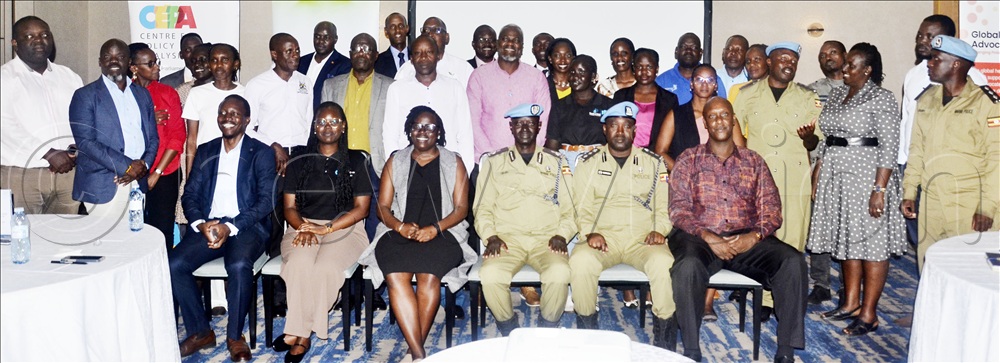
Namanya revealed that studies indicate that some lakeside fishing communities experience drowning rates as high as 502 deaths per 100,000 people, which is more than 62 times the WHO African regional average.
He explained that the strategy recognises drowning not only as a public health issue but also as a transport safety, socio-economic, governance and national development challenge that affects productivity, trade, tourism, fisheries and the country's overall development.
Officials from the ministries of; health, water and environment, Marine Police, Reach-A-Hand Uganda and several civil society organisations attended the meeting to harmonise their approaches to drowning prevention.
Participants emphasised the need for stronger coordination among institutions, noting that no single organisation can address the problem alone.
The meeting was organised by the Global Health Advocacy Incubator (GHAI), with support from Bloomberg Philanthropies.
Justinian Kateetera, Country Coordinator for the Prevention of Epidemics Programme at GHAI, said the meeting was intended to assess Uganda's drowning burden within the global context and strengthen collaboration among stakeholders.
Richard Okullu, the second-in-command of the Marine Police Unit, said failure to wear life jackets remains one of the biggest contributors to drowning.
"The experience we have is that many people do not own life jackets, while others simply have no interest in wearing them," he said.
Okullu noted that people can drown even in shallow water, adding that flooding has also become an increasing cause of drowning.
He observed that many organisations are currently implementing drowning prevention activities independently, making coordination difficult.
"Once this strategy is fully implemented, every institution will know its role, making coordination and follow-up much easier," he said.
He added that the Uganda Police Marine Unit intends to broaden the strategy beyond major water bodies to include other environments where drowning occurs.
"We need to work together to achieve the national target of reducing drowning by 25%. As the Uganda Police Marine Unit, we also intend to strengthen the strategy so it addresses drowning risks not only on water bodies, but also in homes and other settings," Okullu said.
Key causes of drowning
The Marine Unit's Drowning Prevention Programme Coordinator, Bashiri Siriba, identified weak enforcement of maritime safety laws, unsafe and unregistered vessels, low compliance with life jacket use, inadequate Search and Rescue capacity, limited public awareness, poor swimming skills, weak navigation infrastructure, climate change, poor institutional coordination and inadequate funding as the principal drivers of drowning.
The Commissioner for the Department of International and Transboundary Water Affairs at the Ministry of Water and Environment, Eng. Sowedi Sewagudde, said the water sector already has regulations governing water infrastructure and transport safety, adding that coordination mechanisms are in place to improve safety on Uganda's waterways.