
Uganda launches state-of-the-art laboratory to test dairy exports
While launching the laboratory on November 25, 2026, animal husbandry state minister Bright Rwamirama said it had been equipped with the necessary equipment and expertise to test Uganda's milk and dairy products against standards required by export markets.
While launching the laboratory on November 25, 2026, animal husbandry state minister Bright Rwamirama said it had been equipped with the necessary equipment and expertise to test Uganda's milk and dairy products. (Photo by Prossy Nandudu)
__________________
Uganda has launched a National Dairy Laboratory at the UMA show grounds in Lugogo to test milk and dairy products for quality and safety before they are exported.
While launching the laboratory on November 25, 2026, animal husbandry state minister Bright Rwamirama said it had been equipped with the necessary equipment and expertise to test Uganda's milk and dairy products against standards required by export markets.
He explained that the laboratory had received certification from the Kenya Accreditation Service (KENAS) under the ISO/IEC 17025:2017 standard in 2026. With the accreditation in place, Ugandan exporters can now have their milk and dairy products tested for 15 parameters before they leave the country.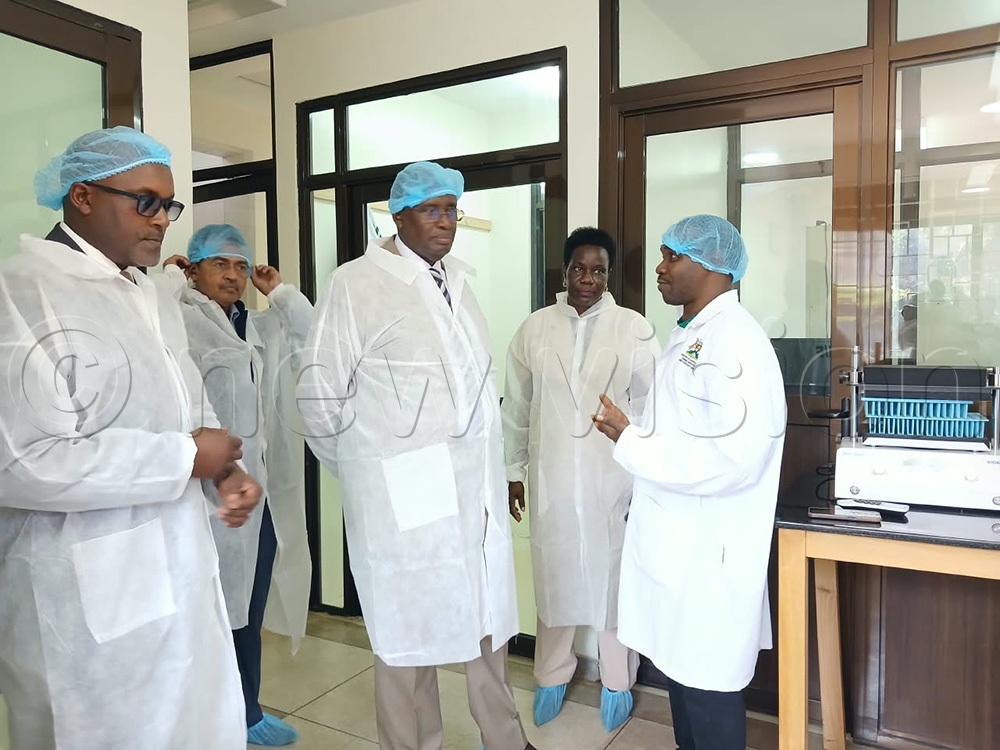
Julius Wandera, a lab technologist on the right, explains to the Minister of State for Animal Husbandry, Bright Rwamirama, in the middle, how the lab works, as Samson Akankiza, Commissioner, Dairy Department, listens. (Photo by Prossy Nandudu)
“This laboratory will help farmers and processors to demonstrate that their products can meet the buyer’s expectations and requirements of the market,” Rwamirama said.
He added that the laboratory was timely given the increase in the production of milk and dairy products. Uganda's milk processing capacity currently stands at 5.4 million litres a day.
Although the ambition is to increase production, which will translate into better and more dependable incomes along the dairy value chain, this cannot be realised without proof that milk and dairy products are safe.
Rwamirama urged farmers to maintain quality standards from the farm through transportation and up to the point when milk and dairy products are submitted to the laboratory for testing.
Samson Akankiza Mpiira, the commissioner for dairy development and production at the Ministry of Agriculture, Animal Industry and Fisheries, said Uganda earns $285 million (about sh1.2 billion) annually from the export of 21 processed dairy products to different destinations.
He explained that the exports comprise products with both long and short shelf lives. They include whey protein concentrate extracted from milk, skimmed milk, casein, whole milk powder, skimmed milk powder and ultra-high-temperature (UHT) milk, among others.
According to Akankiza, the laboratory will test for 15 of the 56 parameters that are key requirements for dairy exports.
The tests include total coliforms, E. coli, Salmonella, Listeria species, yeasts and moulds, routine fat, butterfat reference, moisture content, total solids, solids-not-fat, added water, pH and density, according to Julius Wandera, a senior laboratory technologist stationed at the facility.