
Turning Soroti’s garbage crisis into wealth opportunity
Ediau revealed that about 72.4 percent of the waste generated in the city is organic waste, which can naturally decompose and be converted into useful products.
Journalists filming the waste management plant in Aminit, which has been overwhelmed by waste. (Photos by Godfrey Ojore )
________________
Waste management remains one of the biggest challenges facing urban centres and cities across Uganda. In many towns, piles of uncollected garbage have almost become part of the landscape, frustrating residents and exposing local leaders to criticism over poor service delivery.
For years, residents of towns and cities have blamed their leaders for failing to address the growing waste crisis, with some elected officials even losing political support because of poor sanitation.
Soroti city is among the urban centres struggling under the weight of poor waste management. Overflowing garbage heaps along roadsides and in markets have repeatedly drawn criticism from residents, with many taking to social media to ridicule city authorities over the worsening situation.
Dr James Peter Egonyu with his staff, showing the press the larvae that will transition into black soldier flies that eat organic waste and turn it into fertilisers.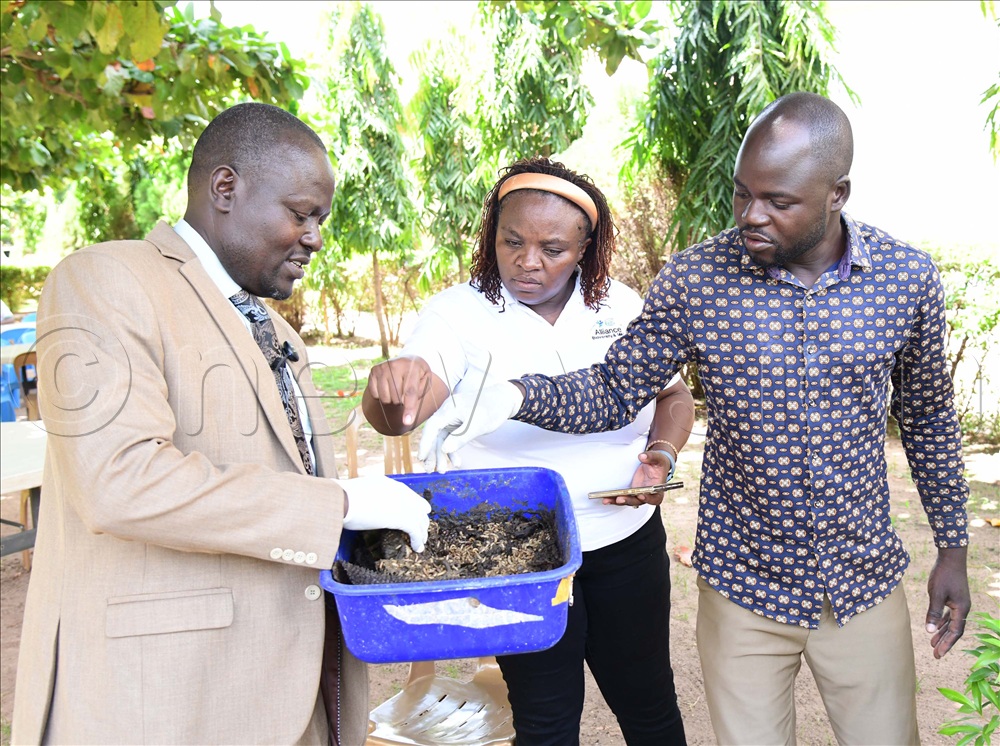
Every day, Soroti city generates an estimated 165 tonnes of waste, yet the city has the capacity to collect only 14 tonnes.
“We have not made significant headway in reducing the volumes of waste left in the environment, which continues to pose a huge burden to both the environment and the people,” said Francis Ediau, the environment officer of Soroti city.
According to Ediau, the city’s annual waste management budget of sh100 million is far too small to effectively handle the increasing volumes of garbage.
However, amid the growing crisis lies a promising opportunity.
Ediau revealed that about 72.4 percent of the waste generated in the city is organic waste, which can naturally decompose and be converted into useful products.
“With such a large percentage of organic waste, Soroti city is actually in an advantageous position if the waste is properly processed and managed,” he explained.
The Faculty of Agriculture and Animal Sciences at Busitema University’s Arapai Campus is partnering with the International Center for Tropical Agriculture (CIAT) to implement a project dubbed “Waste to Wealth: Using Innovative Gender-Responsive Business Models to Turn Organic Market Waste into Organic Fertilizer and Animal Feeds (WAWE).”
The two-year project, which started last year and runs until September 2027, is funded by the Climate and Clean Air Coalition of the United Nations Environment Programme (UNEP).
The initiative seeks to reduce greenhouse gas emissions by tackling the challenge of organic waste management in urban markets. Besides Soroti in Uganda, the project is also being implemented in Nairobi and Kiambu in Kenya, where nearly 40 percent of fruits and vegetables go to waste.
At the centre of the innovation is black soldier fly farming, a method that uses insects to recycle food waste into valuable products.
The larvae feed on decomposing organic waste from markets, helping to reduce the huge volumes of garbage that often rot and leave markets filthy and unhygienic. In the process, the project produces organic bio-fertiliser and protein-rich larvae for animal feed.
“The use of black soldier fly farming is going to be a game changer not only in waste management but also in creating employment opportunities and improving household productivity,” Ediau noted.
Empowering youth and women
Prof. James Peter Egonyu, an Associate Professor of Agricultural Entomology and leader of the project at the Faculty of Agriculture and Animal Sciences at Busitema University, described the project as a major opportunity for youth and women to venture into income-generating activities.
“They can develop enterprises along the waste management value chain, from producing larvae and bio-fertilisers to supplying fertilisers for crop production and larvae for animal feed,” Prof. Egonyu said on May 29, 2026, in Soroti city.
Prof. Egonyu, who has conducted extensive research in insect farming, waste recycling and integrated pest management, said more than 300 students at Busitema University were trained last year in black soldier fly farming as an additional practical skill.
He added that the university is now offering free one-week training sessions to residents of Soroti City to equip them with skills on how to transform waste into profitable ventures.
“We are changing the mindset of the youth by exposing them to opportunities that can turn waste into money. Young people are always interested in activities that can generate income,” he said.
Prof. Egonyu also appealed to city leaders to mobilise and engage unemployed youth in the initiative, saying it could help reduce crime and idleness among urban youth.
Environmental benefits
Dr Christine Chege, a senior scientist with Alliance Bioversity International and CIAT, blamed the growing piles of waste in markets and streets in Uganda and Kenya on limited knowledge about bio-waste recycling.
Dr Christine Chege, a senior scientist with Alliance Bioversity International addressing stakeholders in Soroti city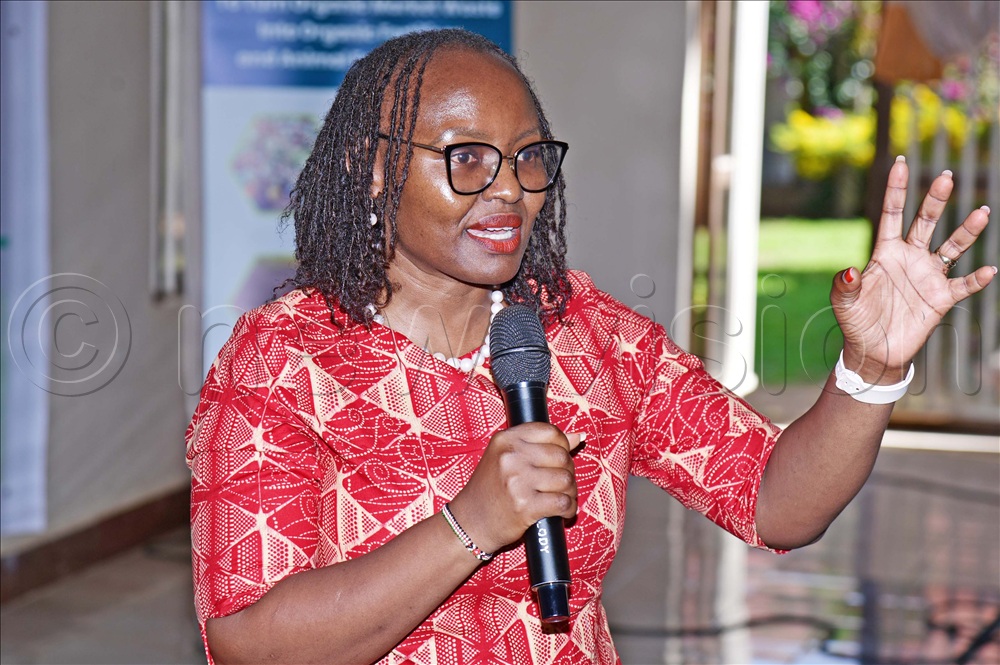
She observed that innovations such as black soldier fly farming can significantly reduce organic waste accumulation in urban centres.
“Furthermore, there is a need for stronger policies, frameworks and guidelines for managing, recycling and reusing market bio-waste,” Dr Chege advised.
She warned that the continued practice of dumping waste in landfills contributes heavily to greenhouse gas emissions, which accelerate climate change.
“When greenhouse gases are emitted into the atmosphere, they contribute to changes in the climate. We are now experiencing irregular rainfall patterns and rising temperatures,” she explained.
Soroti deputy city clerk Badru Ochengel welcomed the initiative, describing it as timely and transformative.
“As a city authority, we recognise that waste should no longer be viewed merely as a problem, but rather as a resource with economic value,” Ochengel said.
He noted that through proper waste segregation, recycling, composting and the adoption of innovative technologies, waste management can create employment opportunities and improve livelihoods across the country.
For a city long overwhelmed by garbage, the new initiative may finally offer hope that what has for years been viewed as waste could become a source of wealth, jobs and environmental recovery.