
Speaker Oboth launches documentary on Parliament’s 105-year journey
"Let us all work together to strengthen accountability, and it starts with us. Don’t ask for payment for trips you have not undertaken, don’t sign in the book of attendance when you did not attend the committee sitting, don’t get money for field trips where you have not been," Speaker Oboth urged lawmakers.
Speaker Jacob Marksons Oboth officially opened the MPs’ induction seminar at Speke Resort Munyonyo, in Kampala on June 30, 2026. (Credit: Parliament)
KAMPALA - Speaker Jacob Marksons Oboth on Tuesday launched an hour-long documentary chronicling Uganda’s political and socio-economic evolution.
The unveiling ceremony of the non-fiction motion picture titled “The century of Parliament and beyond” took place at Speke Resort Munyonyo during the opening of a four-day induction seminar for Members of Parliament.
Oboth urged MPs to cultivate a culture of absolute transparency and integrity while conducting parliamentary business.
"Let us all work together to strengthen accountability, and it starts with us. Don’t ask for payment for trips you have not undertaken, don’t sign in the book of attendance when you did not attend the committee sitting, don’t get money for field trips where you have not been," he urged lawmakers.
Prime Minister Robinah Nabbanja and Leader of Opposition in Parliament Joel Ssenyonyi were in attendance.
Meanwhile, a photo exhibition was part of the event, which the Speaker toured.
The 66-minute-long documentary that he launched is aimed at preserving institutional memory and facilitating research that will enable policymakers to make informed decisions.
“Now that Parliament is 105 years old, we are helping current policy makers to see in the last century what transpired in Uganda’s history," said museum registrar Park Tinyefuza.
"They can pick some lessons and some mistakes which can be avoidable so that going forward, the next policy makers have something to begin with or to avoid.
The documentary showcases key moments, personalities and milestones of Uganda’s history, including the history of formal legislation which commenced in 1921 with the orders in council.
At the time, orders in council were laws issued by and with the approval of Her Majesty’s Privy Council, which was the highest appellate court for the colonial British Empire at the time.
In passing the law, besides empowering the governor to issue proclamations and ordinances for the effective administration of the protectorate, it paved the way for the establishment of the Legislative Council (LegCo).
The documentary also captures Uganda's first elections towards self-governance, which were won by the Democratic Party (DP) under Benedicto Kiwanuka and the repeat polls which were held after Buganda boycotted the initial polls.
The April 25, 1962 elections were won by the Kabaka Yekka (KY) and UPC alliance, which paved the way for Buganda's Kabaka Sir Edward Muteesa II to become Uganda's first President, with Milton Apollo Obote becoming the first prime minister after the October independence.
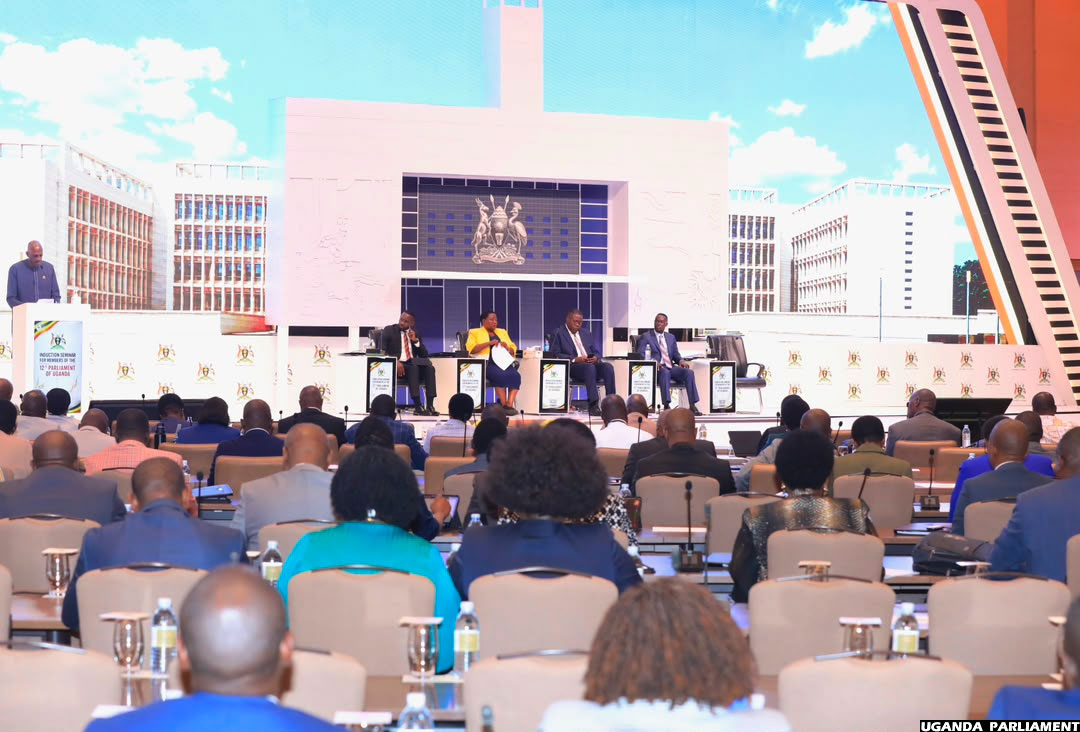
Prime Minister Robinah Nabbanja and Leader of Opposition in Parliament Joel Ssenyonyi were in attendance.
Future plans
The documentary was initially scheduled for release late last year but was postponed. It forms part of broader initiative to preserve Uganda's legislative history, an effort that began with the establishment of the Parliamentary Museum project in 2018.
Plans are reportedly underway to commission bronze sculptures of all former Speakers and Presidents.
One of Sir Edward Muteesa II, with an estimated lifespan of more than 200 years, is already forming part of the collection in the library.
Upon completion of the new parliamentary chambers, these artefacts are expected to occupy the entire mezzanine floor. Last year, former Rubaga South MP John Ken Lukyamuzi weighed in on the subject.
"We should be able to view books written by Parliamentarians, including mine, Uganda; A Creature of the Federo Doctrine and many others that highlight the relevance of Parliament’s history," he told New Vision last September.
"This is very important. There should also be art in the form of statues of prominent figures, such as the first Speaker of Parliament of independent Uganda, Patel (Narendra).
“We should see statues of other notable Parliamentarians like Aggrey Awori, Abu Mayanja, Milton Obote and Benedicto Kiwanuka."
Also at the time, Bukimbiri County lawmaker Eddie Kwizera emphasised the institutional importance of preserving parliamentary milestones.
“As an institutional Parliament, there are some key milestones which were done either as individuals or as a Parliament. For them to be remembered for historical purposes, they always gazette one room or floor and they put there these artefacts, recordings, special occasions.
"That’s what happens in other countries."