
Sh300m water project brings safety to Kalangala residents
Water purification units have also been installed to ensure the water is safe for drinking. In addition, drainale VIP latrines have been constructed at St. Victor Mulabana Primary School and at Bwendero Health Centre III.
Dr. Patrick Kagurusi, the Amref Health Africa Uganda, Country Manager observing flow of water at a washing point at Mulabana Health Centre II in Kalangala district as district officials and Amref staff look on. This was during a joint supervision of activities and infrastructure under the Heroes for Gender Transformative Action program in the district on February 4, 2026. (Credit: Lawrence Mulondo)
KALANGALA - Kalangala District, one of Uganda’s island districts, is surrounded by the vast waters of Lake Victoria. To many outsiders, this geography suggests abundance and easy access to clean water.
Yet for thousands of residents scattered across the islands, water has long been a source of danger, disease, and despair rather than comfort.
Beneath the shimmering surface of the lake lies a daily struggle that has shaped childhoods, disrupted education, and claimed lives.
For years, residents of Mulabana parish and surrounding landing sites have depended on untreated and polluted lake water for drinking, cooking, and sanitation.
Many people walk up to 3kms to reach the lake shores, carrying heavy jerrycans up steep, slippery slopes. The journey is exhausting, risky, and routine, and for schoolchildren, it has stolen time meant for learning and play.
A school day defined by fear and fatigue
At St. Victor Mulabana Primary School in Mulabana Sub county, the school day has for years begun and ended with a dangerous trek to the lake.
Pupils walk 2kms downhill to the shore and back, sometimes twice a day, to fetch water needed for cooking meals, cleaning the school compound, and maintaining basic hygiene for both boys and girls.
Margaret Kenshubi, the school’s headteacher, says access to even unsafe water has been one of the school’s biggest challenges. The journey to the lake exposes pupils to constant danger, including attacks from crocodiles and the risk of harm from irresponsible individuals who frequent the landing sites.
“The place where they collect water is a harbour for crocodiles,” Kenshubi explains. “Every morning, I begin the day with a prayer, committing the lives of the children to God, because I cannot be sure the day will pass without an attack.”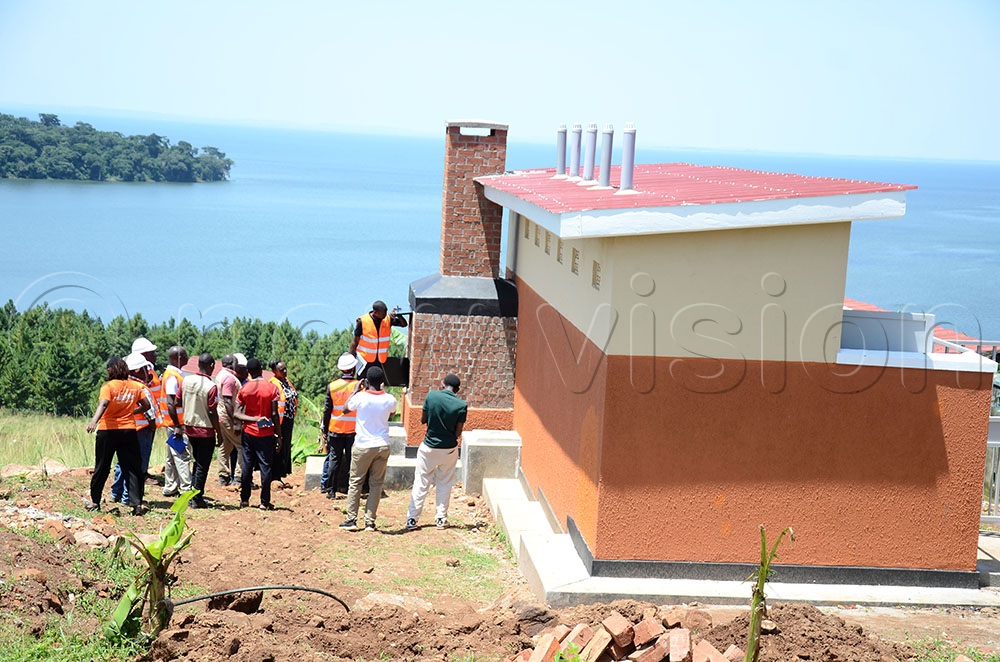
Officials inspecting a Very Improved Pit Latrine constructed at St. Victor Mulabana Primary School. This was during a joint supervision of activities and infrastructure under the Heroes for Gender Transformative Action program in Kalangala district on February 4, 2026. (Credit: Lawrence Mulondo)
She recalls moments when school activities came to a standstill after reports of crocodiles near the water collection point. Fear would grip the pupils and teachers alike. Yet the pause could only last so long. Without water, the school could not function.
The burden has been especially heavy on girls. Kenshubi says the school has been losing about 20 learners every year, most of them girls, as parents fear sending their children to such a dangerous environment.
Long walks to fetch water leave learners tired before lessons even begin, affecting concentration and academic performance.
Hygiene has also suffered. Girls experiencing menstruation often have no water to clean themselves. Many report headaches or sickness to excuse themselves from class, when in truth they feel uncomfortable and ashamed sitting among their peers.
“Our latrine is dilapidated and has very few stances compared to the number of learners,” Kenshubi says. “It fills up quickly, especially because many girls dispose of sanitary pads there. It has been a constant struggle.”
A community living on the edge
The situation at Mabigo Landing Site in Mulabana Parish mirrors that of the school. For years, more than 600 residents here have relied on unsafe lake water for their daily chores, exposing them to waterborne diseases and constant danger.
Augustine Jjuuko, the LC1 chairperson of Mabigo, says residents live with fear every day. Children are particularly vulnerable, both to illness and to crocodile attacks. When sickness strikes, families rush to health centres that are often understaffed and lack essential medicines.
The pain in the community is fresh. Residents recount losing the wife of their area pastor and a Senior Three student to crocodile attacks just over a year ago. These tragedies remain etched in the collective memory of the landing site.
Sanitation is another challenge. Although residents have tried to construct latrines at individual level, the loose and sandy soils cause most structures to collapse within months.
A turning point for over 2,000 lives
More than 2,000 people, including pupils of St. Victor Mulabana Primary School, students of Gyagenda Seed Secondary School, residents of Mabigo and Lwabalega landing sites, and patients at Mulabana Health Centre II, are set to benefit from a sh310m water system.
Construction of the system was commissioned in 2025 and is scheduled to be handed over to the community this February.
Developed by Amref Health Africa, Cordaid, and MIFUMI, with support from the Embassy of the Netherlands in Uganda and the Embassy of Iceland in Uganda, the project falls under the Heroes for Gender Transformative Action programme.
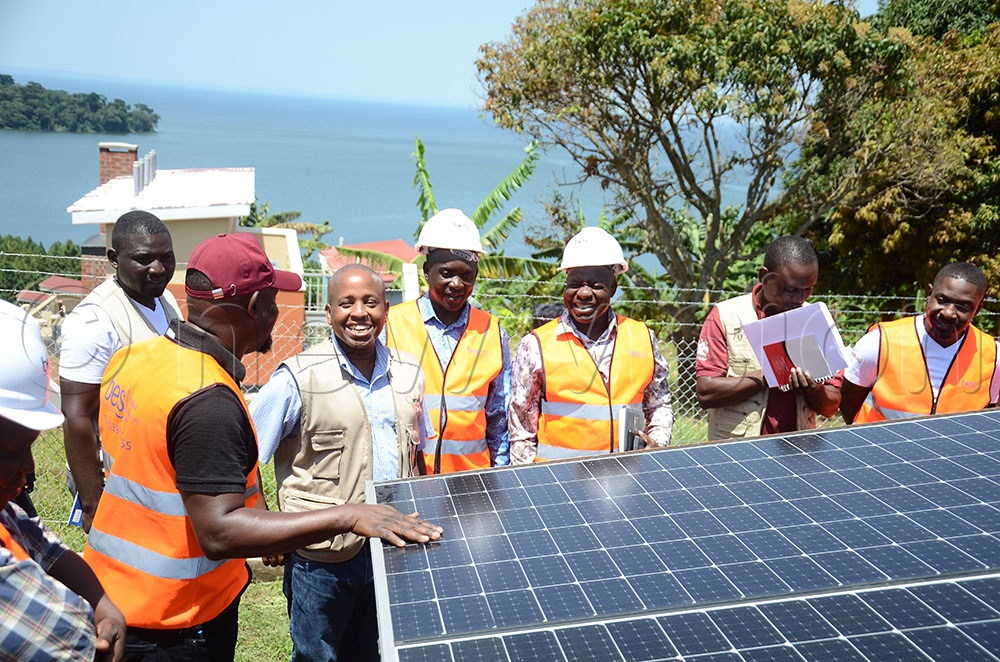
Eng. Andrew Kizito (red cap) explaining about the water system pump situated at St. Victor Mulabana primary school to Dr. Patrick Kagurusi (second from left), the Country Manager Amref Health Africa Uganda, Fred Badda (third from left), the Kalangala Resident District Commissioner, Richard Ssebandeke (fourth from left), the Chief Administrative Officer and other officials. This was during a joint supervision of activities and infrastructure under the Heroes for Gender Transformative Action program in Kalangala district on February 4, 2026. (Credit: Lawrence Mulondo)
The solar-powered system extracts water from Lake Victoria and pumps it approximately 560 metres to a storage tank. It pumps 10,000 litres per hour and has a storage capacity of 10,000 litres, distributing water to distances of up to 4kms across the landing sites.
Forty solar panels, each producing 400 watts, power the automated pump, while public stand posts have been installed to serve the communities.
Water purification units have also been installed to ensure the water is safe for drinking. In addition, drainale VIP latrines have been constructed at St. Victor Mulabana Primary School and at Bwendero Health Centre III.
At landing sites like Mabigo, there has been sensitisation leading to behavior change where locals have abandoned open defication to soliciting funds to put up public latrines.
Restoring dignity and opportunity
For Kenshubi and her pupils, the new water system represents relief and renewal. She says once water begins flowing, the school will finally operate without fear. Time once spent fetching water will be redirected to teaching and learning.
“We are hopeful that academic performance will improve because we will have more time to cover the syllabus,” she says.
The school currently has an enrolment of 522 pupils, a number projected to rise as parents regain confidence in the school’s safety. The new sanitation facilities will allow girls to bathe, change, and return to class comfortably during menstruation. An incinerator will prevent latrines from filling up quickly.
“We are grateful to the development partners for saving us from operating under the fear of death by crocodile attacks,” Kenshubi says.
Established in 1989, Kalangala District comprises 84 islands, 67 of which are inhabited. Despite its size, the district remains sparsely populated.
Richard Sebandeke, the Chief Administrative Officer, says this reality makes Kalangala vulnerable in terms of social service delivery.
“Government funding is largely based on population figures,” he explains. “Yet Kalangala is one of the largest districts by surface area. We simply do not have the capacity to handle all our mandates.”
Although district statistics indicate 75% access to water, Ssebandeke says many residents still cannot access clean and safe water due to the scattered settlement patterns.
Godfrey Hadubi, the Assistant District Health Officer in charge of environment, notes that sanitation-related diseases remain high.
While malaria is the leading disease burden, diarrhoea is also prevalent. He says access to clean water, hand-washing facilities, and toilets will significantly reduce illness.
He adds that loose and rocky soils increase construction costs and that improper waste disposal remains a challenge, especially among migratory populations who rely on public latrines.
Community ownership and renewed hope
Dr. Patrick Kagurusi, the Uganda Country Manager for Amref Health Africa, says the project’s goal is to strengthen health systems by preventing waterborne and sanitation-related diseases.
He urges residents to protect the system from vandalism, contribute to its maintenance, and promote proper usage.
Fred Badda, the Kalangala Resident District Commissioner, welcomed the solar-powered system, describing it as a clean and sustainable solution for a fragile island environment.
He pledged security support and community mobilisation to safeguard the investment.
For residents like Grace Nalubega of Mabigo landing site, the piped water has restored hope. She recalls fetching green-coloured lake water that caused frequent illness and skin allergies, especially among children.
Sylvia Nalukenge of Lwabalega landing site says she used to see worms in the lake water but had no alternative, even for cooking.
As a salon owner, she spent thousands of shillings daily buying unsafe water. With piped water now at her doorstep, she says she will save money and protect the health of her family and clients.