
From despair to dignity: Kalangala girls stitch new futures after surviving violence
“I could not participate in our village savings group before because I had no money,” she says. “Now I save with the group. When I make a dress at sh15,000, I save sh5,000 and use the remaining sh10,000 for necessities like food, soap and sugar.”
One of the girls learning skills in tailoring at Super star training centre at Kasekulo landing site showing Immaculate Akello (second from right) the Sexual Gender Based Violence project manager at MIFUMI and Dr. Patrick Kagurusi (extreme right), the Amref Health Africa Uganda Country Manager a dress she was making as others look on. This was during a joint monitoring of interventions under the Heroes for Gender Transformative Action program in Kalangala district on Wednesday. (Credit: Lawrence Mulondo)
KALANGALA - At just 20 years old, Promise Nankya has lived through pain that would break many. Yet today, in a small tailoring workshop in Kalangala district, the rhythmic hum of her sewing machine tells a different story, one of courage, survival and hope carefully stitched back together.
Nankya, a resident of Kisekulo Landing Site, was a senior three student in Bukomansimbi District in 2021 when her mother asked her to drop out of school due to lack of school fees.
Her dreams of education faded almost overnight. That same year, her elder sister invited her to Kalangala, hoping they could forge a way forward together.
But in 2024, her sister abandoned her.
Alone and without any means of survival, Nankya found herself vulnerable. It was during this period of uncertainty that she entered into a relationship with a man who later made her pregnant. What began as a promise of support soon turned into a nightmare.
“The man took me to his house, and we started living together as the pregnancy grew, but he constantly beat me for no reason,” she recalls, her voice heavy with memory.
“One time, the beating was so bad that I lost consciousness. He ran away, and I was rescued by the village chairperson and the head of women in our village, who gave me refuge.”
The physical wounds healed, but the emotional scars ran deep.
“At that moment, I was tired of life and considered ending it,” she says quietly. “However, the chairperson and residents helped and counselled me a lot.”
A lifeline through skills and support
Nankya is among 450 girls and women in Kalangala who have either survived gender-based violence (GBV) or are at risk of it.
They have received skills training under the Heroes for Gender Transformative Action programme, a six-year programme implemented by MIFUMI, Amref Health Africa Uganda and Cordaid, with support from the Netherlands Embassy and the Iceland Embassy in Uganda.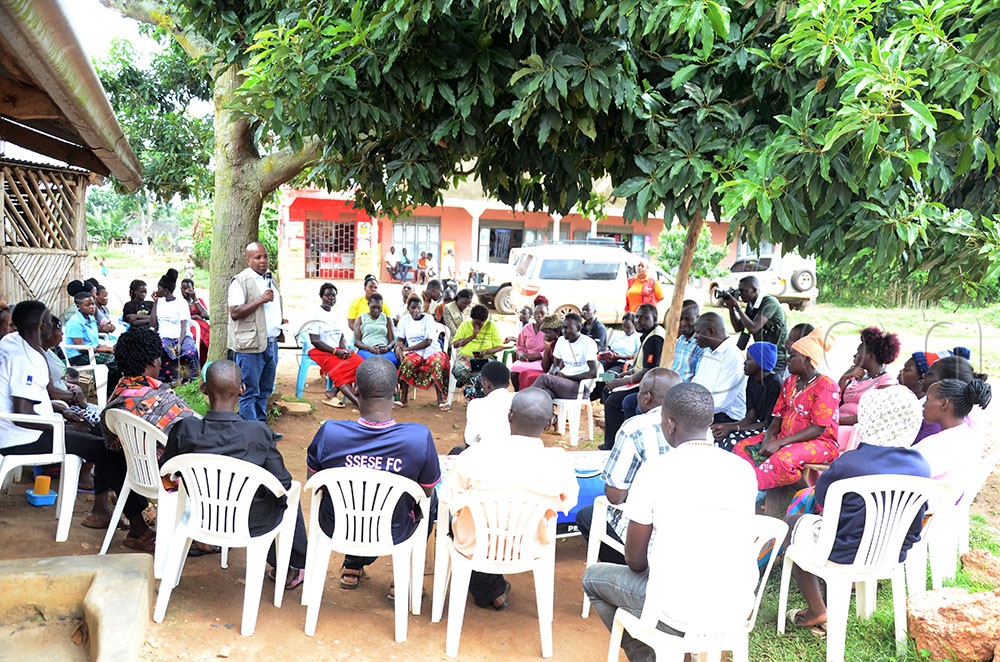
Dr. Patrick Kagurusi (centre standing), the Amref Health Africa Uganda Country Manager addressing some of the residents of Kasekulo landing site, Kalangala district in a meeting on the fight against Gender Based Violence. This was during a joint monitoring of interventions under the Heroes for Gender Transformative Action program in Kalangala district on Wednesday. (Credit: Lawrence Mulondo)
Today, even before her graduation this month, her newfound skills are already transforming her life.
“I could not participate in our village savings group before because I had no money,” she says. “Now I save with the group. When I make a dress at sh15,000, I save sh5,000 and use the remaining sh10,000 for necessities like food, soap and sugar.”
With each dress she stitches, she is not just earning an income; she is reclaiming her dignity and building a future for her baby.
Eighteen-year-old Gloria Nakyanzi, another resident of Kisekulo, shares a story that echoes Nankya’s.
Abandoned by her parents and later forced to drop out of school in senior two due to financial hardship, she enrolled in tailoring in November 2025.
“I want to become an important person in this world one day,” she says with determination. “I want to be successful so that I can be a role model in society and help other abandoned children like I was.”
Breaking the cycle of economic violence
Immaculate Akello, the Sexual and Gender-Based Violence Project Manager at MIFUMI, explains that the programme is being implemented in nine districts, including Bugiri, Iganga, Kalangala, Bukwo, Mbale and Kween.
“In Kalangala alone, over 450 girls and women at risk or who have suffered GBV have been skilled,” Akello says. “We are skilling them so that they are empowered. Economic violence is a big issue. It is difficult to say you are empowered if you cannot afford something for yourself.”
She notes that many women remain trapped in abusive relationships due to financial dependence. By equipping them with skills in hairdressing, tailoring, catering and baking, the programme is helping them become less reliant on those who harm them.
Beyond vocational training, the initiative has focused on transforming communities.
Over 1,450 community champions have been trained on laws, policies, sexual and reproductive health rights, court procedures and forms of violence.
The programme has supported more than 19,246 girls and women across the nine districts to access GBV services through health centres, police, advice centres and courts of law. It has also established 19 advice centres and safe spaces where survivors can report cases, seek counselling and find refuge without fear of stigma.
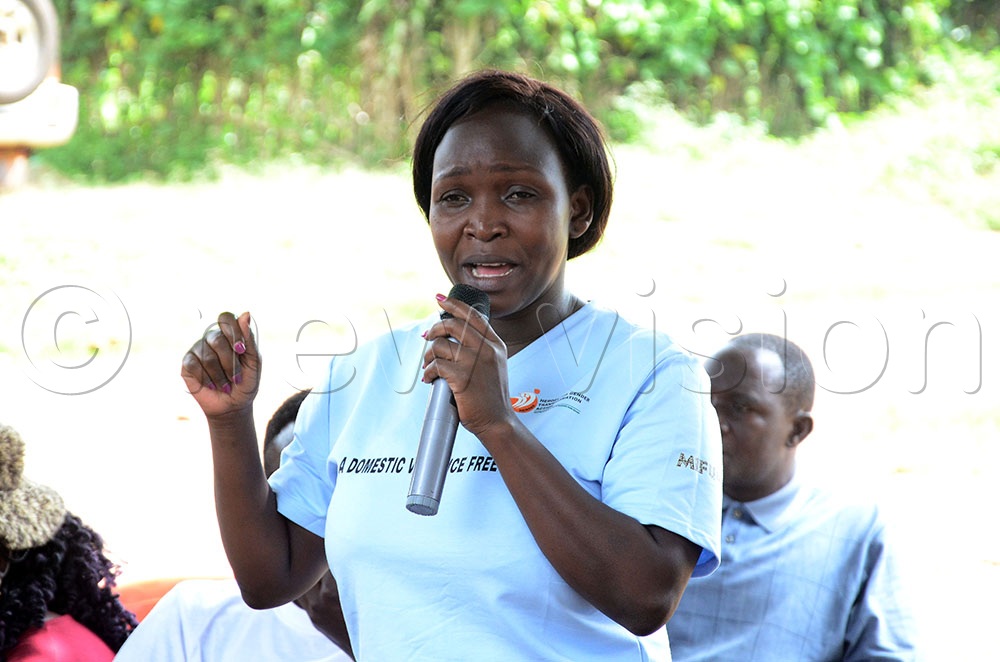
Immaculate Akello, the Sexual Gender Based Violence project manager at MIFUMI addressing some of the residents of Kasekulo landing site Kalangala district in a meeting on the fight against Gender Based Violence. This was during a joint monitoring of interventions under the Heroes for Gender Transformative Action program in Kalangala district on Wednesday. (Credit: Lawrence Mulondo)
One critical intervention has been simplifying information about the 72-hour window for reporting rape and defilement cases to ensure survivors have access to post-exposure prophylaxis to prevent HIV, prevent pregnancy and secure medical evidence for court.
“Many cases were being reported late and missing court because of lack of evidence,” Akello says. “Now communities understand the urgency.”
Dr Patrick Kagurusi, Country Manager of Amref Health Africa Uganda, says the programme has significantly increased awareness of sexual and reproductive health rights among young people.
“For empowerment to happen, there must be a mindset change,” he says. “One must leave behind what has been hurting them and focus on improving their life.”
He encouraged beneficiaries to use their skills to build stable futures, delay subsequent pregnancies and join savings groups such as the Parish Development Model and Emyooga to strengthen their economic standing.
Local leaders commit to sustainability
Kalangala Resident District Commissioner Fred Badda acknowledges that the island district faces unique challenges, particularly in fishing communities where cases of child marriage and sexual abuse have been prevalent.
“These issues have been addressed from the community to institutions, which is great,” he says. “We are going to use the capacity given to us to ensure sustainability.”
Chief Administrative Officer Richard Sebandeke adds that the district will integrate the advice centres into parish headquarters to keep them operational and link more skilled girls and women to government development programmes.
In Kalangala’s 84 islands, 67 of which are inhabited, stories of pain are slowly being rewritten into stories of resilience.
For girls like Nankya and Gloria, empowerment is no longer a distant dream. It is measured in the steady rhythm of sewing machines, in savings books filling with small deposits, and in the quiet but powerful return of hope.