
Rotarians urge govt to make sanitary pads free like condoms
“The government should invest in a sustainable national programme that ensures free access to safe and quality menstrual products for women and girls,” Obai said.
The Commissioner for Gender and Women Affairs in the Ministry of Gender, Labour and Social Development, Angela Nakafeero (in the middle) and the Rotary District Governor D9213 Gerald Obai with Nakivubo Blue Primary School learners and Rotary Club of Kasangati members at the handover of reusable sanitary pads at the launch of Dignity Kit Project on Friday. (Photos by Isaac Nuwagaba)
________________
Women and girls deserve to experience their menstrual periods with dignity, safety and confidence, without shame, Rotary District Governor D9213 Gerald Obai has said, urging the Government to prioritise the provision of free sanitary towels in the same way it provides free condoms.
Obai said the government should invest in a sustainable national programme to ensure free access to safe and quality menstrual products for women and girls, particularly school-going girls, women in prisons, refugees and people in hard-to-reach areas such as Karamoja.
“The government should invest in a sustainable national programme that ensures free access to safe and quality menstrual products for women and girls,” Obai said.
Speaking on October 2, 2026, during the launch of the Dignity Kit Project at Nakivubo Blue Primary School, where Rotarians donated reusable sanitary kits to more than 200 schoolgirls, Obai said it was contradictory for the government to spend billions of shillings every year procuring and distributing free condoms while menstrual hygiene products remained a luxury item left to families and charities.
“Condoms are free in every health centre II, III, in every district store, in bars and lodges because we rightly want to fight HIV/ AIDS. But pads are not free in schools, yet we want to fight school dropouts. Where is the balance? A girl cannot negotiate for education if she is shamed out of class every month,” Obai said.
In partnership with Magenta Girls Initiative, Rotary International has made menstrual health a priority under its maternal and child health focus area, saying charity outreaches cannot replace Government responsibility.
“We are here to break barriers, restore dignity while advancing menstrual health for women and girls with our new project, which is targeting schools, prostitutes and vulnerable women communities living in cities,” he said.
Gorett Komurembe, the co-founder and director of programmes at Magenta Girls Initiative, said the high cost of menstrual products was making it difficult for women and girls to go through their periods with dignity.
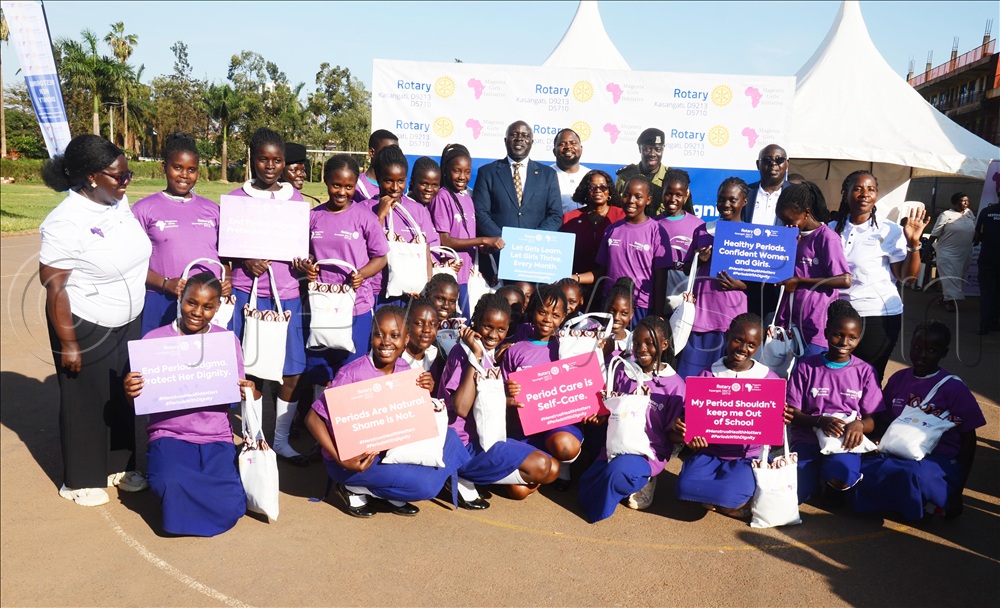
Learners of Nakivubo Blue Primary School in a group picture with Rotary Club of Kasangati members, the commissioner for Gender and Women Affairs in the Ministry of Gender, Labour and Social Development Angela Nakafeero and Director of Parograms Magenta Girls Initiative Gorett Komurembe during the launch of Dignity Kit on Friday
“When girls miss school, they lose confidence, feel ashamed, and they are unable to participate fully because they are menstruating. Some navigate stigma, myths and misconceptions that make menstruation something that should be hidden or spoken about in whispers,” Komurembe observed.
“Pads are sold at sh3500 per piece when condoms are free. This is expensive for school-going children and that’s why we want the government to invest in reusable pads and remove taxes on them,” she appealed.
STIs frustrating girls in schools due to shared toiletries
The commissioner for gender and women affairs in the Ministry of Gender, Labour and Social Development, Angela Nakafeero, has said sexually transmitted infections (STIs) are frustrating school-going girls because of shared toiletries and poor menstrual hygiene facilities in schools.
Nakafeero said many girls in boarding schools, particularly in Universal Primary Education (UPE) and Universal Secondary Education (USE) schools, share knickers, bathing towels, basins and reusable sanitary pads because of poverty and a lack of sensitisation, exposing them to infections that keep them out of class.
Nakafeero said that while the Ministry of Health defines STIs as infections primarily spread through sexual contact, poor hygiene and the sharing of personal items in school settings contribute to cases of vaginal infections, urinary tract infections (UTIs), candidiasis and bacterial vaginosis. She said girls and even teachers often mistakenly label some of these conditions as STIs because they can have similar symptoms.
Shared basins, towels in dormitories
According to Nakafeero, inspections carried out by the Ministry of Gender in more than 200 schools in Karamoja, Busoga, Teso and the Central region found that in some boarding schools, 10 girls share one basin for bathing, while many share towels and knickers because they reported to school with only two pairs at the start of term.
“In boarding schools, you find girls queuing for a bathroom with one basin. They use the same water. They borrow each other's towels. When one girl has an infection, and another uses her towel or panty, the infection is transferred. The girls fear to tell teachers; they just say they have a private disease,” she said.
She said the problem was worse in schools where menstrual health facilities were inadequate, including a lack of changing rooms, incinerators, water and private drying lines for reusable pads.
“When Rotary says women and girls deserve to experience their menstrual periods with dignity, safety, confidence and without shame, this is what they mean. If a girl is not given private space to dry her reusable pad, she dries it under her mattress. It does not dry properly; it harbours bacteria, and next month she gets an infection,” Nakafeero reasoned.
According to the Ministry of Education and Sports and UNICEF, one in four girls in Uganda misses three to five days of school every month during her menstrual period, translating into 24 to 40 days lost per year.
The Dignity Kit Project is a partnership between Magenta Girls Initiative and the Rotary Club of Kasangati.