
Rotarians roll out road safety campaign to curb crashes
Launching the campaign at Nakasero Primary School, the club's director of service projects, Prossy Logose, said road safety is the signature project of Rotary District 9213 Governor Geoffrey Martin Kitakule for the current Rotary year.
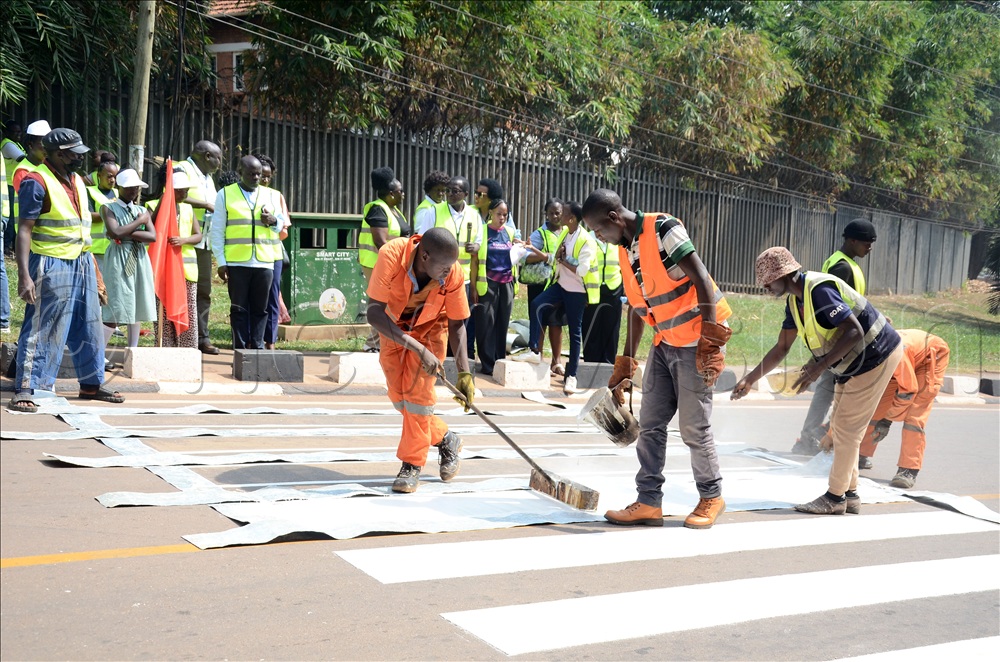
Assistant Governor Edward Mugerwa (L), other Rotarians and pupils of Nakasero Primary School launching the road safety campaign with painting of a zebra crossing along Sezibwa Road in Kampala on Sunday. (Photos by Lawrence Mulondo)
________________
For 13-year-old Ciera Tumwebaze, a Primary Six pupil at Nakasero Primary School, the journey to school is a daily encounter with danger. Every morning, she leaves her home in Bukoto and walks to Kamwokya, where she boards a taxi to Kampala city centre before completing the rest of the journey on foot.
She says navigating the city's busy roads is one of the most challenging parts of her day. With few zebra crossings and inadequate pedestrian walkways, crossing roads has become a risky routine.
“Crossing roads feels dangerous because many drivers speed and rarely stop for pedestrians. Sometimes we have to wait for a volunteer to stop traffic so that we can cross safely, and that makes us late,” she said.
Tumwebaze added that pedestrians are often forced to compete for space with boda boda riders who use pedestrian walkways, particularly during rush hour.
“I am supposed to be at school by 7 am for morning lessons, but I sometimes arrive late because it takes a long time to navigate the roads safely,” she said.
To improve road safety for children like Tumwebaze and other pedestrians, the Rotary Club of Kampala Sunrise has launched a road safety campaign aimed at reducing road crashes. The initiative includes repainting zebra crossings, distributing road safety kits and conducting public awareness campaigns targeting schoolchildren, motorists, boda boda riders and other road users.
According to the 2025 Traffic Police Annual Report, Uganda recorded 5,383 road traffic deaths in 2025, underscoring the growing road safety crisis.
Launching the campaign at Nakasero Primary School, the club's director of service projects, Prossy Logose, said road safety is the signature project of Rotary District 9213 Governor Geoffrey Martin Kitakule for the current Rotary year.
“Sometimes you find a boda boda carrying a parent and three to five children. That is extremely risky and should not happen,” she said.
Logose said the campaign will also target motorists who disregard traffic regulations, endangering both their own lives and those of other road users. In addition, volunteers who regularly help children cross roads will receive safety equipment, while boda boda riders will be provided with road safety kits.
Road safety expert Mabel Tomusange used the launch to educate pupils about traffic signs, the importance of zebra crossings and the role of visibility in preventing crashes.
“White is an important colour on the road because it improves visibility and helps prevent crashes,” she said.
Tomusange advised pedestrians to walk on the right-hand side of the road where there are no designated walkways so they can see oncoming traffic. She also cautioned against carrying more than one passenger on a motorcycle and condemned the practice of seating children in front of riders.
She further stressed the importance of wearing helmets.
“A helmet protects your head in the event of a crash. The head is one of the most vital parts of the body and must always be protected,” she said.
The president of the Rotary Club of Kampala Sunrise, Hodge Semakula, described road crashes as one of Uganda's most pressing public safety challenges.
“We lose an average of 15 people every day to road crashes. This is a challenge for government, communities and schools alike,” he said.
Semakula attributed the high number of crashes to poor road infrastructure, inadequate pedestrian facilities, reckless driving, poor lighting, limited public awareness and the poor mechanical condition of some vehicles.
He noted that pedestrians and motorcyclists remain the most vulnerable road users.
Beyond the human cost, Semakula said road crashes also result in significant economic losses through reduced productivity and increased healthcare expenditure.
“When a doctor, teacher, engineer or farmer dies in a road crash, the country loses valuable skills and services. Government also spends enormous resources on treating crash victims,” he said.
As part of the campaign, the club has already repainted a zebra crossing on Sezibwa Road and plans to expand similar interventions.
“Curbing road crashes cannot be left to government or Rotary alone. Every citizen has a role to play in supporting efforts to make our roads safer,” he said.
Semakula said the campaign is being implemented in partnership with the Ministry of Works and Transport, the Uganda Police Force, boda boda associations and schools.
Assistant governor Edward Mugerwa said the campaign is about more than painting road markings.
“We are not merely painting white lines. We are creating a line of defence for human life, promoting a culture of caution and protecting the most precious asset of our nation, our children,” he said.
He said improving road safety around schools would help protect Uganda's future workforce.
Nakasero Primary School deputy headteacher Richard Abura welcomed the initiative, saying it would benefit both learners and the surrounding community.
“We appreciate Rotary for choosing our school despite the many needs across the country. Road safety benefits everyone,” he said.
Abura said the school already integrates road safety messages into classroom teaching, but partnerships such as Rotary's strengthen the impact of those lessons.
“Our pupils will become ambassadors of road safety in their homes and communities. As future leaders, they will help build a safer Uganda for generations to come,” he said.