
Rotarians rally Ugandans to join cancer fight as cases rise
The mobilisation was part of the Rotary Cancer Run activation drive, held on August 9, 2026, under the theme “Ggwanga Mujje”, a call for Ugandans to unite in the fight against cancer and support efforts to raise funds for cancer treatment infrastructure at St Francis Hospital Nsambya in Kampala.
Stephen Mwanje (Front on Right), the Rotary Past District Governor flagging of Rotarians to match in Kawuku communities along Entebbe Road during the Rotary Cancer Run activation drive in Kawuku Katabi town council Wakiso district on August 9, 2026. (Credit: Lawrence Mulondo)
WAKISO - Members of the Entebbe Road Corridor Rotary clubs have mobilised communities in Kawuku, Wakiso district, to raise awareness about cancer and its devastating impact on families and livelihoods.
The mobilisation was part of the Rotary Cancer Run activation drive, held on August 9, 2026, under the theme “Ggwanga Mujje”, a call for Ugandans to unite in the fight against cancer and support efforts to raise funds for cancer treatment infrastructure at St Francis Hospital Nsambya in Kampala.
Led by a brass band and cyclists, the Rotarians marched through communities, markets and business centres along Entebbe Road, engaging residents on cancer prevention, early detection and treatment.
Speaking as the chief guest at the activation event held at Centenary Bank Kawuku in Katabi town council, Wakiso district, Rotary past district governor Stephen Mwanje said cancer remains one of Uganda’s leading causes of death and requires collective action.
Mwanje said more than 34,000 people are diagnosed with cancer in Uganda annually, with a significant proportion dying within the first year of diagnosis.
“Cancer does not discriminate. It kills the young, the old, the leaders, the educated, the illiterate and people of all religious backgrounds,” he said.
He added that cancer has also affected the Rotary community, noting that about 80% of Rotarians who have died over the past 20 years were victims of cancer.
Mwanje said the Rotary Cancer Run remains the organisation’s main fundraising vehicle for its cancer programme and has enabled Rotarians to make significant investments in cancer care.
He explained that this year’s theme, “Ggwanga Mujje”, was inspired by the traditional African drum call used to alert communities about danger.
“We are using it as a clarion call for everyone to come together and fight this cause of cancer,” he said.
More cancer treatment infrastructure needed
However, he said the facility has limitations, particularly for patients requiring chemotherapy and other specialised cancer treatment.
He said Uganda needs significantly more cancer treatment equipment to meet the growing demand.
According to Mwanje, Rotary is currently constructing two bunkers to house two medical linear accelerator machines, thereby increasing the country’s capacity for cancer treatment.
He said the additional machines would bring the number of such machines in the country to five, which remains far below the estimated requirement.
“Five medical linear accelerator machines are way short of the requirement, and therefore, we can’t stop running now,” Mwanje said.
He urged Ugandans to continue participating in the Cancer Run, saying Rotary plans to expand cancer infrastructure beyond Nsambya to other parts of the country, including Kasese and Arua.
Mwanje attributed the slow pace of developing cancer infrastructure to the low number of participants in the annual run.
He challenged Rotarians to increase participation, saying that if the country could mobilise one million runners, fundraising could support the construction of a cancer treatment facility much faster.
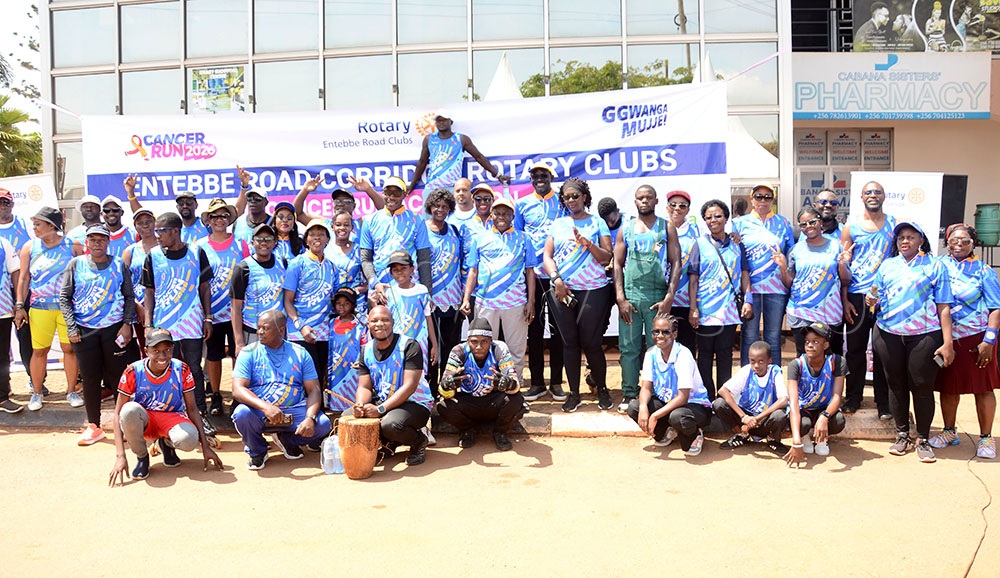
Some of the members of the Entebbe Road Corridor Rotary Clubs pose for a group picture during the Rotary Cancer Run activation drive in Kawuku Katabi town council Wakiso district on August 9, 2026. (Credit: Lawrence Mulondo)
Awareness and early detection
He stressed that early detection significantly improves the chances of survival.
“The earlier you are diagnosed with cancer, the higher the chances of survival,” he said.
He added that Rotary is collaborating with the Uganda Cancer Institute to train medical personnel, noting that modern equipment is of little value without adequately trained specialists to operate it.
Ann Kawooya Nsubuga, president of the Rotary Club of Akright, said the activation was intended to remind communities that cancer is a reality that requires individual and collective action.
She urged people to adopt healthier lifestyles by eating well, exercising regularly and going for routine medical check-ups.
Rita Nakasawe, president nominee of the Rotary Club of Kajjansi, said the 22 Rotary clubs along Entebbe Road had pledged to mobilise at least 5,000 running kits for the Cancer Run.
She said the main run will be held at Kololo Ceremonial Grounds on August 30, with parallel runs taking place in 40 cities and towns across Uganda and in 20 cities abroad.
Janet Kabuzire, president of the Rotary Club of Seguku, said the activation targeted markets, plazas, communities and road users to ensure that people understand the dangers of cancer and the importance of prevention and early detection.
Nathaniel Kasozi, president of the Rotary Club of Garuga, urged Ugandans not only to buy running kits but also to participate in the run, saying the initiative both raises funds for cancer infrastructure and creates awareness about the disease.
Cancer burden continues to grow
Recent cancer estimates show that Uganda recorded about 34,000 new cancer cases and more than 22,000 deaths in 2022. Cervical cancer remains among the most common cancers, followed by Kaposi sarcoma, breast cancer, prostate cancer and non-Hodgkin’s lymphoma.
Cancer incidence is expected to continue rising, with projections indicating that Uganda could record more than 70,000 new cases annually by 2035, driven by infection-related factors, population growth and changing lifestyles.