
Regional defense chiefs meeting in Uganda warn of new security threats
Chief of Defence Forces, Gen. Muhoozi Kainerugaba, who chairs the Committee of Chiefs of Defence and Security, said the changing nature of conflicts requires countries to build military readiness before crises occur rather than attempting to prepare when emergencies have already erupted.
Chief of Defence Forces, Gen. Muhoozi Kainerugaba, speaking during the 36th Ordinary Session of the Committee of Chiefs of Defence and Security of the Eastern Africa Standby Force (EASF), held at the Sheraton Hotel in Kampala. (Photos by Simon Peter Tumwine)
________________
Eastern Africa’s top military commanders have called for stronger regional preparedness, predictable financing and greater interoperability among security forces in order to confront increasingly complex and unpredictable threats.
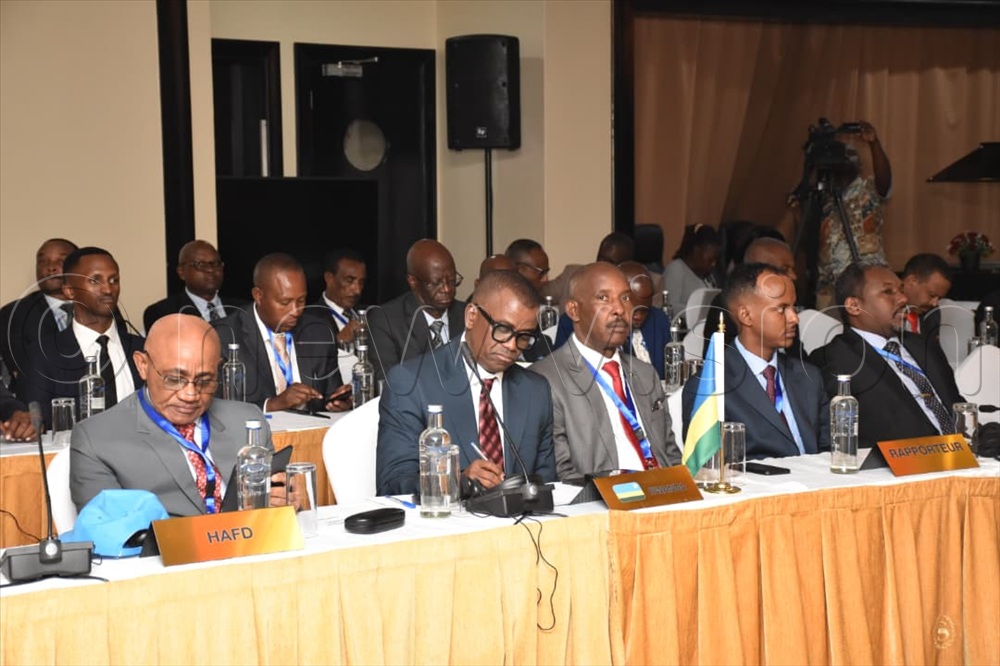
The call was made on Thursday, August 13, 2026, during the 36th Ordinary Session of the Committee of Chiefs of Defence and Security of the Eastern Africa Standby Force (EASF), held at the Sheraton Hotel in Kampala.
Chief of Defence Forces, Gen. Muhoozi Kainerugaba, who chairs the Committee of Chiefs of Defence and Security, said the changing nature of conflicts requires countries to build military readiness before crises occur rather than attempting to prepare when emergencies have already erupted.
“Preparedness cannot be improvised in crisis. It must be built in advance, maintained consistently and tested regularly,” CDF Kaienrugaba said.
He said modern conflicts are changing rapidly, while illicit networks are becoming more sophisticated and technology is reshaping military operations.
Noting that humanitarian crises, displacement and climate pressures are placing additional demands on defence forces across the region,he added that “in such an environment, preparedness is no longer measured by numbers alone. It is measured by agility, interoperability, foresight and the ability to respond decisively under uncertain circumstances."
In addition, he said the EASF must maintain continuous planning, regular training and adaptation if it is to remain capable of responding whenever the African Union or member states require collective action.
The warning comes as the region continues to adjust to changes in the African peace-support architecture, including the transition to the African Union Support and Stabilisation Mission in Somalia (AUSSOM).
Kainerugaba said the EASF’s recent force verification exercise conducted in Uganda demonstrated the region’s progress in developing a credible and deployable capability.
“A standby force earns credibility not only through the missions it undertakes, but through the confidence it inspires before deployment becomes necessary,” he said.
In addition, he said regular verification, realistic exercises and sustained preparedness can strengthen deterrence, support preventive diplomacy and give the African Union a dependable regional capability when circumstances demand collective action.
He warned that the decisions being taken by the regional military leadership would shape the future of the force, particularly in areas such as doctrine, training, force generation, command and control, logistics and interoperability.
Funding challenge
Kainerugaba acknowledged that sustaining readiness, conducting exercises and maintaining operational capabilities require resources that are often stretched.
Grace Ngabirano looking on as Gen. Muhoozi shares a moment with Eastern Africa Standby Force (EASF) director Brigadier General Ronald Rwivanga
He, however, assured the EASF leadership that Uganda would meet its financial obligation to the regional force.
“I would like to inform the Director, they informed me just before I came in here that there is a bit of a gap for Uganda. We are going to cover that. We are going to fully meet our obligation in terms of funding,” said the CDF.
EASF Director Brigadier General Ronald Rwivanga, said the regional mechanism needs sustained investment in pledged capabilities, enhanced interoperability and predictable financing.
Rwivanga noted that the security environment facing Eastern Africa includes terrorism, violent extremism, maritime insecurity, cyber threats, transnational organised crime and humanitarian crises, while climate change is increasingly affecting communities and regional stability.
He said the reduction of external support for peace operations means African institutions will increasingly have to assume greater responsibility for peace and security on the continent.
“This presents both a challenge and an opportunity,” Rwivanga said, explaining that member states will have to shoulder greater political, operational and financial responsibilities, while regional mechanisms such as the EASF have an opportunity to demonstrate their ability to plan, deploy and sustain multidimensional peace-support operations.
He said this would require sustained investment in pledged capabilities, interoperability and predictable financing.
Push for EASF summit
Rwivanga also called for the convening of the EASF Summit of Heads of State and Government, which he said has not met since 2014 despite provisions in the EASF Agreement requiring regular meetings.
He argued that the changing security environment and growing expectations placed on the regional mechanism make the summit increasingly urgent.
According to Rwivanga, such a summit would provide renewed political commitment, strategic direction and collective ownership of the EASF at the highest level.
He also disclosed that seven partners had, for the first time, delivered their commitments on time, which he described as an achievement deserving recognition.
State Minister for Defence and Veteran Affairs (Defence), Grace Akifeza Ngabirano, said Uganda was proud to host the regional military leadership and reaffirmed the importance of collective security.
She said security cannot be sustained through isolation, but must be built through confidence and partnerships among countries.
“No country, regardless of its capabilities, is immune to the consequences of instability beyond its borders,” Ngabirano said, stressing that developments in one part of the region can quickly affect political, economic and humanitarian conditions elsewhere.