
PWDs demand 10% share of sh72b women enterprise grants
“If you put us in a pool of everybody, how do you pull out the 10%? I want you to pull out the 10%, put it aside, and then say, women with disabilities, you come here for your percentage,” said Kanushu.
The Coordinator of GROW project, John Ssengendo (left) looks on as speaks the Member of Parliament representing persons with disabilities, Laura Kanusu during a GROW meeting for disabled business women at Imperial Royale Hotel Kampala on Novomber 26, 2026. (Photos by Ronnie Kijjambu)
________________
Women with disabilities have challenged the government to ring-fence 10% of the sh72 billion women’s enterprise grant for them.
They have warned that a competitive application process could leave many of them behind, despite affirmative action provisions under the programme.
The women said difficulties in accessing government financing, limited digital skills, inadequate access to smartphones and stringent business requirements could undermine their participation in the Generating Growth Opportunities and Productivity for Women Enterprises (GROW) Project.
The concerns emerged during a two-day training organised by the Ministry of Gender, Labour and Social Development at Imperial Royale Hotel in Kampala. The training intends to equip women with disabilities from different parts of the country with information on accessing the project’s Business Plan Competition Grant.
The government has allocated sh72 billion towards the grant, which targets 2,626 women entrepreneurs seeking financing to expand their businesses.
Addressing the participants, Laura Kanushu, the national female representative for persons with disabilities in Parliament, challenged the ministry to ensure the grant translates into tangible benefits for women with disabilities rather than subjecting them to competition on unequal terms.
“When we launched the GROW Project, we were told that there is 10% for women with disabilities. Where is the 10%?” Kanushu asked.
She proposed that the ministry ring-fence the allocation and allow women with disabilities to compete for the designated share instead of placing them in the same pool as all other applicants.
“If you put us in a pool of everybody, how do you pull out the 10%? I want you to pull out the 10%, put it aside, and then say, women with disabilities, you come here for your percentage,” she said.
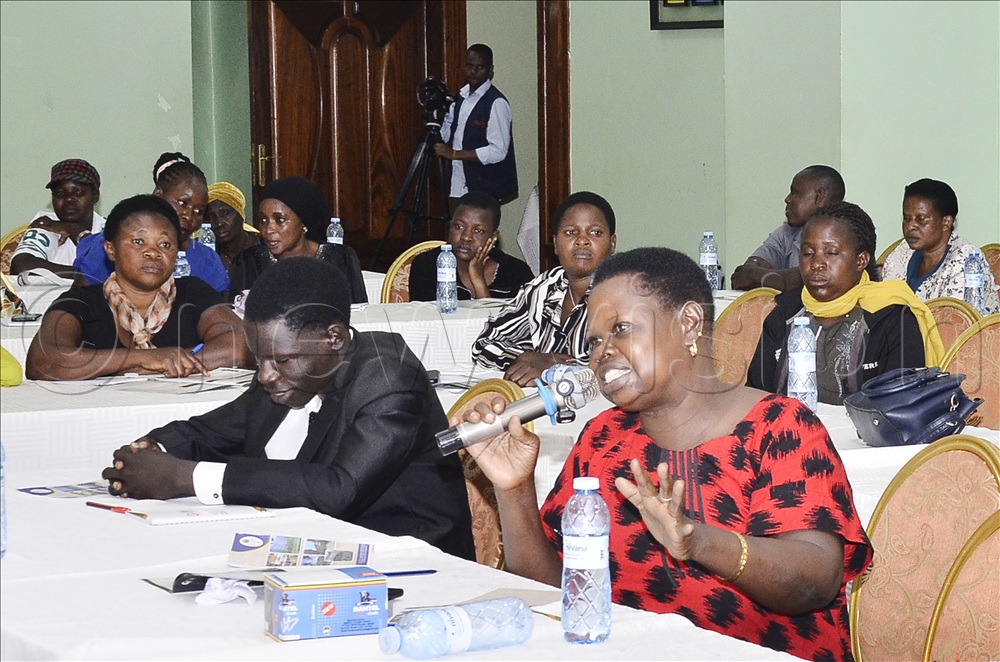
The founder of Bamtel Classic Chalker Ltd, Telopecho Dorothy (right) from Mayuge district making her contribution during a GROW meeting for disabled businesswomen at Imperial Royale Hotel Kampala
Kanushu argued that women with disabilities face additional barriers that could make a conventional competitive application process unfair.
She questioned whether a woman with limited formal education, digital skills and access to technology could reasonably compete with an educated entrepreneur who has better access to professional business planning services.
“Even if you put that form online and you bring my woman from Kaberamaido, and you also bring a banker, definitely the banker is going to win. Is that a proper competition?” she asked.
She further challenged the ministry to consider women who lack smartphones and cannot independently complete online applications.
Kanushu said some prospective applicants had reported difficulties accessing the application website and obtaining assistance through the toll-free telephone number.
She cited the example of Dorothy Telopecho, an entrepreneur from Mayuge district who manufactures chalk and has established a sizeable business but had previously failed to access financing under the project's loan arrangements.
She argued that entrepreneurs with established businesses and the potential to create employment should not be excluded because of barriers in accessing application procedures.
Kanushu said she had specifically pushed for tailor-made training for women with disabilities because their circumstances and support requirements differ from those of other entrepreneurs.
She also called on the ministry to provide interpretation services so that participants could follow proceedings and ask questions in languages they understand.
Small businesses seek inclusion
The concerns extended beyond access to technology and the application process to the size and nature of businesses likely to benefit from the grant.
Annet Katushabe, a woman with a disability who operates a farming business in Mbarara city, said women running small enterprises risked being overlooked in favour of those with relatively established businesses.
She questioned how women selling agricultural produce such as jackfruit and tomatoes could benefit if the selection process favoured businesses with bigger operations.
“Most of these women you are seeing here have small businesses, very small businesses. Even if you teach us, it is like you are considering those with big businesses,” Katushabe said.
She also cited difficulties women with disabilities have encountered in accessing funds under the Parish Development Model (PDM), arguing that similar barriers could undermine their participation in GROW.
Under the GROW Business Plan Competition Grant, eligible micro enterprises can receive up to sh35.69 million, while small enterprises can access grants of up to sh107.07 million.
The funding is intended for business expansion rather than general household consumption. Eligible investments include purchasing machinery and equipment, digitising business operations, improving production processes, training employees, developing new products, expanding production capacity and accessing new markets.
The programme targets enterprises operating in sectors including agribusiness, manufacturing, construction, renewable energy, information and communications technology, science and technology, creative industries and social enterprises, including childcare services.
Ministry promises application support
Responding to the concerns, Odiirah Nansamba Kemerwa, the ministry’s communications specialist, acknowledged that the number of participants invited for the training had been constrained by available resources.
She said the ministry had considered the cost of bringing participants from distant districts, including Moroto, and opted for a manageable group that could receive the training.
However, she urged participants to use the ministry’s district-level GROW focal persons to support other women with disabilities who had not attended the training.
“We have representatives at every district, every city and every municipality. If you don't know your focal person, please don't leave here without their phone number,” she said.
Kemerwa said the focal persons had been trained to guide prospective applicants through the application process. She added that women who encounter difficulties could contact the ministry directly for assistance, including support from its head office by telephone.
The ministry urged applicants to complete their applications by December 11, 2026, saying it did not intend to extend the deadline because doing so would delay disbursement.
Sh72b grant targets 2,626 women
John Ssengendo, the GROW Project coordinator responsible for monitoring and evaluation, said the Government had reserved sh72 billion for the Business Plan Competition Grant, targeting 2,626 women entrepreneurs.
He said the call for applications was launched on November 11, 2026, and the ministry had received approximately 650 applications by the time of the training, equivalent to about 25% of its intended beneficiary target.
The overall allocation translates into an indicative average of approximately sh27.4 million per targeted beneficiary, although actual awards will depend on enterprise classification, assessment and approval.
Ssengendo said the project was making deliberate efforts to ensure vulnerable and marginalised groups, including persons with disabilities, benefit from the programme.
He said the inclusion of such groups was among the project’s requirements, which also provide for mainstreaming their participation in its financing and implementation arrangements.
The selection process will involve screening applications against minimum requirements before eligible businesses proceed to competitive assessment, due diligence and field verification.
Successful applicants will receive support from business advisers to develop bankable funding proposals, business plans, implementation work plans, budgets and performance indicators.
Grant recipients will subsequently sign performance-based agreements with the ministry, with disbursements guided by approved business plans and applicable financial management requirements.
Who qualifies?
The grant is open to legally recognised micro and small enterprises operating in Uganda and majority-owned and controlled by women.
Applicants must demonstrate that women hold more than 50% of the business ownership or shareholding and that the business is managed by women.
The enterprise must have operated for at least one year and have a verifiable physical location in Uganda.
Micro enterprises are classified as businesses employing up to four people or generating annual sales or turnover not exceeding sh10m. They can access grants of up to sh35.69 million.
Small enterprises employ up to 48 people or generate annual sales or turnover not exceeding sh100 million, with grants capped at sh107.07 million.
Applicants must provide evidence of business registration, ownership, identity and at least one year of business operations. Supporting documents may include registration certificates, national identity cards, trading licences, bank statements covering 12 months or mobile money statements covering six months.
The application process also requires business location details, including GPS coordinates, and an LC1 letter confirming the existence of the business at the stated location.
The programme is open to eligible Ugandan women and legally registered women refugees, including enterprises operating in refugee-hosting communities and hard-to-reach areas.
Beyond meeting the minimum eligibility requirements, applicants will be assessed on their business growth strategies, potential to create employment, revenue growth, innovation, scalability and contribution to the programme's priority sectors.
The project also seeks to promote women entrepreneurs in traditionally male-dominated sectors such as construction, technology and industrial production.
The two-day training commenced on November 25, 2026, and is set to conclude today, Thursday.