
PPDA tracks 1,296 govt projects as procurement reforms gather pace
The progress of the system was presented to the Minister of Finance, Planning & Economic Development, Henry Musasizi, during a briefing by the PPDA leadership led by Board chairperson Julius Ishungisa and executive director Benson Turamye.
The Minister of Finance, Planning & Economic Development, Henry Musasizi, during a briefing by the PPDA leadership led by Board chairperson Julius Ishungisa and executive director Benson Turamye. (Courtesy photo)
_________________
The Public Procurement and Disposal of Public Assets Authority (PPDA) is tracking the performance of 1,296 government projects worth sh1.2 trillion through its digital Contracts Monitoring System (CMS), as it steps up reforms aimed at improving accountability, transparency and value for money in public procurement.
The progress of the system was presented to the Minister of Finance, Planning & Economic Development, Henry Musasizi, during a briefing by the PPDA leadership led by Board chairperson Julius Ishungisa and executive director Benson Turamye.
The officials said the authority has significantly expanded the use of technology to monitor public contracts and improve project implementation across government.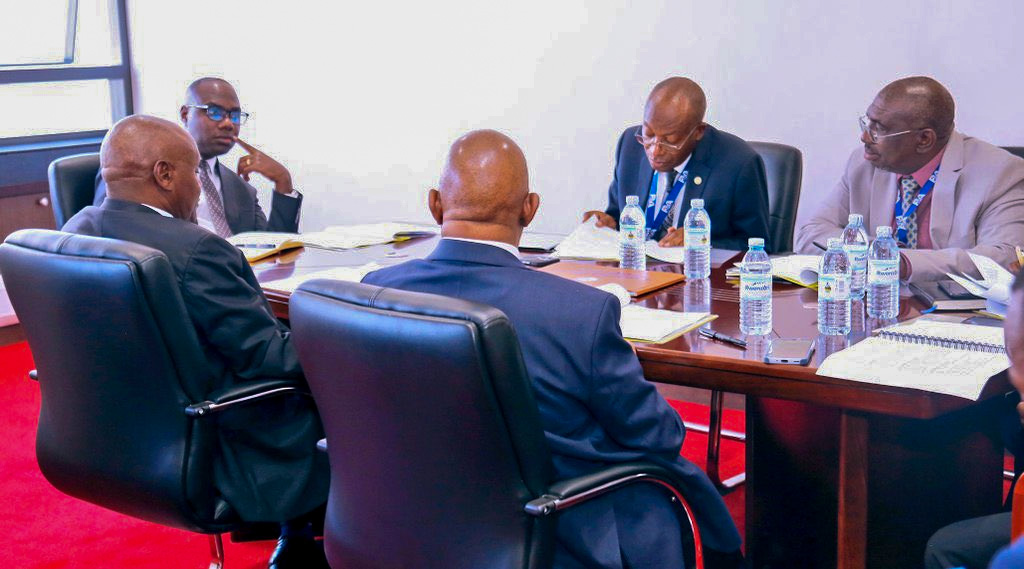
PPDA officials said the authority has significantly expanded the use of technology to monitor public contracts and improve project implementation across government. (Courtesy photo)
The digital Contracts Monitoring System, introduced last year, enables government and oversight institutions to monitor project implementation in real time, allowing them to identify delays, cost overruns and contract management challenges before they escalate.
According to Turamye, the monitoring initiative is expected to strengthen accountability among procuring and disposing entities while ensuring that public projects are completed on time and within budget.
“The digital tracking platform is a major step toward addressing long-standing concerns over stalled projects, abandoned contracts and poor value for money in public investments,” Turamye told the minister.
During the meeting, Turamye also highlighted several reforms introduced by PPDA to improve procurement efficiency and reduce wasteful spending.
He said the authority has issued a standardised unit cost framework for roads to harmonise costing and stabilise estimation practices across government agencies.
Turamye also revealed that PPDA issued Guideline No. 1 of 2026 on June 24, 2026, covering the procurement of aggregated requirements.
Under the guideline, government entities are required to use National Framework Agreements when placing call-off orders for procurement requirements.
He said the approach would enable the government to leverage economies of scale, reduce procurement costs and speed up the acquisition of commonly used goods and services.
The meeting focused on the role of public procurement in advancing Uganda's economic transformation agenda and supporting the government's target of growing the economy tenfold to reach $500 billion by 2040.
Musasizi said procurement remains one of the government's most important tools for accelerating development and ensuring value for money in public investment.
He urged all government entities to fully embrace the Electronic Government Procurement (e-GP) system, saying digitising procurement processes is critical to improving transparency, efficiency and accountability.
"The transition to the Electronic Government Procurement system must be embraced by all government entities," Musasizi said. "Public procurement must be aligned to the tenfold growth strategy to transform Uganda into a $500 billion economy by 2040."
The minister also called for the swift completion of ongoing procurement reforms aimed at streamlining procurement processes and closing loopholes that facilitate corruption, wastage and financial leakages.
He said PPDA's core mandate includes setting procurement standards, monitoring compliance, advising government and procuring entities, building national procurement capacity, and promoting competitive, transparent and value-for-money procurement practices.
"Sixty-five percent of Uganda's national budget is directly spent through procurement," Ishungisa said, emphasising that procurement remains a critical driver of economic growth and public service delivery.
Given the scale of resources involved, he said strengthening oversight and compliance mechanisms remains essential to ensuring taxpayers receive value from public spending.
Turamye said PPDA has also introduced Reservation Guideline 11 to increase the participation of Special Interest Groups in government procurement.
The guideline seeks to ensure that young people, women and persons with disabilities benefit more directly from government procurement opportunities through targeted tender awards.
The initiative forms part of broader government efforts to promote inclusive economic growth by enabling marginalised groups to participate in public sector business opportunities.
Officials believe the policy will expand access to government contracts while creating employment and income opportunities for thousands of entrepreneurs from Special Interest Groups.
As part of efforts to digitise procurement, Turamye announced that more than 100 additional government institutions will be enrolled onto the Electronic Government Procurement platform during the 2026/27 financial year.
The e-GP system is expected to reduce paperwork, improve efficiency, shorten procurement timelines and strengthen transparency by enabling end-to-end electronic management of procurement processes.
Government has increasingly promoted the system as a key anti-corruption tool because it minimises human interaction in procurement transactions and creates digital audit trails that can be easily monitored.