
Police investigators tipped on new trends of human trafficking
"Traffickers are no longer limited to physical borders. They operate through phones, social media, and false job advertisements. They deceive, exploit, and endanger our sons, daughters, sisters, and brothers," Mulimba said.
Investigators from the Uganda Police Force in a group photo after a training on combating human trafficking. (Photos by Ibrahim Ruhweza)
________________
More than 70 investigators from the Uganda Police Force have begun a week-long specialised training on combating human trafficking, with officials warning that traffickers are increasingly exploiting social media, fake job advertisements, and digital platforms to lure victims into modern slavery.
The five-day capacity-building programme, which started on Monday at the United Nations African Institute for the Prevention of Crime and the Treatment of Offenders (UNAFRI) headquarters in Naguru, brings together police officers from all policing regions, including border entry and exit points, to strengthen their investigative and prosecution skills against one of the world's fastest-growing organised crimes.
According to the International Labour Organization (ILO), International Organization for Migration (IOM) and Walk Free Foundation, an estimated 49.6 million people were living in modern slavery in 2021, including 27.6 million in forced labour and 22 million in forced marriages.
The United Nations Office on Drugs and Crime (UNODC) also reports that trafficking for forced labour has risen sharply worldwide, while children account for about 38% of detected trafficking victims globally.
Opening the training, UNAFRI Governing Board Chairperson John Mulimba said traffickers have shifted from conventional recruitment methods to sophisticated online operations, making investigations more challenging.
"Traffickers are no longer limited to physical borders. They operate through phones, social media, and false job advertisements. They deceive, exploit, and endanger our sons, daughters, sisters, and brothers," Mulimba said.
He noted that the training aims to create a nucleus of specialized investigators within the Uganda Police Force capable of responding to emerging trafficking trends.
"The knowledge you gain this week will be used to rescue victims, prevent further exploitation, and bring traffickers to justice. Human trafficking is a transnational organised crime, and no single agency or country can defeat it alone. We must work together," he said.
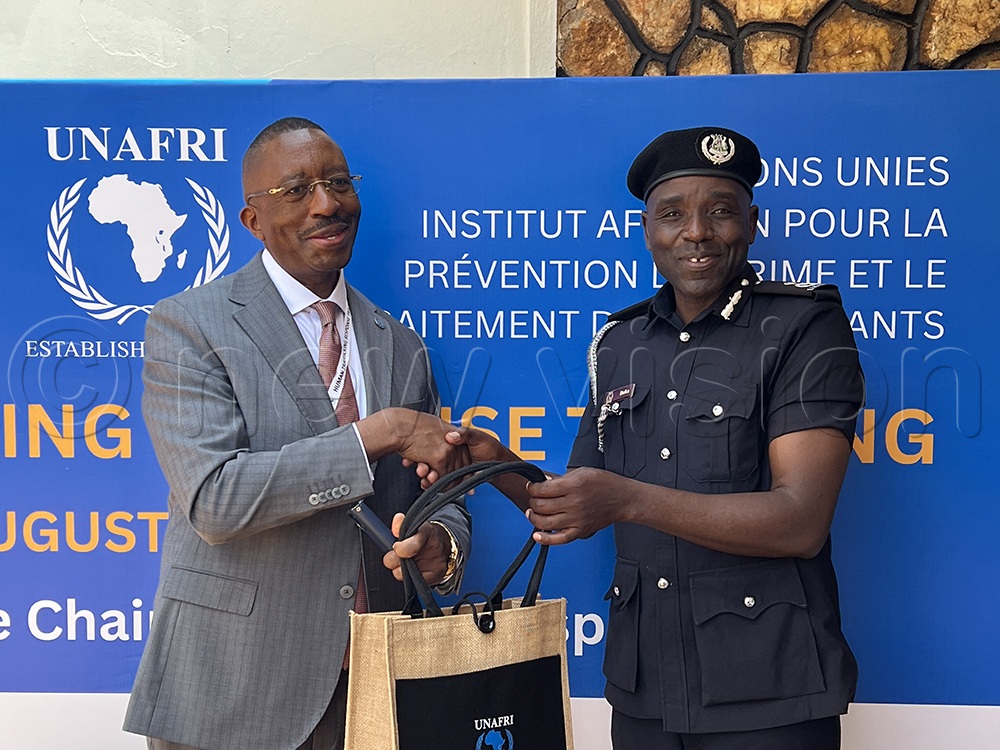
UNAFRI Acting Director General Andrew Munanura Karokora handing over a gift to Assistant Commissioner of Police Ramathan Doka dressed in black police uniform.
Assistant Commissioner of Police Moses Taremwa, who heads the Human Trafficking Department at the Criminal Investigations Directorate (CID), said Uganda continues to grapple with trafficking networks that target young people using deceptive employment offers.
"We are training investigators drawn from all policing regions, including border entry and exit points, to equip them with the skills to investigate human trafficking professionally and prosecute offenders. Uganda, like many countries, is facing serious challenges because many of our young people are recruited through social media, fake advertisements, and even some licensed and unlicensed recruitment companies before being trafficked abroad," Taremwa said.
He stressed that continuous training is necessary because trafficking syndicates constantly change their methods.
"Crime keeps changing forms and shapes. We therefore need to keep training our officers so that they match these changing crime patterns. Human trafficking is no longer affecting only the uneducated. Even educated people are now being trafficked for forced labour, sexual exploitation, domestic servitude and other forms of abuse," he said.
Taremwa described human trafficking as one of the world's most profitable organised crimes.
"It is highly organised and generates enormous criminal proceeds globally. To dismantle these networks, investigators must be equally organised, highly trained and capable of understanding the latest trends used by traffickers," he said.
Addressing participants, Taremwa urged officers to approach the training from multiple perspectives.
"From today, look at yourself as a potential victim, a trafficker and an investigator. Unless you understand how traffickers think and operate, you cannot investigate this crime effectively," he said.
UNAFRI Acting Director General Andrew Munanura Karokora said Uganda's growing urban migration patterns require careful analysis to distinguish legitimate migration from criminal trafficking.
"Some of this movement is genuine migration by people seeking safety, while some of it could involve trafficking. This is the time to have an honest conversation about these migration trends so that we understand what is happening and respond appropriately," Karokora said.
He, however, cautioned against generalising all foreign nationals as trafficking victims or suspects, noting that Uganda continues to host thousands of refugees fleeing conflict in neighbouring countries.
Assistant Commissioner of Police Ramathan Doka explained that many urban refugees legally leave refugee settlements to conduct business in towns and cities under Uganda's progressive refugee policy.
"Many refugees come to Kampala and other urban centres to do business because the law allows them to work. They remain registered in recognised refugee settlements and often return there to receive assistance before coming back to continue their businesses," Doka said.
He noted that urban refugees have significantly contributed to the growth of trade, small businesses, and local economies, while emphasising that security agencies remain vigilant against traffickers who may exploit refugee movements.
"Uganda operates an open refugee policy, and genuine refugees are recognised by government. They are issued business licenses, they pay taxes and contribute to economic activity. At the same time, security agencies continuously monitor movements to identify criminals or trafficking victims who may attempt to exploit these systems," he said.
Mulimba cited a recent case in which several Ugandans were rescued after being deceived by fraudulent online job offers promising employment in Malaysia but were instead trafficked into conflict areas.
"Traffickers have become invisible. They exploit technology and social media to lure unsuspecting young people with promises of lucrative jobs abroad. Our investigators must be equipped with the knowledge to identify and disrupt these criminal networks before more victims are recruited," he said.
He added that forensic investigations, intelligence sharing, and cross-border collaboration among African countries will form a key component of the training.
Mulimba said the week-long program is expected to strengthen Uganda's capacity to investigate trafficking cases, improve collaboration with regional law enforcement agencies, and enhance protection for vulnerable communities increasingly targeted by organised trafficking syndicates.