
News
Persons with dwarfism decry discriminatory acts
“Many of us have been used to do comedy that demeans us. It is bad because even if we are going to be paid, it leaves one with embarrassment and the thought that maybe we shouldn’t have been born this way,” Sarah Short revealed.
Joyce Acan Okeny, the State Minister for Disability Affairs under the Ministry of Gender, Labour and Social Development (far right), alongside members of the Foundation of Persons Affected by Dwarfism Uganda. (Credit: Derrick Muduku)
By: Derrick Muduku, Journalist @New Vision
KAMPALA - For the past decade, Sarah Nantege, popularly known as Sarah Short, has become a sensation on the television screen for her captivating comedy skits.
However, she revealed that all was not rosy owing to her stature - being a little person.
“Many of us have been used to do comedy that demeans us. It is bad because even if we are going to be paid, it leaves one with embarrassment and the thought that maybe we shouldn’t have been born this way,” she revealed.
She spelt out challenges arising from transporting herself to various workplaces.
“Taxis tend to leave us behind when they see us fidgeting. Even to hop onto a boda boda is a problem because you need support from someone to lift you,” she said.
Nantege made the revelation during a press briefing at the Gender Ministry headquarters on October 26. The briefing was organised by the ministry as part of the activities to celebrate the International Day of Little Persons, which falls on October 25 annually.
Call for research
With growing numbers of persons of short stature identified in the country, Joel Kawanguzi, the Programme Manager at the Foundation of Persons Affected by Dwarfism Uganda, highlighted the need for research to address the challenges that come with dwarfism.
“We are calling on the Government to help us understand because we hear that if people of short stature marry, they will produce another short-statured person. However, this is all hearsay. We need real data and evidence to guide us on this,” he said.
Kawanguzi appealed to content creators to stop demeaning persons with short stature, calling for the creation of respectful work that promotes dignity, inclusion and positive representation.
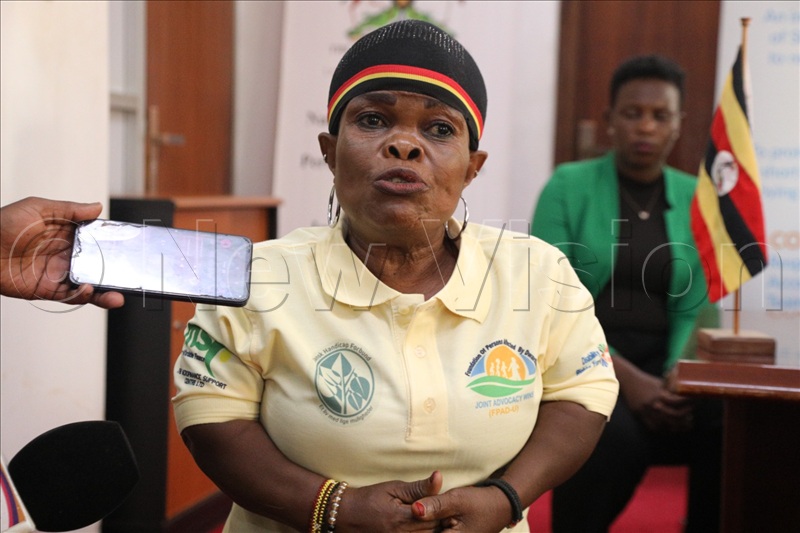
Sarah Nantege, aka Sarah Short, addressing journalists at the Gender Ministry. (Credit: Derrick Muduku)
“Some entertainment productions use persons with short stature for commercial gain while offering them minimal benefits and excluding them from meaningful participation and opportunities,” he said.
He urged government to support disability-inclusive savings and business groups, calling for greater support for savings and credit initiatives that enable persons with short stature to access financing, grow businesses and contribute more to the economy.
He also called on government to review collateral requirements under the Generating Growth Opportunities and Productivity for Women Enterprises (GROW) programme to enable women with short stature to access business loans, particularly those who lack land or other assets to offer as security.
Kawanguzi decried the high cost of vocational education and the competitiveness of existing scholarships, calling for targeted support and improved access to information to help people living with dwarfism acquire practical skills.
Joyce Acan Okeny, the state minister for Disability Affairs under the Gender Ministry, called for improvement in access to healthcare for persons of short stature, strengthening inclusive education and skills training, as well as promoting employment and economic participation.
She also appealed for improvement in accessibility to public buildings for people living with dwarfism to enable them to easily access public offices.