
Parliament urges govt to expand geriatric care for older persons
MPs have warned that the country’s ageing population faces rising medical costs, limited access to geriatric services and inadequate financial support.
Sironko District Woman MP Asha Nabulo Mafabi (NRM) moves a motion urging Government to improve access to geriatric healthcare and strengthen social protection for older persons during a parliamentary sitting on August 18, 2026. (Courtesy: X/@Parliament_Ug)
__________________
Parliament has urged the Government to expand specialised healthcare and social protection for older persons.
MPs have warned that the country’s ageing population faces rising medical costs, limited access to geriatric services and inadequate financial support.
The resolution followed a motion moved by Asha Nabulo Mafabi (Sironko District Woman MP, NRM) on August 18, 2026, urging the Government to improve access to geriatric healthcare and strengthen social protection for older persons.
The motion calls for a health insurance scheme targeting older persons, stronger community and home-based healthcare, dedicated geriatric units in regional referral hospitals, training of healthcare workers in geriatric medicine and quarterly health check-ups for older persons.
Parliament wants the Government to review the Senior Citizens Grant under the Social Assistance Grants for Empowerment (SAGE) programme, including its coverage, eligibility age and the amount paid to beneficiaries.
The motion states that Uganda has more than 1.4 million people aged 60 years and above, many of whom carry the burden of age-related and non-communicable diseases such as hypertension, diabetes, arthritis, cancer and dementia.
Mafabi said older persons require healthcare tailored to their needs rather than being left to navigate a health system that is not designed for their vulnerabilities.
The MPs said most older persons live in rural areas, lack health insurance and face difficulties accessing specialised care, essential medicines, diagnostic services, assistive devices and affordable transport to health facilities.
The resolution calls for dedicated geriatric units and age-friendly service points, including ramps, rest areas and priority queues, at regional referral hospitals, with the services progressively extended to general hospitals and health centre IVs.
The Minister of State for Older Persons, Jacqueline Mbabazi, says older persons deserve respect, care and dignity, noting that Uganda lacks enough specialists to meet their healthcare needs. (Courtesy: X/@Parliament_Ug)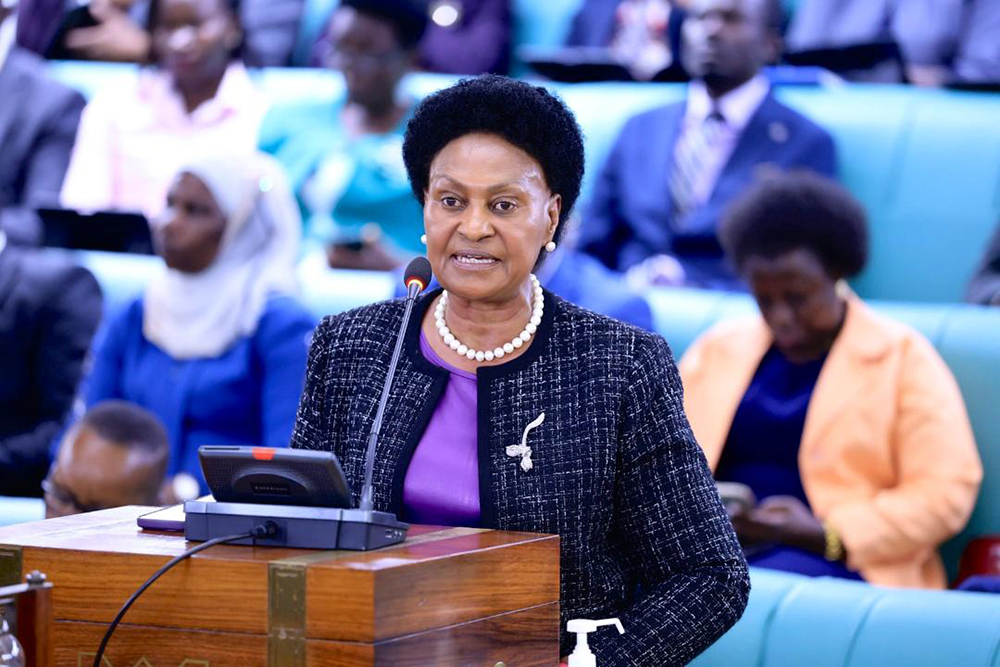
“Uganda has only three geriatric doctors, and there are no geriatric nurses,” Mbabazi said. She said the Government was engaging Makerere University to develop training for geriatric doctors and nurses.
“We are engaging Makerere University so that the curriculum for geriatric doctors and nurses is adopted and training takes place. We need geriatric doctors to support older persons,” she said.
Mbabazi said healthcare costs were consuming a large share of the money received by older persons under SAGE.
She said about 30% of the sh35,000 monthly grant goes towards medical care and proposed that sh5,000 could be set aside for health insurance if an insurance arrangement for older persons is adopted.
Mbabazi gave an account of an older person who was taken to a district office in a wheelbarrow to receive the SAGE grant, an anecdote that brought into sharp focus the difficulties faced by some elderly Ugandans in accessing social protection services.
She said that although beneficiaries could receive the money through mobile money, some older persons forget their personal identification numbers, while their phones are sometimes controlled by caregivers or younger relatives.
The minister said the problem goes beyond receiving money, pointing out that many older persons remain responsible for families despite their age.
Government Chief Whip Jane Ruth Aceng said the National Development Plan IV recognises the need to train nurses and doctors in geriatric care, although inadequate resources remain a constraint.
Aceng said the Ministry of Health had entered into a partnership with an institution to train geriatric nurses. She said Uganda needs to consider a health insurance model that protects the wider population rather than creating a scheme that benefits only older persons.
“An insurance scheme based on the principle of the rich supporting the poor and covering everyone would be more successful than one which targets only the older persons,” Aceng said.
Aceng said the growing population of older persons requires additional resources if the Government is to provide them with adequate healthcare and social protection.
The motion notes that while the Senior Citizens Grant provides important financial support, the monthly payment is inadequate to meet the basic and healthcare needs of beneficiaries, while the programme does not reach all eligible older persons.
The MPs want quarterly health check-ups to be conducted at designated health centres, with the timing aligned, where practical, to payment of the Senior Citizens Grant. They said this could give older persons a practical bridge between social protection and preventive healthcare, allowing illnesses to be detected before they become expensive and debilitating.
The resolution calls for mobile health clinics, community outreach services and older persons' support committees, particularly in rural and hard-to-reach communities.
Deputy Speaker Thomas Tayebwa, who chaired the sitting, said Parliament expects the Government to translate the resolution into action.
Tayebwa directed the Government to present an action report to Parliament within 60 days detailing progress in implementing the resolutions, in accordance with the Rules of Procedure of Parliament.
The motion was seconded by James Kakooza (Older Persons Representative for Central), Fred Boseke (Ntenjeru County South) and Boniface Henry Okot (Kole South).