
Over 1,300 dogs vaccinated against rabies in Iganga
Nankwanga said it was a chilly morning on September 12 last year when her housemaid opened the gate to allow a visitor to drive in, and her dog sneaked out, only to inflict scratches on the five-year-old boy who was standing just outside her house.
Veterinary staff undertake a spay-neuter surgery on one of the dogs. (Photo by Moses Bikala)
_________________
Forty-eight-year-old Stella Nankwanga recalls with pain the day she was ordered to pay sh870,000 by a Local Council 1 court after her German shepherd dog scratched a five-year-old boy who was passing by her home.
Nankwanga said it was a chilly morning on September 12 last year when her housemaid opened the gate to allow a visitor to drive in, and her dog sneaked out, only to inflict scratches on the five-year-old boy who was standing just outside her house.
"After hearing the boy raise an alarm, I rushed to see what was happening and realised that the dog had scratched him twice on his left leg but not bitten him," she said.
She offered first aid by washing the scratches with disinfectant before wrapping a bandage around them.
"I later escorted the boy to his home and explained to the mother what had transpired and knew the matter had been settled as neighbours," she said.
Nankwanga said she was shocked moments later after being summoned by one of the local council officials of Busei B village, Nakalama sub-county, in Iganga, and told that she had a case to answer.
"Upon reaching one of the local council officials asked whether I had a vaccination card for my dog to prove whether it's not rabid," she said.
She reportedly tried to explain to the local council officials that she was sure the dog was not rabid because she had just bought it from a dog seller in Kampala, although she had forgotten to secure a vaccination card.
"They instead just shut me down, accusing me of being a liar who was putting the lives of locals at risk by letting her dog out of her home," she said.
The local council officials and the boy's parents demanded sh1m, but later reduced the amount to sh870,000 to meet the costs of treating the boy.
"They threatened to forward the matter to police in case she failed to pay the money within two days," she said.
"What hurt me most was that the same boy was not even taken to hospital to get the treatment they were insisting on," she said.
Nankwanga said the LC1 court took advantage of her lack of a rabies vaccination card to demand money from her.
"In case I had any documentation to prove that my dog was safe, I wouldn't have been exploited to that level," she said.
Nankwanga said the experience taught her a lesson to always vaccinate her dog, which she has named Shadow, at least once a year.
Nankwanga and other dog and cat owners were among those who turned up for a one-day free pet community clinic held at Iganga district headquarters on September 11, 2026.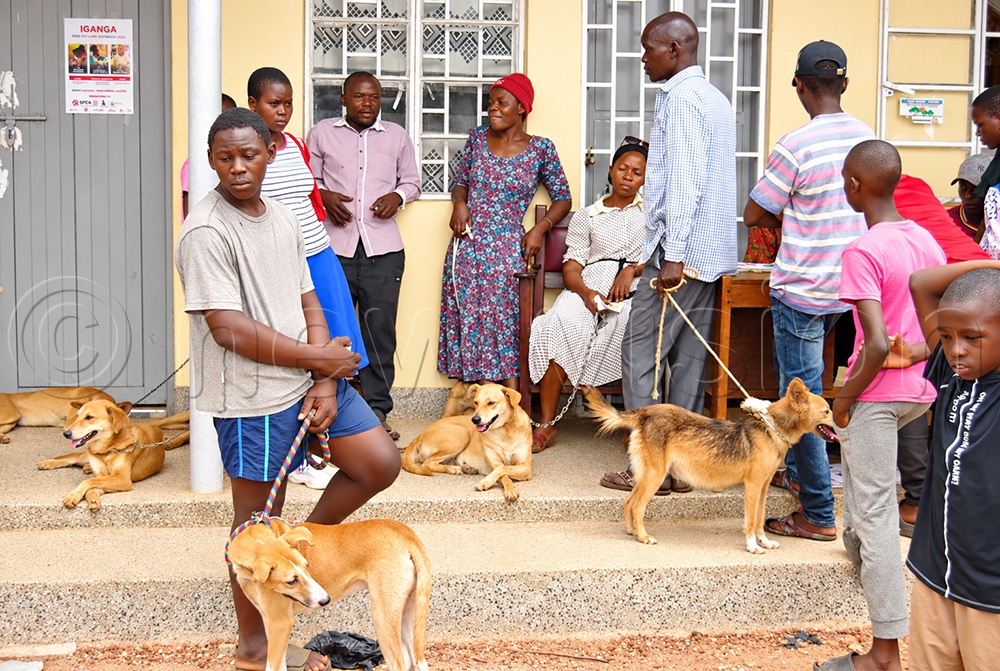
Dog and cat owners who turned up for a one-day free pet community clinic held at Iganga district headquarters on September 11, 2026. (Photo by Moses Bikala)
The free pet community clinic, organised by the Ministry of Agriculture, Animal Industry and Fisheries in collaboration with Bam Animal Clinics, offered rabies vaccinations, spay and neuter surgeries, and free pet-care education for children below the age of five.
The director of Bam Animal Clinics, Dr David Balondemu, said a total of 1,344 dogs had received rabies vaccinations by the end of the free pet community clinic.
Balondemu said they decided to organise the free community pet clinic, the first of its kind in the Busoga sub-region, after realising that most pet owners were reluctant to seek medical attention from qualified veterinary personnel for fear of incurring financial costs.
"That's why some of the animals were discovered to be having worms or had developed internal injuries," he said.
Balondemu urged pet owners to always show love by playing with their pets or running or jogging with them during evening or morning hours so that they are friendly to all family members.
"We always have cases of dogs turning around and biting family members just because they get enclosed in one place for long," he said.
Balondemu said there was a need to organise similar free community pet clinics because there was still demand for more services, especially in the Busoga sub-region.
"Unfortunately, some people who came in later failed to get services because we had run short of the rabies vaccine," he said.
Iganga district health officer Dr Patrick Kitimba said 43 people died in the district last year after being bitten by rabid dogs.
Kitimba said the majority of those who died had delayed reporting to the nearest health facility for treatment against rabies.
"Some people took the matter lightly and instead used local herbs, thinking it could be effective," he said.
He attributed the increase in the number of rabies cases to failure by dog owners to vaccinate their pets.
Derick Maganda, a hawker operating in Iganga Municipality, urged relevant authorities to trap all stray dogs that move around aimlessly and cause harm to locals.
"These stray dogs are the ones that have caused more harm to locals, especially during night hours," he said.
Hassan Kasimba, the LC3 chairperson of Central Division, said they had earlier passed a resolution before the council to have all stray dogs trapped, but lacked the manpower to implement the resolution.
"As a council, we are handicapped since trapping these stray dogs requires very professional people who are skilled to do that," he said.