
NWSC needs sh650b to improve water network
According to the NWSC Managing Director, Dr Silver Mugisha, most of the places he has visited complain about water availability. He cited Kaberamaido, where water must be piped all the way from Soroti, which is 70km away.
Dr Silver Mugisha, NWSC Managing Director, addressing district leaders during the annual evaluation and stakeholder engagement forum at the International Resource Centre (IREC) in Kampala on 16th October 2026. (Photo by Juliet Kasirye)
________________
Following increased public outcry over water scarcity, the National Water and Sewerage Corporation (NWSC) is seeking about sh650b to boost water supply reliability in 50 towns across the country.
The towns include Lyantonde, Kakumiro, Kitgum, Nakawuka, Sembabule, Apac, Ibuje, Bukedea, Kaberamaido, Ibanda, Kabale, Rubanda, Katakwi, Kazo, Mitooma, Sheema, Tororo, Bobi, Palenga, Koro-Abili, Karuma, Bunyangabu, Mugusu; Buhweju, Bushenyi, Busia; Gomba, Kaabong, Kotido, Lwengo, Nebbi, Paidha, Ntungamo, Rubare, Rwentobo, Pader, Kalongo, Pallisa, Ruhama and Serere.
According to the NWSC Managing Director, Dr Silver Mugisha, most of the places he has visited complain about water availability. He cited Kaberamaido, where water must be piped all the way from Soroti, which is 70km away.
“We need sh650b to start construction of the water supply improvement project. This means we will need sh130b every year. To secure these funds, we are in talks with the government to see how we can access the required financing, and when the project can begin,” explained Mugisha.
As a corporation, Mugisha said, their contribution to Uganda’s socio-economic transformation involves ensuring that clean water and sanitation reach as many people as possible.
Mugisha noted: “Our aim is to reduce the long distances people trek to access clean and safe water, curb waterborne diseases and reduce the cost of water. If we bring water closer to people, we will reduce their cost of living and allow them to utilise their money on other productive work.”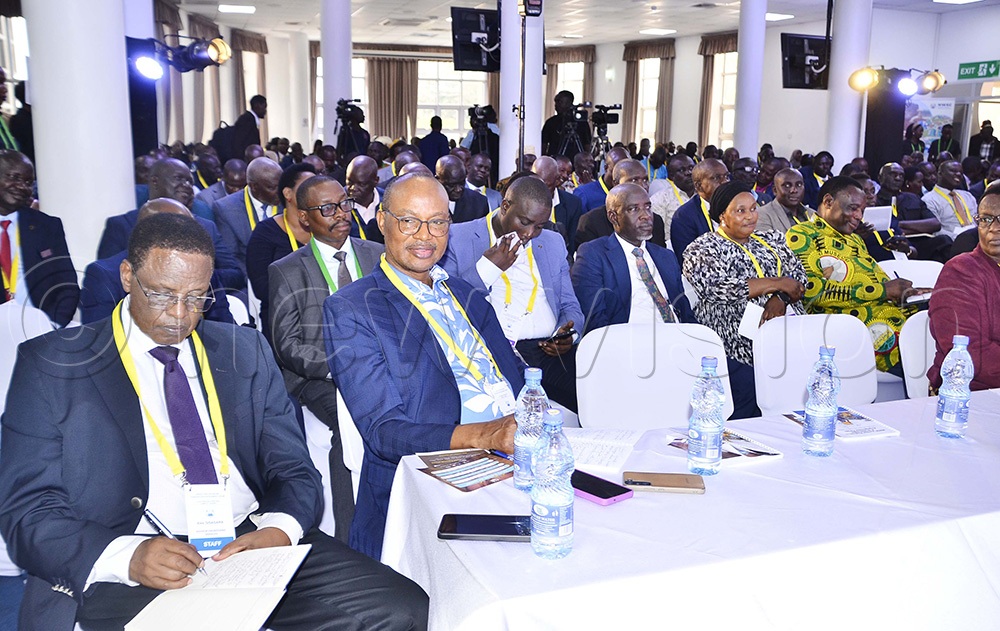
A cross-section of district leaders during the annual evaluation and stakeholder engagement forum at the International Resource Centre (IREC) in Kampala on 16th October 2026. (Photo by Juliet Kasirye)
According to the Ministry of water and Environment statistics, as of June 2025, safe water coverage in Uganda stood at 70%. About 20% of the villages or roughly about 30% of Ugandans (13.7 million people), do not have access to safe and clean water. Uganda has a population of 45.9 million people, according to the 2024 national census figures from the Uganda Bureau of Statistics.
The meeting attracted Local Council V Chairpersons, Town Clerks, City Mayors, Deputy Mayors, Resident District Commissioners/City Commissioners, and Representatives of Operation Wealth Creation across the country. It was held under the theme: Water for all, for health and prosperity.
During the dialogue, experts from NWSC told district leaders about some of the completed water supply projects, ongoing interventions to improve supply reliability and planned projects to address water supply challenges across all NWSC areas.
According to the customer satisfaction survey conducted by NWSC, part of the complaints raised by customers include water supply unreliability, lack of timeliness and accuracy of bills, lack of regular information updates regarding services, and inadequate information regarding disconnection and connection.
To ensure all Ugandans have access to clean and safe water, Mugisha appealed to leaders to support the corporation’s agenda of increasing water for production.
While national water can engineer the network and lay the pipes, he emphasised that it needs leaders’ administrative support and political goodwill.
Performance evaluation for financial year 2025/26
In a bid to expand access and coverage as required under the national development plan and human capital development programme, the NWSC principal economist, Anna Nyadoi, said the corporation has surpassed their target of 500 kilometres and laid 1,024 kilometres of new water mains to extend water supply.
This, Nyadoi said, represents a target of 205%. "We have laid an additional 42 kilometres of water mains. This represents a growth of 169% from the baseline year where we laid 382 kilometres," she said.
“If you notice, the Government arrears have reduced from sh106b to sh49b. However, the non-government areas are continuously growing. Since they have grown by sh8b within the year, I call upon all stakeholders for support because we have a big number of people, who are not paying their bills,” Nyadoi noted.
District leaders' concerns
During the meeting, the district chairperson for Nebbi district, George Othuba, said Nebbi General hospital is grappling with water scarcity, yet water is an essential ingredient and a crucial component of service delivery in the facility.
“The hospital has 90 flush toilets serving both the patients and attendants. Currently, the Government only allocates sh380m annually to run the hospital, while the annual water bill alone amounts to sh180m. Since the district can only afford to pay sh10m per quarter, the hospital has accumulated arrears of over sh1.7b. I request that you intervene and provide us with alternative water sources,” explained Othuba.
The Vice chairperson of Kapchorwa district, Priscilla Chebet, said since the council approved land for national water last week, they requested the corporation to develop the area and extend the water supply to all parts of the district so that water-stressed communities can access clean drinking water.
“Although we are a source of water that flows to parts of Soroti region, water in Kapchorwa is unfortunately served mainly in municipalities. Besides that, it is expensive for residents to connect water to their compounds because the service lines are too far from the communities,” Chebet revealed.
The district chairperson of Kotido district, Paul Lotee Komol, said residents in Karamoja sub-region, especially in areas such as Napak, Abim, Nabilatuk, Karenga, Kotido and Moroto, are grappling with water scarcity, both for livestock and domestic use.
The Chairman of Nwoya local government, Patrick Okello Oryema, commended NWSC for its efforts to ensure that some Ugandans have access to clean water. However, he said some municipalities are still grappling with water challenges.
"For example, there is a town council with about 35,000 people, but only 8,500 of them are getting water. I appeal to you to avail water in all the town councils, especially Olwiyo, which has a big population," Oryema requested.