
New water project frees Wakiso pupils from daily search for clean water
For the school's 500 learners, the project promises more than access to clean water. It offers hope for better health, improved attendance, enhanced academic performance and restored dignity, especially for girls.
Angella Ssemukuutu (in green top), the Guest of honour and past assistant governor cutting a ribbon on a donated water tank to commission the Water, Sanitation and Hygiene project at St. Bruno Zziru Primary school as Rotarians, teachers and pupils look on. This was during the event at the school in Ssisa subcounty, Wakiso district on July 25, 2026. (Photos by Lawrence Mulondo)
________________
For years, pupils at St Bruno Zziru Primary School in Wakiso district began each school day with an exhausting task that had little to do with learning. Before opening their books, they had to walk nearly 2km to fetch water from a community well, often returning to school tired and late for lessons.
That daily routine is now set to become history after 21 Rotary Clubs and 15 Rotaract clubs, led by the Rotary Club of Akright City under District 9214, launched a major Water, Sanitation and Hygiene (WASH) project at the school.
The project includes the construction of an underground well and the installation of a 10,000-litre water tank, with another 5,000-litre tank expected to be delivered soon to boost water storage capacity.
For the school's 500 learners, the project promises more than access to clean water. It offers hope for better health, improved attendance, enhanced academic performance and restored dignity, especially for girls.
A burden that stole learning time
Established by the Catholic Church in 1903 and later handed over to the government in 2009, St Bruno Zziru Primary School has operated for decades without a reliable water source.
Head teacher Betty Adong said the lack of water has been the school's biggest challenge, affecting both learning and learner retention.
“The children have been suffering. Every morning they first have to fetch water from a distant source before lessons can begin. By the time they return, they are exhausted, and we have to give them time to rest before classes,” Adong said.
Angella Ssemukuutu (in green top extreme Right), the Guest of honour and past assistant governor inspecting the construction of the underground well which part of the Water, Sanitation and Hygiene project at St. Bruno Zziru Primary school as Rotarians, teachers and pupils look on. This was during the event at the school in Ssisa subcounty, Wakiso district on July 25, 2026. 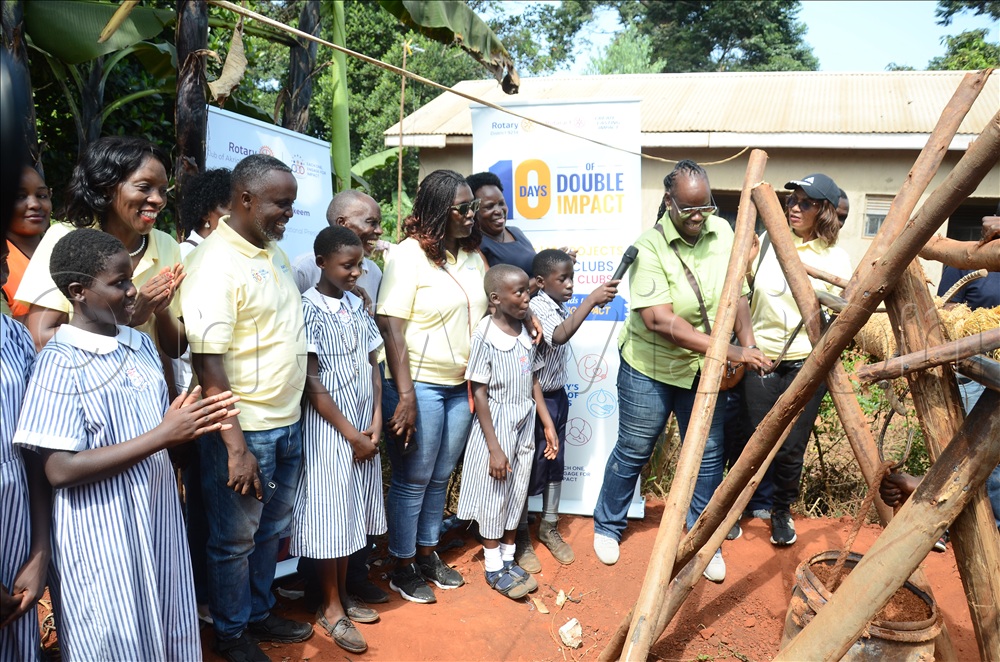
Although Caritas Uganda previously donated a 10,000-litre rainwater harvesting tank, she said it only stores enough water to serve both the school and the neighbouring church for about a week after rainfall.
The water shortage has also presented serious challenges for menstrual hygiene management.
“Many girls begin their periods while at school, yet there isn't a single drop of water for them to bathe or clean themselves. It affects their confidence and forces many to miss school,” Adong explained.
Rotary steps in
The school was identified by the Rotaract Club of Akright City, which later partnered with the Rotary Club of Akright City to mobilise support under the 10 Days of Double Impact Initiative, a campaign bringing together 21 Rotary Clubs and 15 Rotaract clubs across District 9214 to implement high-impact community projects.
Speaking during the commissioning ceremony, Rotary Club of Akright City President Ann Kawooya Nsubuga said the initiative was conceived two years ago when the current club presidents were still president nominees.
She said the clubs resolved to undertake 10 impactful community projects within their first 10 days in office.
“When we visited this school, we realised that access to water was the greatest challenge. Imagine a child leaving home at 6 am only to spend the first three hours of the school day collecting water. What kind of academic performance can you expect?” Nsubuga asked.
She said the clubs chose to provide a lasting solution by constructing a well and installing water tanks instead of offering temporary relief.
She appealed to other organisations to support the school, which still needs additional classroom infrastructure to match its growing enrolment.
To promote environmental conservation and future sustainability, Rotary presidents also donated fruit tree seedlings to the school.
Expanding access to clean water
Under the same initiative, Rotarians led by the Rotary Club of Seguku donated a 10,000-litre water tank to St Gyaviira Lweza Primary School to strengthen its WASH programme.
Rotary Club of Seguku president Janet Brendah Kabuzire said although the school had several needs, its leadership identified inadequate water supply as the most urgent challenge.
“We want learners to access education and grow into responsible citizens without water being a barrier,” she said, while thanking Rotarians and Rotaractors for supporting community service initiatives.
Hope for a brighter future
Guest of honour and past assistant governor Angella Ssemukuutu said the project reflects Rotary's commitment to improving communities through access to clean water, one of the organisation's key areas of focus.
“There is a reason Rotary is here today. This collaboration brings hope to the people of Zziru and, most importantly, to the learners of St Bruno Primary School,” she said.
Assistant governor Paul Kigonya urged the school community to safeguard the new facilities and use water responsibly so that future generations also benefit.
He expressed hope that improved access to water would translate into better school attendance, stronger academic performance and higher learner retention.