
New Rotary Club in Kololo signals growing culture of giving in Uganda
Geoffrey Martin Kitakule, the Governor of Rotary District 9213, emphasised that the formation of the new club is part of a broader strategy to expand Rotary’s footprint and deepen its impact across Uganda.
Geoffrey M. Kitakule, the rotary district governor of D9213 (L) and Minsa Kabanda the Minister for Kampala and Metropolitan affairs installing Hamida Altaf Khetani as the charter President of the rotary club of Kololo summit view as other rotarians look on. (Photos by Simon Peter Tumwine)
________________
A new wave of community impact is taking shape in Uganda's capital, Kampala, following the chartering of the Rotary Club of Kololo Summit View — an initiative that leaders say reflects the rapidly growing culture of service and philanthropy in the country.
Speaking at the charter celebration in Kololo, Geoffrey Martin Kitakule, the Governor of Rotary District 9213, emphasised that the formation of the new club is part of a broader strategy to expand Rotary’s footprint and deepen its impact across Uganda.
“We need more hands to help people in different areas of Uganda. This club fits within our drive to grow Rotary and extend service where it is needed most.”
Geoffrey M. Kitakule, the rotary district governor of D9213 (centre) cutting a cake with Rotarians from the rotary club of Kololo summit view shortly after chartering their club. 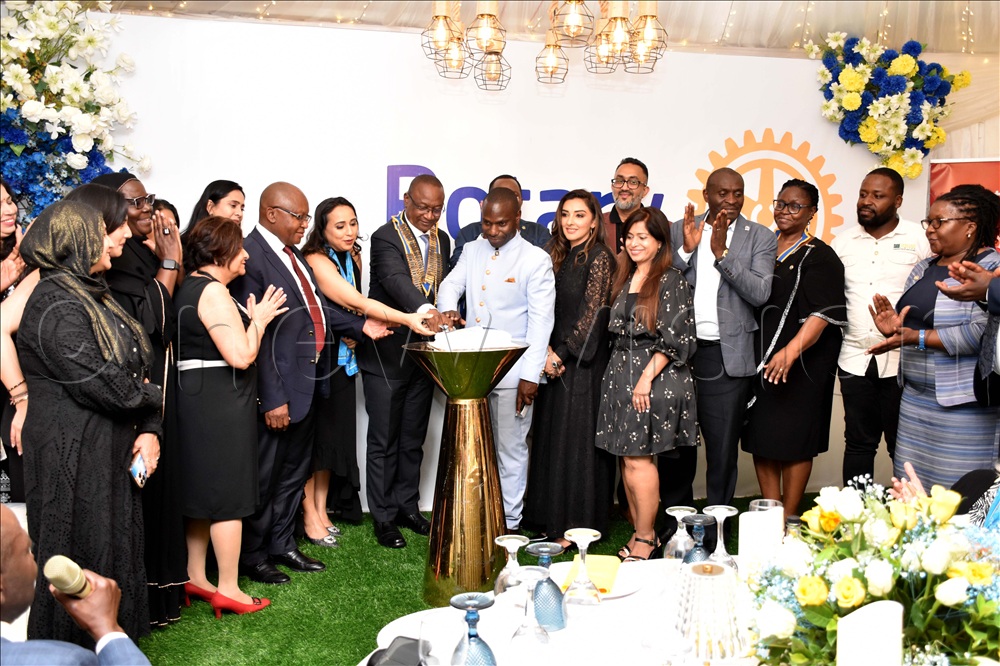
Kitakule said this growth is being driven by increased public awareness of Rotary’s work in key focus areas such as water and sanitation, disease prevention, environmental protection, maternal and child health, education, and literacy.
“Ugandans are embracing the culture of giving back. When people see impactful projects, they ask how they can be part of it.”
Diversity and inclusion
The Rotary Club of Kololo Summit View stands out for its diversity, bringing together Ugandans, Indians of Ugandan origin, and members of the Indian community.
“This club reflects diversity, equity, and inclusion. It brings together people from different backgrounds who live in the same community to contribute to its development," said Kitakule.
Beyond diversity, members of the new club are already known for supporting early childhood development initiatives across Uganda, efforts that have improved access to foundational education for young children.
Installed as the club’s charter president, Hamida Khetani Altaf outlined a bold, action-oriented agenda centred on education, women empowerment, and health and hygiene.
“We are more about action than words. Our signature project will focus on pre-school education because that is the foundation of a child’s future," she said.
Khetani revealed that their first project will target the Wabigalo slum, where members plan to address poor sanitation conditions highlighted by local residents.
“The women told us they want a clean environment. That’s where we are starting."
'New force for good'
Minsa Kabanda, Minister for Kampala Capital City and Metropolitan Affairs, officiated at the event and praised the initiative as a timely intervention in addressing urban challenges.
Geoffrey M. Kitakule, the rotary district governor of D9213 handing over an accolade to Minsa Kabanda the Minister for Kampala and Metropolitan during a rotary fellowship at Kololo summit view. 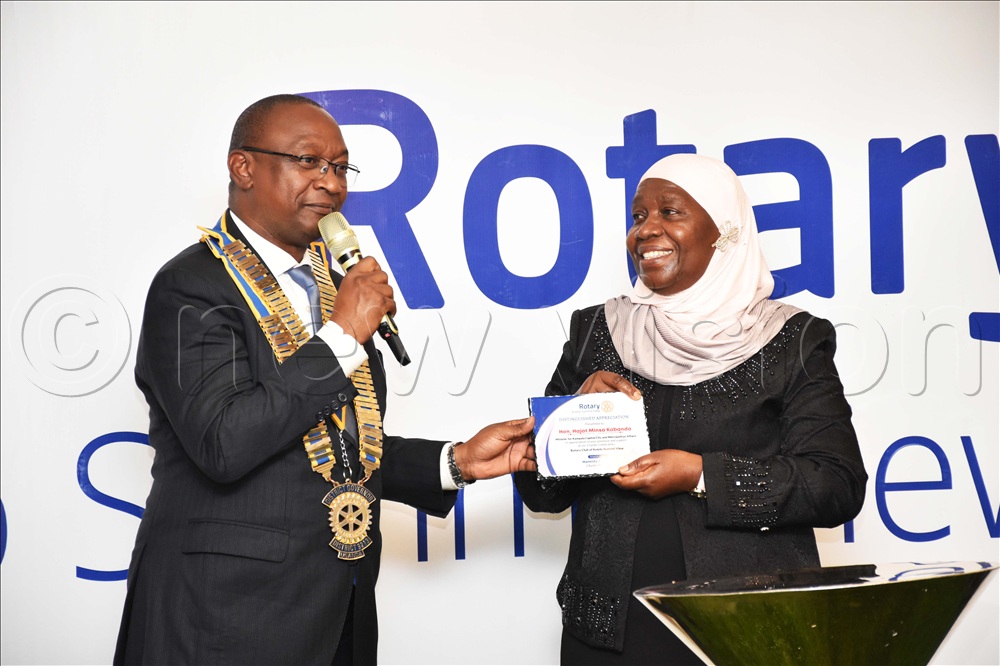
“This is not just the formation of another organisation, it is the birth of a new force for good,” she said.
Kabanda stressed that government efforts alone are insufficient to tackle the city’s challenges, calling for stronger partnerships with civic organisations like Rotary.
“The true measure of your success will be in the lives you transform."
May Virji, a long-time Rotary partner and CEO of Institute for Rural Education and Development (IREAD Early Childhood Development Limited ), underscored the importance of early childhood education (ECD), describing it as critical to national development.
Through partnerships with Rotary, her organisation has established 24 ECD centres across Uganda, stretching from urban centres to underserved districts such as Arua, Bukedea and Wakiso.
"These centres are designed to shape young minds during their most formative years. If we don’t build a strong foundation for our children, we weaken the future of our country,” she said.
“When donor money comes in and is taxed, we lose resources that should be building classrooms and training teachers."
Community ownership
A key idea the IREAD Early Childhood Development Limited CEO emphasised is sustainability, moving away from charity-driven models toward community empowerment.
They work closely to ensure that communities take ownership of the schools, managing them through local structures while receiving technical guidance.
“We don’t control the schools; we empower the community to run them. That’s how you create something that lasts."
However, this approach is not without challenges. Virji cited resistance from some local institutions, like churches, on land allocation as a major barrier to scaling impact.
“We are not the leaders of tomorrow; our children are. The question is: what are we leaving for them?”
She also pointed to the need to integrate technology into early learning, even in rural settings, while acknowledging barriers such as electricity and digital literacy.
“We want our centres to be IT-compliant, but we must also invest in training people and addressing infrastructure gaps like power."
'Education is the hope'
For beneficiaries like Fabian Nkasi, now District 9213 Governor Nominee for 2027, such projects have already made a tangible difference.
In Mirembe village, Masaka, a modern nursery school established through donor collaboration now serves over 150 children annually.
“Education is the hope of those in villages who may not access opportunities,” he said, noting that more than 200 children have benefited since the school’s inception.
As Rotary continues to expand, Kitakule encouraged the new club to focus on sustainable, high-impact projects and to attract more members through visible community service.
“When people see what you are doing, they will join you. Service above self must remain our guide."