
Museveni tasks cultural leaders on African heritage, wealth creation and national devel
President Yoweri Museveni has urged cultural leaders to preserve Africa’s heritage, promote indigenous knowledge and support wealth creation, while strengthening African unity and complementing government efforts in community development.
President Yoweri K. Museveni poses for a group photo with cultural leaders from across Uganda on Wednesday, November 4, 2026, State House, Entebbe, during the opening of the two-day Cultural Leaders Conference. (PPU)
____________________
President Yoweri K. Museveni has challenged traditional and cultural leaders in Uganda to take a more active role in preserving Africa’s heritage, promoting continental unity and supporting government efforts to transform communities through wealth creation.
Cultural institutions, he said, have a critical responsibility to safeguard Africa’s historical identity, indigenous knowledge, languages, traditional skills and cultural practices, many of which were undermined by colonialism and its aftermath. He made the remarks on Wednesday (November 4) while addressing traditional and cultural leaders whom he hosted at State House, Entebbe, for the opening of the two-day Cultural Leaders Conference.
The two-day conference, scheduled for 4th–5th November 2026, has brought together cultural leaders from across Uganda to engage with the President of the Republic
of Uganda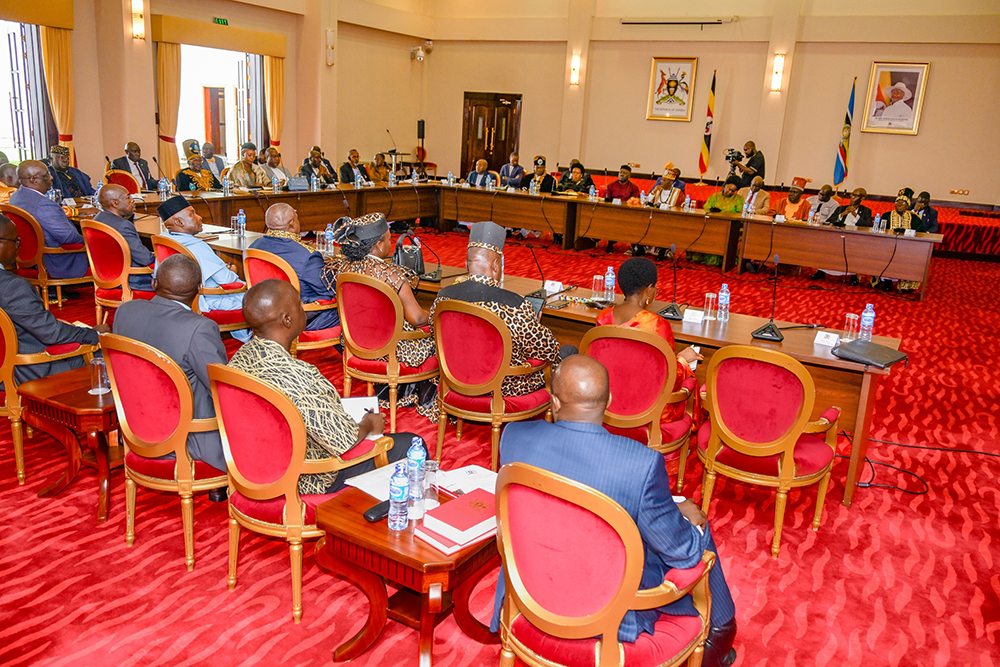
President Yoweri K. Museveni hold talks with cultural leaders from across Uganda on Wednesday, November 4, 2026, State House, Entebbe, during the opening of the two-day Cultural Leaders Conference. (PPU)
In his opening remarks, President Museveni said Africa’s shared history, cultural heritage and linguistic connections should be used as a foundation for strengthening cooperation, economic integration and unity among African countries. Quoting Matthew 19:6, he said, “Therefore what God has joined together, let no man put asunder,” urging Africans to overcome artificial divisions and recognise their common heritage and shared interests.
According to release from the Presidential Press Unit sates that Museveni emphasised that cultural institutions should complement, rather than compete with, elected government structures, noting that each institution has its own distinct responsibilities. According to the President, cultural leaders should concentrate on preserving heritage, promoting indigenous knowledge and advising their communities, while leaving legislation, public administration and other formal government responsibilities to the respective constitutional institutions. Relatedly, he cautioned against the politicisation of cultural institutions, saying their role should remain rooted in cultural preservation, community guidance and social cohesion.
The President said Africa’s development must be guided by what he described as five historical missions: liberation from colonialism, democracy, economic prosperity, strategic security and African unity. He explained that political independence alone was insufficient without economic independence, which requires countries to produce goods and services and access bigger markets.
In this regard, he highlighted regional integration through the East African Community (EAC), the Common Market for Eastern and Southern Africa (COMESA) and the African Continental Free Trade Area (AfCFTA) as important frameworks for expanding markets, increasing trade and creating opportunities for producers. He further called for stronger strategic security and deeper East African integration, arguing that the region’s shared history, cultural connections and economic interests provide a strong basis for closer cooperation and eventual political federation.
Cultural leaders propose development partnerships
PPU reveals that in their presentation, cultural leaders called for stronger collaboration with the government to harness Uganda’s cultural diversity as a resource for social and economic transformation.
Through their representative, they described traditional kingdoms, chiefdoms and community-based cultural institutions as important structures for preserving national identity, promoting moral values, strengthening social cohesion and supporting reconciliation and peace.
They proposed joint programmes with the government in different sectors, including: wealth creation, agricultural development, community industrialisation, tourism, cultural preservation, women's economic empowerment and skills development. Under the proposed wealth creation initiative, cultural institutions offered to provide land for model agricultural farms that would serve as centres for practical training, agricultural innovation, technology transfer, food production and agribusiness development. They appealed to the government to support the initiative with: improved seeds, livestock, irrigation facilities, agricultural machinery, extension services and technical expertise.
On cultural preservation and tourism, they proposed the establishment of a Digital Cultural Park to showcase Uganda's kingdoms, traditional leadership systems, historical sites, cultural artefacts, indigenous knowledge, music, dance, food and other cultural practices. They further called for partnerships to develop cultural tourism destinations around royal and historical sites, palaces and traditional burial grounds.
The cultural institutions also announced plans to organise a Uganda National Cultural Festival in collaboration with the Ministry of Gender, Labour and Social Development. The proposed festival is expected to bring together cultural institutions, artists, communities, tourism stakeholders, young people and the private sector to celebrate Uganda's diversity, promote national unity and stimulate cultural tourism.
Other proposals included: strengthening women's economic empowerment through enterprise development, cooperatives, vocational training and access to financial services, as well as expanding community skills development and employment opportunities.
The leaders called for a clear framework of engagement, regular dialogue and mutual respect between the government and cultural institutions to enable them to participate more effectively in national development programmes.
They also highlighted challenges affecting cultural institutions, including inadequate staffing, limited infrastructure, and low public awareness. They appealed for government support to strengthen the Forum of Cultural Institutions, which they lead, and improve coordination among cultural institutions across the country.
According to the release, the Minister of Gender, Labour and Social Development, Lt Gen. Henry Tumukunde, urged cultural leaders to work closely with the government in addressing social challenges affecting communities. He highlighted gender-based violence, harmful cultural practices, child marriage, teenage pregnancy, poverty, unemployment and discrimination against persons with disabilities as issues requiring collective action.
The Minister also drew attention to the economic potential of Uganda's creative and cultural industries, commonly referred to as the Orange Economy. The sector encompasses music, film, performing arts, fashion, crafts, cultural tourism, publishing, design and digital creativity, which he said offer opportunities for employment, enterprise development and economic growth.
The two-day conference brought together traditional and cultural leaders representing different communities and institutions across Uganda to deliberate on cultural preservation, indigenous knowledge, social development and the role of traditional institutions in national transformation.