
Mukono diocese launches tree-planting campaign as COU marks 150th anniversary
The campaign aims to unite the entire province, communities, partners and other stakeholders in tree-growing initiatives as part of efforts to promote a sustainable and safer planet.
Church ministers, teachers and students holding tree seedlings before heading to where they planted them. (Photo by Michael Nsubuga)
_________________
Mukono Diocese has launched an ambitious campaign to plant 385,000 trees over the next two years in response to a call by Church of Uganda (COU) Archbishop Dr Stephen Samuel Kaziimba Mugalu. The bishop urged Christians across the province to grow 15 million trees.
In a circular sent to all dioceses, the archbishop announced the launch of a flagship environmental conservation campaign dubbed: 15 Million Trees for 150 Years: A Legacy of Stewardship for a Greener Future. The initiative is part of activities leading to the COU’s 150th anniversary celebrations in 2027.
“In that regard, for the next two years, we will deepen our legacy in environmental conservation,” the circular reads.
The campaign aims to unite the entire province, communities, partners and other stakeholders in tree-growing initiatives as part of efforts to promote a sustainable and safer planet.
▪️ t.ly/PLqA5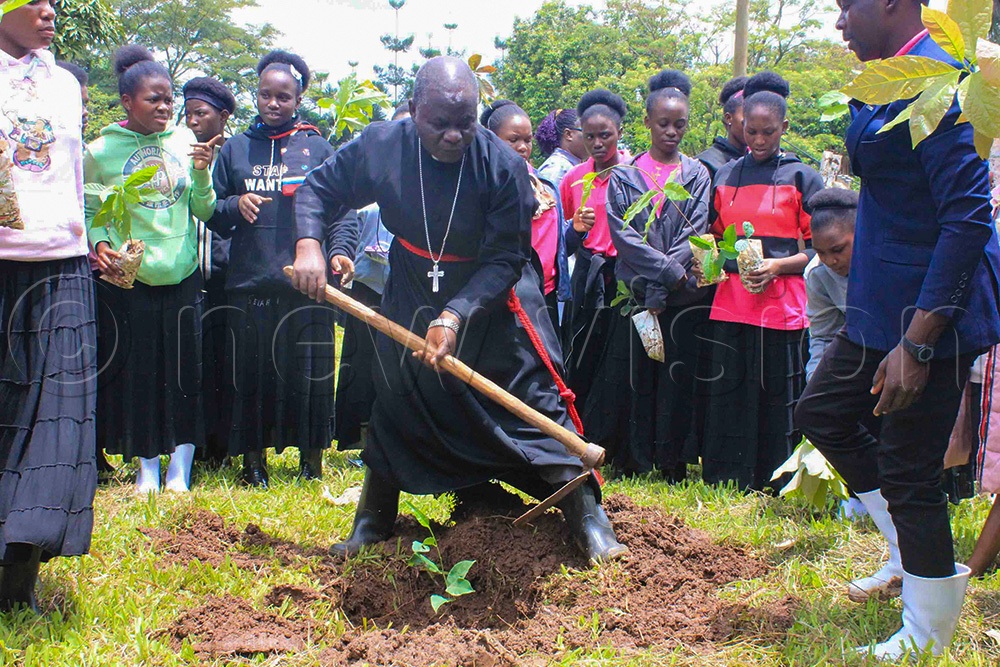
Ven. Kenneth Kampi Lukwago, the Archdeacon of Nassuuti Archdeaconry, planting a tree as the students are looking on. (Photo by Michael Nsubuga)
According to the Mukono Diocese planning and development director Deborah Zawedde Ssetyabula, each diocese has been tasked with planting 385,000 trees within two years.
She said the target will be implemented in phases, with the diocese expected to plant about 192,000 trees annually.
“This phased approach allows for effective planning, community participation and sustained environmental impact,” Zawedde said on March 4, 2026.
Mukono Diocese officially launched its tree-planting campaign at the Mukono Diocese School of Nursing and Midwifery (MUDI-SONAMS) at Kisowera village in Nama sub-county, Mukono district. The event attracted various stakeholders, including representatives from education, banking and agriculture-based institutions.
Zawedde said the trees will mainly be planted on land belonging to church-founded schools and churches across the diocese. She also called on individuals to heed the archbishop’s call by continuing to plant trees over the next two years.
Dr Damalie Babirye Magala, a researcher at the Mukono Zonal Agricultural Research and Development Institute (MUZARDI), welcomed the archbishop’s call for environmental restoration through tree planting.
She noted that trees play a vital role in supporting the environment and communities by providing food, fuel, timber and medicine.
However, Magala emphasised that tree planting alone is not enough, stressing the need to sensitise communities about both the benefits of trees and the dangers of cutting them down without replanting.
“Cutting trees causes significant environmental damage, including increased greenhouse gas emissions, loss of biodiversity and disruption of water cycles,” she said. “It also leads to soil erosion, floods, habitat destruction and accelerated global warming.”
Rev. Henry Katumba said the campaign is expected to succeed largely because it will rely heavily on young people in schools and other institutions to drive its implementation.
Nathan Kigongo, the headteacher of St. Andrews Ndwaddemutwe Seed Secondary School in Kimenyedde sub-county, said many church-founded schools have idle land that could be utilised for tree planting.
“Planting trees on designated pieces of land to create forests, within school compounds and along boundaries, will also help protect school land from encroachers,” he said.
Introduce policy
Juliana Etho Tenda, a midwifery student at MUDI-SONAMS, said schools often contribute to deforestation in their search for timber and firewood.
Tenda urged the government to introduce a policy requiring schools to establish sizeable forest reserves.
“Schools should be allowed to harvest these trees once they mature, provided they can prove that they have planted new ones to replace the one to be harvested,” she said.
She also urged the youth to take up tree planting as a business, saying that if embraced, it could help many unemployed young people earn a living.
“They can establish tree nurseries and plant trees such as eucalyptus, which can be harvested and sold as poles. If left to mature for longer, they can also produce quality timber. Fruit trees can also generate good income,” she said.