
More needs to be done to curb unemployment – labour minister
While presenting a report on labour and employment earlier this year, Esther Davinia Anyakun, then state minister for labour, employment and industrial relations, said more needs to be done to curb unemployment.
Esther Anyakun Davinia, the Minister of State for Labour, Employment and Industrial Relations, delivering a press statement at delivered at the Uganda Media Centre on Wednesday, April 22, 2026. (Courtesy: X/@UgandaMediaCent)
________________
For many households, informal work is not a choice. It is survival. Street vending, bodaboda transport, market trade, small workshops, casual construction and family farming keep millions afloat.
However, such work can also mean unstable incomes, exposure to abuse and little protection in times of illness or old age.
While presenting a report on labour and employment earlier this year, Esther Davinia Anyakun, then state minister for labour, employment and industrial relations, said more needs to be done to curb unemployment.
The labour-market figures show that employment remains overwhelmingly informal. The informal sector contributes about 54.5% of Uganda’s Gross Domestic Product (GDP) and employs nearly 88% of the workforce.
This means most Ugandans work outside formal payroll systems, often without contracts, pensions, health cover or reliable labour protections. Against this backdrop, the case for vocational and technical skilling is becoming increasingly relevant to Uganda’s economy.
He said the board’s mandate is to develop curricula and assess them. The curriculum for technical and vocational training is flexible, covering both short- and long-term courses, allowing Ugandans to learn specific modules, acquire skills and enter the world of work.
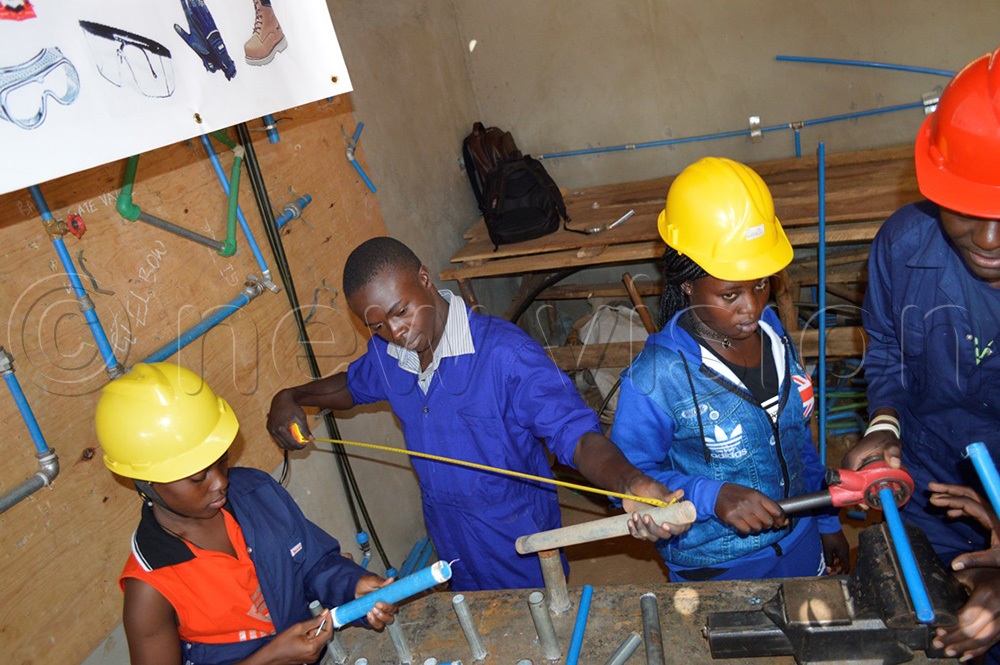
Skilling can lead to gainful employment, often in a shorter time than conventional formal education. (File photo)
“I can come and only train in terrazzo making as a module, or laying tiles as a module or plumbing,” he said in his Kyambogo office.
The issue of gainful employment is crucial, given that Uganda’s real GDP per person employed stood at $6,162 (about sh22.9m) in 2021 on a purchasing power parity basis.
This compares with $10,278 (about sh38.2m) for Sub-Saharan Africa and $41,510 (about sh154.4m) globally.
Certification opens opportunities
He said some artisans are highly skilled, but miss out on job opportunities because they lack certificates to demonstrate their abilities.
The certification is particularly important for people who acquired their skills through apprenticeships or years of practical experience rather than conventional education.
Beyond Uganda, a UVTAB certificate could also open better opportunities for Ugandans seeking work abroad, including in the United Arab Emirates (UAE).
“Even those going abroad for work should come for certification because it improves their potential to earn,” said Kambaho Narasi Anyijuka, the head of communications at UVTAB.
She added that someone going to work as a maid in the UAE could upgrade their skills and become an early childhood carer, potentially earning more than they would as a maid.
For Uganda, the argument is, therefore, increasingly about not simply creating jobs, but equipping people with practical skills that can help them earn better incomes and move into more productive work.