
Minor disputes need not reach formal courts, Bushenyi LC1 leaders told
During the workshop, the chief magistrate took the leaders through the composition and quorum of LC courts, the types of cases they are mandated to handle and the basic elements of criminal justice.
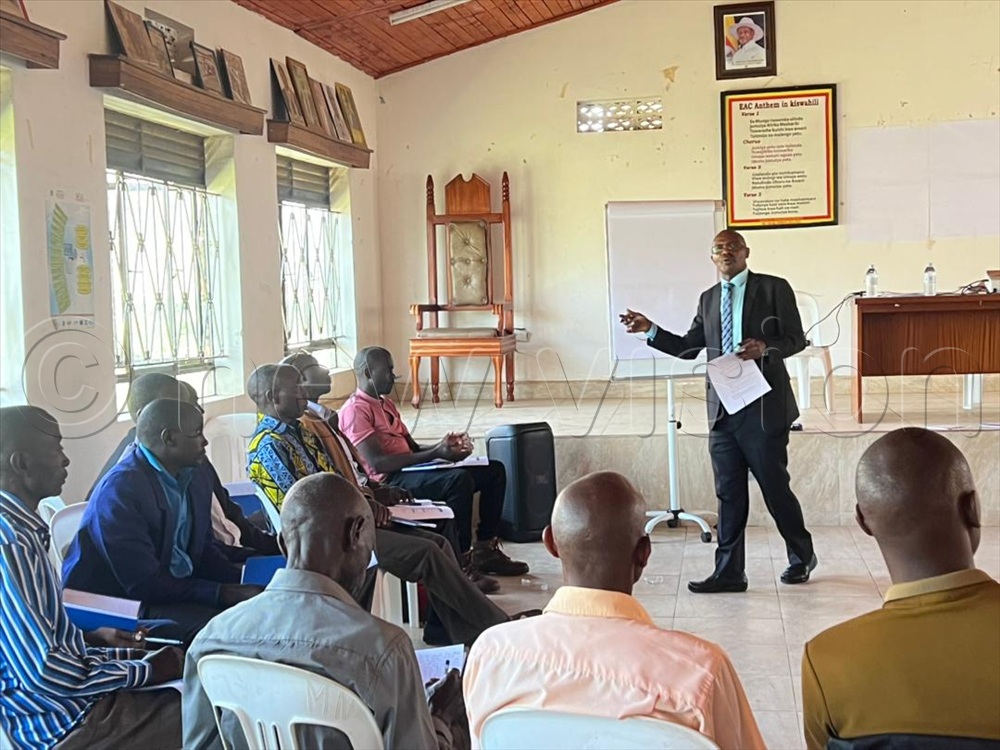
Bushenyi Chief Magistrate Saidi Barigye addressing the Bushenyi District LC1 chairperson. (Photos by Bruno Mugizi)
________________
Newly elected Local Council One (LC1) chairpersons in Bushenyi district have been urged to properly use local council courts and alternative dispute resolution (ADR) mechanisms to settle minor disputes at village level and reduce unnecessary pressure on the formal justice system.
The call was made by Bushenyi chief magistrate Saidi Barigye on August 29, 2026, during a two-day training workshop for newly elected LC1 leaders in Bushenyi district, organised by Communication for Development Foundation-Uganda (CDFU).
The workshop, held at Bushenyi Multipurpose Hall, aimed to equip the leaders with knowledge of the legal mandate of LC courts and the use of alternative dispute resolution (ADR) mechanisms in settling disputes.
Barigye cautioned the leaders against handling matters beyond the jurisdiction of LC courts, urging them to understand the limits of their powers and follow proper legal procedures when handling disputes.
During the workshop, the chief magistrate took the leaders through the composition and quorum of LC courts, the types of cases they are mandated to handle and the basic elements of criminal justice.
The training emphasised the role of LC1 courts in handling cases that fall within their legal mandate, including specified civil matters, customary law disputes, some by-law and ordinance violations, child-related matters and land disputes.
The leaders were also reminded to ensure that the required members are present whenever an LC court sits and that parties appearing before the court are given a fair hearing.
Call for proper use of LC courts
Gerald Byamugisha, a rehabilitation officer at Nyamushekyera Government Prison in Bushenyi district, said failure to properly use LC courts had contributed to an increase in the number of prisoners over minor cases that could have been handled at community level.
He urged LC1 chairpersons to welcome and support former inmates returning to their communities after serving their sentences instead of discriminating against them.
Byamugisha said proper use of LC courts could prevent minor disputes from unnecessarily progressing into the formal criminal justice system.
Police pledge to work with LC1 leaders
Laban Ajuna, officer in charge of Kyamuhunga subcounty, said police would strengthen cooperation with LC1 chairpersons to ensure that appropriate minor cases are handled at village level in accordance with the law.
“We shall work with LC1 chairpersons to ensure that small cases are handled by LC1 courts where the law allows,” Ajuna said.
He said the approach would help police and local leaders resolve minor disputes before they unnecessarily escalate into formal criminal cases.
Caution against misuse of stamps
Allen Nankunda, the executive director of CDFU, warned the leaders against conflicts of interest when handling community disputes and urged them to step aside from cases involving their relatives.
“If there is a case at a village level involving your relative, please step aside for the committee to handle such cases,” Nankunda said.
Nankunda warned against leaders stamping agreements involving the same piece of land after it has already been sold to another person.
She said some leaders stamp land agreements even when they know the same piece of land had already been sold to another person, describing the practice as illegal.
She cautioned the leaders that such conduct could put them on the wrong side of the law and contribute to land disputes in their communities.
'Be problem-solvers'
Bushenyi deputy resident district commissioner Donanto Kasigazi cautioned the newly elected leaders against becoming sources of problems in the communities they lead.
“In villages where there are problems, it means LC1 themselves have problems because when a leader fails to solve a problem, the problem becomes a leader and a leader becomes a problem. Therefore, we want to urge the village chairperson to become the problem-solvers of their villages instead of becoming problems to their villages ,” Kasigazi said.
He challenged the leaders to take responsibility for security and social order in their communities.
“When you find there is a village with thieves, it means the chairperson is a thief or connives with thieves, which can be a big problem to the community,” he said.
Leaders commit to using new skills
Karuhanga Wilson, the LC1 chairperson of Nyamiko cell in Ngakabirizi division, said the training had equipped them with skills that would help them resolve appropriate community disputes at village level.
He said the leaders would use the knowledge gained from the workshop to handle cases within their mandate and involve police or other authorities when necessary.