
Minister Barugahara evicts Kabale market landlords, hands stalls to traders
Barugahara directed Kabale Municipality Town Clerk Jamil Kassajja to register all affected traders and issue them documents confirming ownership.
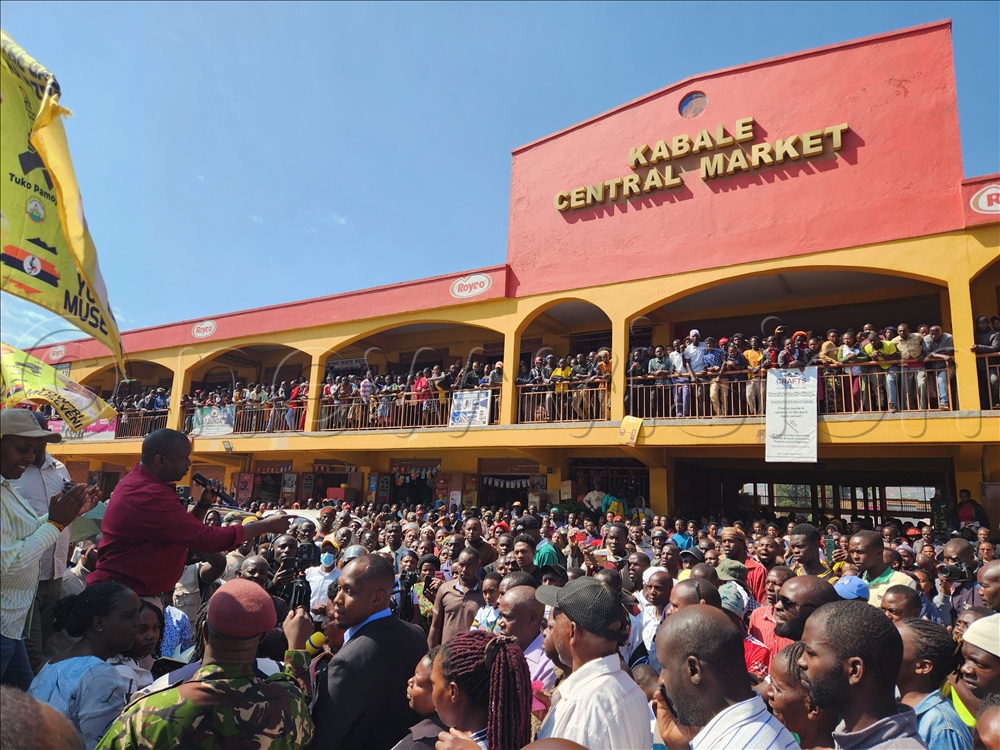
Local Government Minister Balaam Barugahara addressing traders at Kabale Central Market on Thursday, October 22. (Photos by Lawrence Mulondo)
________________
For years, traders in Kabale Central Market have been crying foul, accusing landlords of hijacking stalls and lock-ups meant for low-income vendors and turned them into a lucrative private rental business.
On Thursday, Local Government Minister Balaam Barugahara walked into the market and blew the lid off the cartel.
Barugahara, who was starting his Expose the Corrupt campaign in Kabale Municipality, toured the market before holding a mini rally outside to interact with traders. The testimonies were damning.
Traders pay sh5m for sh80,000 stalls
The government set up Kabale Central Market to empower ordinary citizens, with approved charges of sh120,000 per year per stall, or sh80,000 per lock-up per month, payable directly to Kabale Municipality through its official account.
On Thursday, October 22, however, the minister revealed that he was shocked to discover rotten management structures at the facility.
His investigations revealed that traders are paying through the nose. Some presented receipts showing they pay as much as sh5m per year to private landlords who do not even live in Kabale. The landlords operate through middlemen who collect the cash
Complaints
Maurice Atukwase, a trader, narrated that for her stall A238, she pays sh150,000 monthly to a man identified only as Kabode, who collects on behalf of an absentee landlord.
Relatedly, Duncan Agaba said that for his B2019 rented stall, he pays sh150,000 per month to one Dan, whom he described as his landlord.
Janette Owokuhiisa, who runs a saloon in AX43F, reported that she rents the premises from one Amon who works in the finance department of the municipal council. She also pays sh150,000 monthly.
More traders told the minister that although they have no receipts to prove payment to their landlords, they need Government intervention to end what they describe as their suffering with huge rental bills.
Others alleged that a number of public servants own several stalls and lock-ups in the market which they rent out at exorbitant fees, while some traders own more than one stall and sublet the extras, depriving other deserving vendors of workspace.
Saying that he was unaware of the extortions, the visibly angered Barugahara told traders that the government built the market as a work place to generate income for local traders. Sadly, he added that the complex has unfortunately been turned into private property.
He immediately banned the practice of landlords renting out stalls and lock-ups. The minister on Thursday also ordered that over 100 traders currently renting from landlords be registered as rightful owners of their workspaces.
He directed Kabale Municipality Town Clerk Jamil Kassajja to register all affected traders and issue them documents confirming ownership. He also warned traders to pay money only to the municipality and through its official bank account, not to individuals.
To underscore the mismanagement, traders informed the minister that about 52 lock-ups are being used as stores while hundreds of vendors have nowhere to work. Barugahara ordered that all such lock-ups be opened up and allocated to traders who need working space.
Powerful middlemen and missing market master
The rot went beyond rent. Traders also complained of middlemen who operate electricity meters in the market. They alleged that when they pay for seven units of power, they are only given three minutes of electricity.
Barugahara advised traders to form groups of three and be given a shared meter to cut out the middlemen whom he accused of stealing from them.
He said all the traders' woes point to poor management of the facility by the market master, who was conspicuously absent during the minister's inspection. The minister ordered an investigation into the management of the market.