
Media managers seal e-reporting incorporation in African migration
The 3-year Erasmus+ project, code-named ‘Communicating Migration and Mobility, E-Learning Programmes and Newsroom Applications for Sub-Saharan Africa (COMMPASS) ', is a culmination of two earlier conferences in Kampala (Uganda) and Blantyre (Malawi) in 2023.
Dr. Michael Leroy (second right), the academic manager COMMPASS-Research, Dortmund University and Prof. Monica Chibita (second left) of UCU handing over the certificate of the 1st runners up, Djakaridia Siribie from Burkina Faso to the representatives from Burkina Faso. (Photo by Henry Nsubuga)
__________________
The third and final international conference for consolidating online digital reporting on migration and mobility in Sub-Saharan Africa has been closed at Uganda Christian University (UCU), Mukono.
The 3-year Erasmus+ project, code-named ‘Communicating Migration and Mobility, E-Learning Programmes and Newsroom Applications for Sub-Saharan Africa (COMMPASS) ', is a culmination of two earlier conferences in Kampala (Uganda) and Blantyre (Malawi) in 2023.
The conference, held under the theme ‘Media, Migration And Mobility: Re-imagining the African Narrative’, had several objectives, including: laying a foundation to move beyond stereotypes in migration reporting, exploring digital narratives, digital storytelling on social change, learning and a competitive E-learning arrangement.
More than 100 researchers and teachers, and over 1,500 students, associated partners in higher education institutions, journalists and online courses have been trained over the period.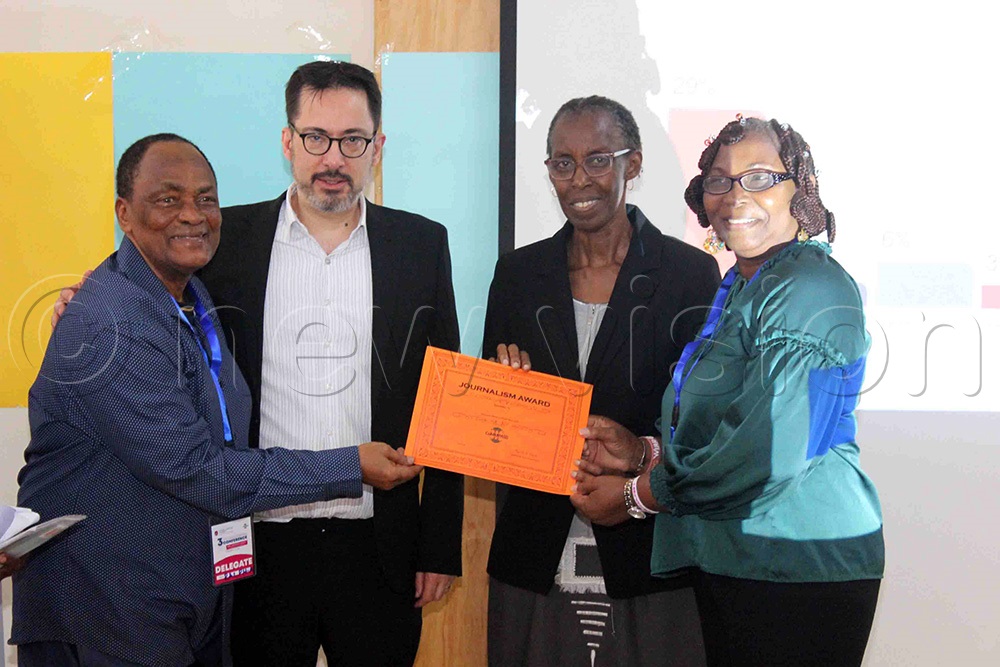
Dr. Michael Leroy (second left), the academic manager COMMPASS-Research, Dortmund University and Prof. Monica Chibita (second right) of UCU handing over the certificate of the winning Nigerian journalist Henry Nwachukwu to Prof. Ralph Afolabi Akinfeleye (left) of the University of Lagos, Nigeria. (Photo by Henry Nsubuga)
The COMMPASS project is calculated to strengthen journalism training capacity with a view to helping improve the quality of information and public discourse on migration and mobility in countries of origin, transit and destination at a time when the African media industry is struggling to tell the African story of migration.
Participants in the five-day discourse co-funded by the European Union (EU) included journalism and media learners and lecturers from six universities in Malawi, Uganda and Burkina Faso, two universities in Germany and Portugal, and eight associated partner universities from Ethiopia, Cameroon, Ghana, Guinea-Bissau, Kenya and Nigeria.
Facilitators among them international journalism and media authorities included: Prof. Monica Chibita of UCU, Prof. Ralph Afolabi Akinfeleye of the University of Lagos, Nigeria, Burkinabe co-Principal Investigator for the COMMPASS project Lassane Yameogo, Assistant Professor at the Ethiopian University of Agder Mulatu Alemayehu Moges, the chairperson of the University Council of Malawi Prof. John Kalenga Salca, Dr William Tayebwa of Makerere University, while COMMPASS Principal Investigator Prof. Susanne Fengler was the conference coordinator.
At the conference closure, a six-man panel of jurists, chaired by the Vice Chancellor of Livingstonia University of Malawi, Prof. Timothy Nyasulu, recognised and awarded three authors of the best mobility articles.
An article by a Nigerian journalist, Henry Nwachukwu, was classified as the best written, followed by Djakaridia Siribie from Burkina Faso and Collins Mtika from Malawi.
Nwachukwu, a student at Pan-Atlantic University, Nigeria, wrote about the ‘Digital Traps: How Online Promises Are Hurting Migrants across the Nigeria–Ghana Corridor’, which examines how young people in Nigeria and Ghana are being misled by online job advertisements and informal recruitment channels, particularly on social media platforms such as WhatsApp and Facebook.
What COMPASS training beneficiaries say:
Chissono Semani, from the University of Livingstone, Malawi: Owing to the very limited knowledge I used to have about migration, I used to keep clear of reporting migration, and I erroneously used to think that migration was limited to refugees.
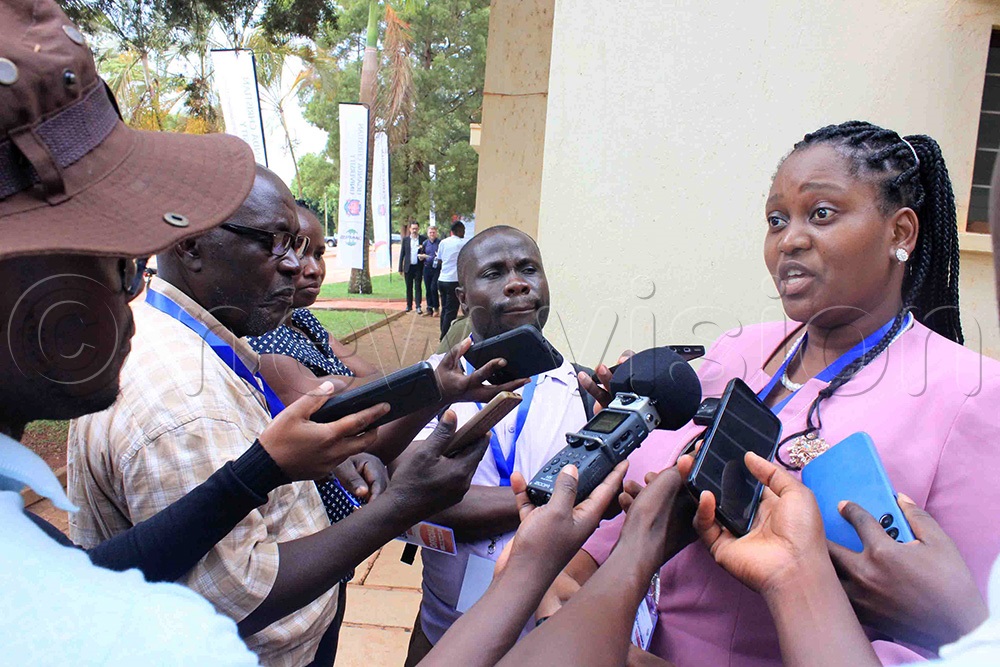
Chissono Semani (right), from the University of Livingstone, Malawi, a journalist under COMMPASS training addressing journalists at the closure of the conference at UCU on Thursday. (Photo by Henry Nsubuga)
However, with more knowledge acquired later on, I realised that they were simply underrepresented. Many asylum seekers were not referred to as refugees and were called by their countries’ names.
After the COMMPASS course, I managed to write an article about the double-edged sword of the vice of migration. The course was very insightful, and the aspect of online learning is vital.
Anthony Kizza of Makerere University: Topics covered on migration are very crucial; many of our friends from the DR Congo and South Sudan were displaced by internal civil strife in their countries. While Ugandan refugees in other countries went there in search of jobs, treatment and education.
Bill Dan Arnold Borodi, a journalism graduate (2023) at UCU who also enrolled for the COMPASS course: It is unfortunate that although Uganda has the biggest number of refugees in Africa, there is scanty information about their lives, but through COMMPASS training, I have learnt how to source and access information relevant for my work.
A lot of refugee issues and migration in general go unreported, and this course has come as an eye-opener. The course is rich and enriching; it nourished our knowledge. It was sort of a refresher course as far as Africa is concerned.