
Low-interest Katale Loan excites Soroti traders
"To qualify for the loan, a trader must own a stall or lock-up in the market and belong to a group of five members," Kimuli said.
Soroti City modern market. The Katale Loan initiative, introduced by President Yoweri Museveni last year, targets market vendors with affordable credit at an annual interest rate of eight percent.
________________
Traders in Soroti city have welcomed the government's plan to extend the Katale Loan programme beyond Kampala, describing it as a timely intervention that could free them from the grip of exploitative money lenders.
The Katale Loan initiative, introduced by President Yoweri Museveni last year, targets market vendors with affordable credit at an annual interest rate of eight percent. Under the programme implemented through the Microfinance Support Centre (MSC), beneficiaries can access loans ranging from sh500,000 to sh2 million to expand their businesses.
According to government officials, more than 10,000 vendors in Kampala markets have already benefited from the scheme. The government is now rolling out the programme to markets outside the capital, with Soroti Main Market among the first beneficiaries.
The initiative was introduced to help traders access affordable financing and reduce dependence on private money lenders who often charge high interest rates and demand daily repayments.
While addressing vendors at Soroti Main Market on June 17, 2026, the senior presidential adviser on markets, Faridah Kimuli, outlined the eligibility requirements for prospective beneficiaries.
"To qualify for the loan, a trader must own a stall or lock-up in the market and belong to a group of five members," Kimuli said.
Modesta Ilau, a vendor at the market, said money lenders have made life difficult for many traders because they demand repayments regardless of business performance.
"There are lenders we pay daily and others weekly. Whether you have made sales or not, they still demand their money together with interest," Ilau said.
She believes the Katale Loan programme will give traders the breathing space needed to grow their businesses.
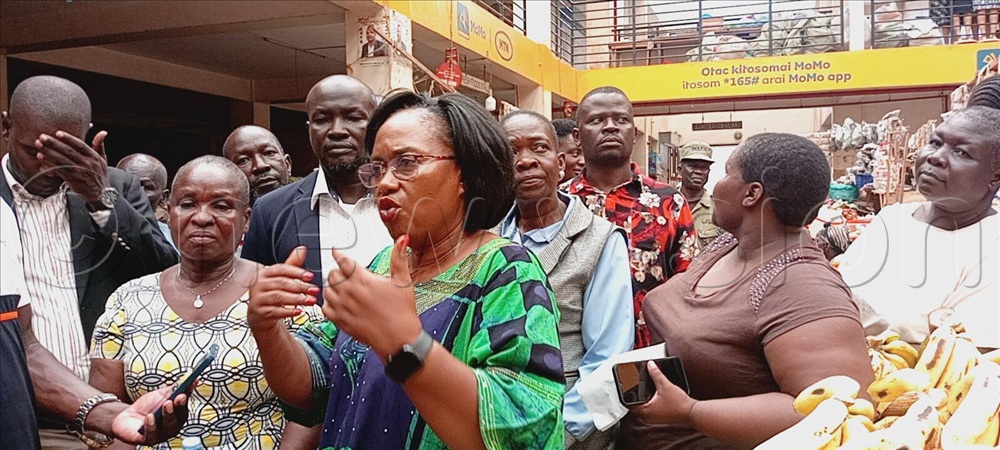
The Senior Presidential Adviser on Markets, Faridah Kimuli talking to Soroti city main market vendors. (Photos by Godfrey Ojore and Rebecca Amongin)
"With this programme, I can proudly say my vote did not go to waste. I am grateful to President Museveni for thinking about ordinary traders," she added.
"We understand our businesses very well. What we need is capital to expand. Unlike some beneficiaries of the Parish Development Model who are starting businesses from scratch, we already have operational enterprises," Opus said.
Peter Aporu noted that many traders have been pushed to the brink by harsh lending conditions imposed by informal money lenders.
"There are days when a trader makes no sales at all, but the money lender does not want to hear any explanation. All they want is their money," Aporu said.
For Musa Egadu, a tomato vendor, the government loan programme offers hope for a more stable future.
"With affordable loans and enough time to repay, we can invest properly, educate our children and improve our livelihoods. Right now, many traders operate under constant pressure from money lenders," Egadu said.
To qualify for the Katale Loan, applicants must possess a valid national identity card, operate a stall or lock-up within the market, and belong to a registered group of five traders or more.
Traders in Soroti are optimistic that the programme will provide affordable capital, stimulate business growth and improve household incomes across the city.