
Labour firms cautioned against forced HIV status disclosure
“Companies that export labour to the Middle East usually subject job applicants to mandatory HIV screening and disclosure. When they discover that you are HIV positive, they usually leave you out. This is not right.”
Patricia Asero, board member of ICW-Kenya; Lilian Mworeko, Executive Director of ICWEA-Uganda; Dr.Vincent Bagambe, Director of Planning and Strategic Information at the Uganda AIDS Commission; Dr Tatu Nyangu, Board Chairperson of ICWEA; and Joan Chamungu, Executive Director of Tanzania Network of Women Living with HIV and AIDS and Trive Advocate during the Thrive Regional Coalition Action Convening at Protea Hotel in Kampala on Wednesday. (Photo by Hope Mafaranga)
____________________
Female HIV advocates from East Africa have appealed to labour export companies and employers to stop forcing job-seekers into disclosing their HIV status, noting that the act violates the rights of persons living with HIV and usually results in denial of employment.
“Companies that export labour to the Middle East usually subject job applicants to mandatory HIV screening and disclosure. When they discover that you are HIV positive, they usually leave you out. This is not right,” Dorothy Namutamba, the Deputy Director at the International Community of Women Living with HIV East Africa (ICWEA), said.
Under Uganda’s 2014 HIV policy and national guidelines, individuals living with HIV are not legally obligated to disclose their HIV status to employers or colleagues, and medical test results are strictly confidential.
Namutamba said most of the victims of forced disclosures, even among couples, were women and girls.
She made the remarks on September 23 at Protea Hotel in Kampala during the start of a three-day workshop on ending violence against women living HIV.
The workshop, which was organised by International Community of Women living with HIV Eastern Africa (ICWEA), was attended leading female HIV advocates from East Africa.
Patricia Asero, a board member of ICWEA from Kenya, called for stronger confidentiality, informed consent and protection of women’s rights across HIV services.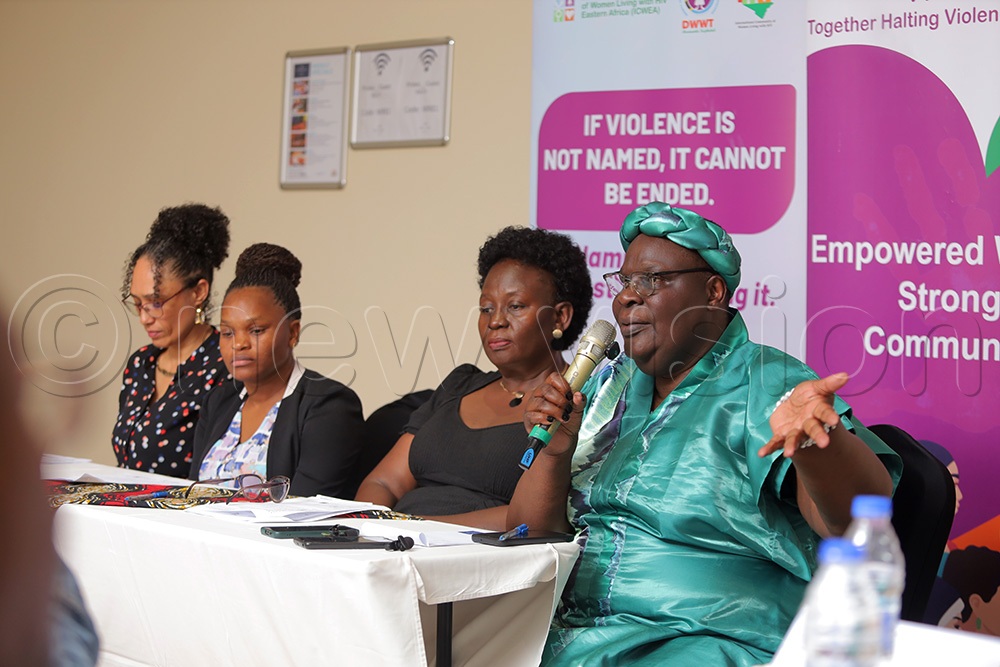
Patricia Asero, board member of ICW-Kenya, speaking during a press briefing at the Thrive Regional Coalition Action Convening at Protea Hotel in Kampala on Wednesday. Looking on are Dorothy Namutamba, Deputy Director at ICWEA-Uganda; Violeth Edwin, Thrive Project Coordinator, Dignity and Wellness for Women living with HIV in Tanzania; and Christina Makumi, Executive Director of ICW-Kenya. (Photo by Hope Mafaranga)
She also raised concerns about assisted partner notification, saying women can face violence, eviction, loss of employment and even death after their HIV status is disclosed without adequate consent and protection.
She said the experiences were documented through a multi-country research on new and evolving forms of violence against women and girls living with HIV in Kenya, Uganda and Tanzania.
She cited the case of a woman in Kenya, who was imprisoned with her two children after health workers accused her of failing to give her child HIV medicine on time.
“Those are some of the new and evolving forms of violence that are not seen,” Asero said.
Asero recounted how relatives attempted to dispossess her of property after her husband died, using a cultural practice in which demolishing a widow’s house signifies divorce.
She said stigma also persists in healthcare settings, where women living with HIV are questioned or discouraged from having children despite advances in HIV prevention and treatment.
Namutamba said ICWEA was implementing a two-year project, Together Halting Violence and Inequality (THRIVE), funded with $340,000 (about sh1.3b) by the UN Trust Fund.
The project seeks to strengthen the collective power, resilience and impact of the regional movement of women and girls living with HIV.
She also urged organisations to empower and mentor younger women to take up leadership and advocacy roles.
She also highlighted efforts to strengthen intergenerational connections, particularly with adolescent girls and young women, whom she said were being prepared to carry the work forward.
Christina Makumi, the Executive Director of ICW-Kenya, said women living with HIV were increasingly experiencing forms of violence that required specific attention, documentation and evidence-based responses.
She said one strategic objective was to strengthen the regional movement through evidence generation, analysis, documentation and information sharing.
“We are not leaving our young women behind,” Makumi said.
Violeth Edwin, the executive director of Dignity and Wellbeing for Women Living with HIV in Tanzania (DWWT), said the convening provided political narrative, storytelling and advocacy training for coalition educators to strengthen ethical and survivor-centred messaging.
Dr. Vincent Bagambe, the Director of Planning and Strategic Information at the Uganda AIDS Commission, said Uganda was committed to ending AIDS by 2030.
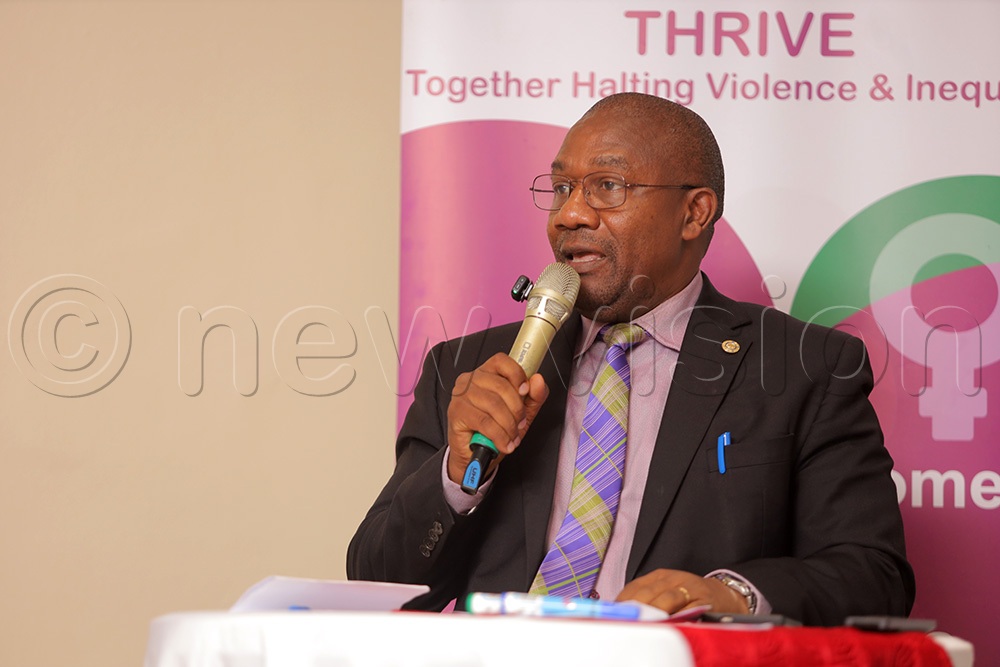
Vincent Bagambe, the Director of Planning and Strategic Information at the Uganda AIDS Commission, giving his opening remarks during the Thrive Regional Coalition Action Convening at Protea Hotel in Kampala on Wednesday. (Photo by Hope Mafaranga)
“Our work brings together different stakeholders, including government, civil society, cultural institutions, faith-based organisations, communities affected by HIV, the private sector, researchers and academia, with the aim of effectively achieving this goal,” he said.
She was speaking during the THRIVE Regional Coalition Action Convening in Kampala Uganda, where advocates from Kenya, Tanzania and Uganda convened to share one advocacy agenda to end new and evolving forms of violence against women and girls living with HIV.
Adella Mbabazi, ICWEA’s Communications & Advocacy Officer, said ïf violence is not named, it cannot be ended.