
Justice Abodo roots for mediation in land disputes
Abodo argued that such disputes are uniquely suited for mediation because they frequently involve family relationships, community ties, historical claims and economic livelihoods.
Land justice stakeholders in a group photo with the Principla Judge Jane Frances Abodo on Friday May 22, 2026. (Photo by Farooq Kasule)
_________________
The Principal Judge, Jane Frances Abodo, has rooted for mediation in resolving land disputes.
Abodo argued that such disputes are uniquely suited for mediation because they frequently involve family relationships, community ties, historical claims and economic livelihoods.
According to Abodo, many land disputes do not need to drag on through prolonged adversarial litigation.
“I strongly encourage judges, mediators and advocates to proactively identify suitable cases for mediation at the earliest possible stage,” Abodo said.
Abodo said it is time for parties involved in land disputes to shift from a purely adversarial mindset to one that also embraces reconciliation and win-win outcomes wherever justice permits.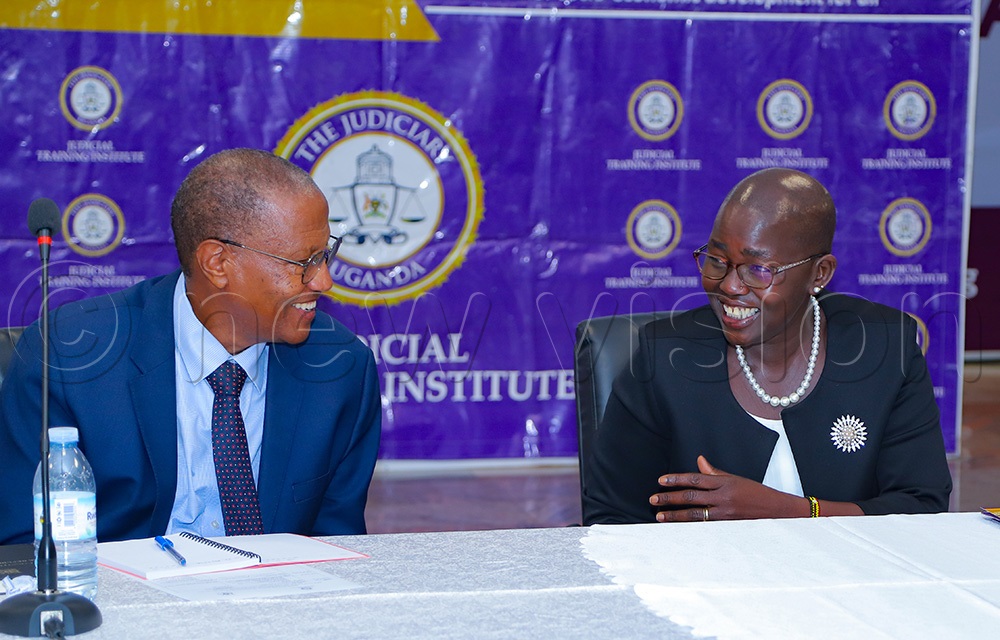
Principal Judge Jane Frances Abodo interracting with former Deputy Chief Justice Richard Buteera during the roundtable discussions on land matters on Friday May 22, 2026. (Photo by Farooq Kasule)
She made the appeal during a roundtable discussion with stakeholders at the Supreme Court Conference Hall in Kampala on May 22, 2026, ahead of the mediation fortnight settlement for land disputes.
Convened by the Judiciary through the Judicial Training Institute (JTI), the roundtable discussion brought together actors in land justice administration, including judges of the Land Division of the High Court, registrars, mediators, advocates and officials from the Ministry of Lands, Housing and Urban Development, among others.
Abodo said the roundtable was a strategic preparation for the upcoming land dispute mediation settlement fortnight, enabling stakeholders to discuss the current state of land disputes in the Land Division of the High Court, identify practical ways of unlocking mediation opportunities and strengthen collaboration in order to deliver faster, fairer and more meaningful justice to justice seekers.
“Delayed justice, especially in land matters, often leads to hardship, frustration and sometimes even breaches of the peace. Therefore, timely delivery of decisions is an essential part of restoring public confidence in the Judiciary,” Abodo noted.
Abodo underscored the importance of predictability and consistency in the country’s jurisprudence, saying litigants, investors and the general public deserve to know how the court is likely to approach recurring issues such as spousal consent, fraudulent transfers, customary land rights, registration disputes and eviction procedures.
“While every case must be decided on its own merits, a consistent and principled application of the law builds certainty and reduces unnecessary litigation,” Abodo noted.
Abodo commended the Judicial Training Institute for convening the roundtable, saying the success of the settlement fortnight will largely depend on the quality of ideas and commitments generated from the engagement.
High Court judge Damalie Lwanga, the head of the Land Division of the High Court, noted that while the workload at the court reduced when the Entebbe and Wakiso High Court Circuits were operationalised, the division still faces heavy caseloads.
“A total of 8,930 land matters were brought forward from the previous financial year, of which 243 were for mediation. 3,692 new matters have been registered since this year began, of which 655 of these cases went for mediation. 5,739 matters have so far been completed this year, of which 421 are mediation causes. The total number of pending matters in the division is 7,051, and of these, 477 are mediation causes,” Lwanga noted.
With mediation resolutions increasing to 394 cases from 261 in the previous financial year, Lwanga said this prompted the division to introduce a mediation fortnight for land cases to substantially reduce caseloads.
“We have since set up an ADR committee composed of 11 members, including two judges and four registrars at the division, among others. The committee meets regularly and performs the duties of monitoring and evaluation of the effectiveness of ADR in addition to offering support in all the ADR processes,” Lwanga noted.
Lwanga said the division has resolved to make timely and systematic referral of suitable cases to mediation in order to encourage early mediation and faster disposal of cases.
She commended Prof. Justice Andrew Khaukha, the executive director of the Judicial Training Institute, for his efforts in promoting ADR mechanisms, especially court-annexed mediation within the Judiciary, which has created a positive impact in terms of case disposal.
Supreme Court Justice Mike Chibita, who is also the chairperson of the Judicial Training Institute Governing Council, reaffirmed the institute’s commitment to strengthening judicial capacity and promoting ADR as a key component of access to justice.
Land-related disputes remain among the most prevalent forms of conflict within communities in both rural and urban areas across Uganda.
In 2016, President Yoweri Museveni established a judicial commission of inquiry into land matters to address escalating land conflicts, rampant illegal evictions and systemic corruption within land administration.
The commission, chaired by now Supreme Court Justice Catherine Bamugemereire, has since handed its report to President Museveni for action.