
Judiciary constitutes faculty to support alternative dispute resolution
According to Abodo, the faculty will provide continuous training and mentorship to judicial officers and other stakeholders, including mediators, to ensure that there are high ethical standards and alignment with the country’s constitution as well as the international human rights norms.
Gulu Resident Judge, Phillip Odoki receiving the ADR register from Principal Judge, Jane Frances Abodo. (Photos by Jesse Johnson James)
________________
The Judiciary has constituted a faculty aimed at supporting the alternative dispute resolution (ADR) initiative, also known as the alternative justice system (AJS), Principal Judge Jane Frances Abodo has said.
ADR refers to several methods of resolving legal disputes outside of court, such as mediation, arbitration, conciliation, and negotiation.
In Uganda’s justice system, ADR was introduced in 2013 but later went dormant. It has been revived in 2024 to date, over 100 courts across the country have mediators, with more still being trained, according to the ADR registry.
Members of the faculty
Without disclosing when the faculty was constituted, Abodo revealed that it comprises Deputy Chief Justice emeritus Richard Buteera, former Principal Judge Yorokamu Bamwine and retired judge David Kutosi Wangutusi. Others are Dr Henry Onoria, former Solicitor General Francis Atoke and former Uganda Law Society President Francis Gimara.
According to Abodo, the faculty will provide continuous training and mentorship to judicial officers and other stakeholders, including mediators, to ensure that there are high ethical standards and alignment with the country’s constitution as well as the international human rights norms.
She asked the judicial officers to approach the ADR with open minds and the spirit of innovation.
“Build respectable working relationships with the religious and cultural leaders and other judicial actors so that parties are not denied formal justice when they need it, but also, that community –based solutions are given a chance to succeed,” she said.
Promulgation of the Judicature Rule
Abodo made the revelation on May 4-5, 2026, as the Judiciary, through the Judicial Training Institute (JTI), promulgated the Judicature (Court Annexed Mediation) Rule, 2026, to judicial officers, mediators, religious and cultural leaders, as well as other government officials in Acholi and Lango, respectively.
The Principal Judge, Jane Frances Abodo and others pose for a group photo with other stakeholders.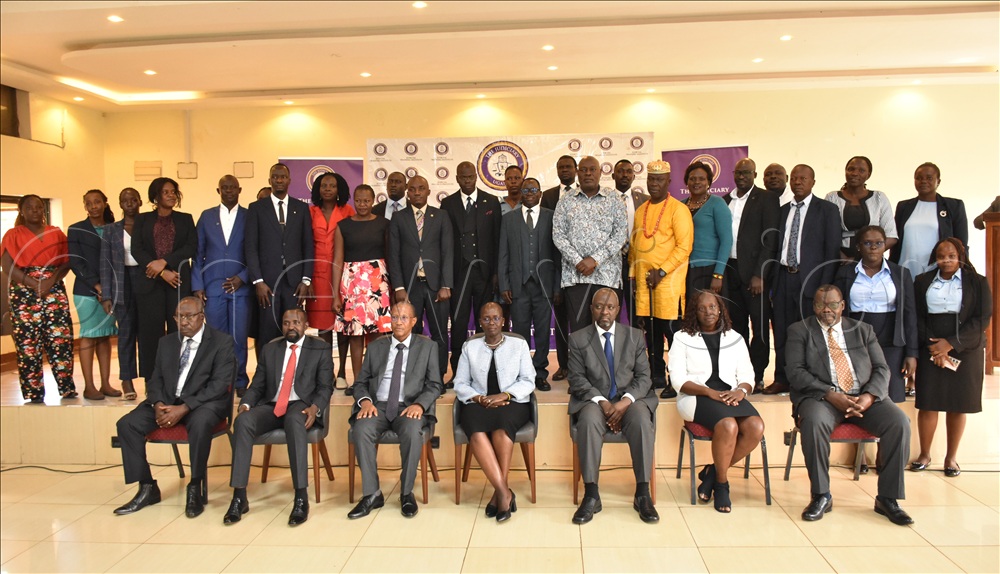
The rule, which has nine parts, guides the mediation of legal disputes outside of court.
It covers areas including the administration of court-annexed mediation, accreditation and registration of mediators, roles of a mediator, disputing parties, as well as their advocates, mediation process, conclusion of mediation and settlement agreements, as well as recognition and enforcement of the agreements, among others.
During the engagements, the AJS/ ADR practitioners and institutions were issued register books, while the judicial officers received a register for court case referral to AJS/ ADR practitioners and institutions.
During the engagement at Acholi Inn in Gulu city, Abodo cautioned judicial officers against overqualifying the ADR.
“AJS/ ADR should not stand out alone and leave the court processes. There should be a meeting point,” she said.
“If we overqualify (AJS/ ADR, we are actually trying to get back to where we are actually running away from… Maybe we can choose what to qualify, maybe the fairness, and the human rights elements,” she added.
Judicial officers cautioned
Meanwhile, Gulu Resident Judge Phillip Odoki asked the stakeholders practising ADR to always respect the bill of rights and also desist from trying to formalise the ADR system.
He also appealed to the judicial officers and advocates to explain the ADR to the litigants, so that they embrace it with full knowledge.
Mediators speak about ADR benefits
Records from the ADR Registry indicate that from July 2024 to date, over 3,000 cases have been resolved through the ADR.
Many mediators in Acholi Sub–Region have revealed that the ADR is proving to be effective in settling disputes, especially those that are land –related.
Francis Ocitti, an accredited court mediator operating in Pader District, cited that he helped to settle a land dispute case through ADR in Awere Sub –County.
Ocitti, who was accredited in 2018, said the case had lasted for over 20 years in court. He appealed to litigants to embrace ADR since it is cost-effective and time-saving.
Pheebias Ayelo, an advocate of the high court operating in Lamwo District, appealed to fellow lawyers to desist from interfering with mediation, but rather support the disputing parting to reach an agreement.