
Justice Abodo pledges improved access to justice in Karamoja
“Justice must not only be done but also be understood, accessible and trusted,” Abodo said, adding that every person deserves to be heard and treated fairly whether or not they can afford legal representation.
Justice Abodo also pledged simpler court processes and the translation of relevant information into local languages, noting that people cannot exercise rights or demand services they do not know exist. (Credit: Farooq Kasule)
KAMPALA - The Principal Judge, Jane Frances Abodo, has pledged improved access to justice for communities in Karamoja sub-region and promised to act on case backlog, prison congestion and the long distances that keep many residents away from the courts.
Speaking at the Moroto High Court Open Day on Tuesday, November 10, 2026, Justice Abodo, who also hails from the region, said the Judiciary is committed to ensuring that courts serve everyone, regardless of gender, age, disability, economic circumstances, geographical location or social standing.
“Justice must not only be done but also be understood, accessible and trusted,” she said, adding that every person deserves to be heard and treated fairly whether or not they can afford legal representation.
Justice Abodo identified case backlog, resource constraints and prison congestion as major challenges, particularly in hard-to-reach areas like Karamoja.
She revealed that Chief Justice Dr Flavian Zeija has set up a task force on prison congestion, which she chairs.
The taskforce brings together the police, the Office of the Director of Public Prosecutions (ODPP), the courts and prisons.
Abodo said the taskforce will also explore alternatives to detention, as well as reconciliation and settlement in suitable cases.
At Moroto High Court, Abodo said efforts are underway to strengthen criminal case management and increase criminal sessions.
Continuous hearings and closer coordination with the ODPP, Abodo said, would help prevent cases from piling up.
Justice Abodo also pledged simpler court processes and the translation of relevant information into local languages, noting that people cannot exercise rights or demand services they do not know exist.
She highlighted the role of mobile courts in reaching communities affected by poverty, long distances and insecurity.
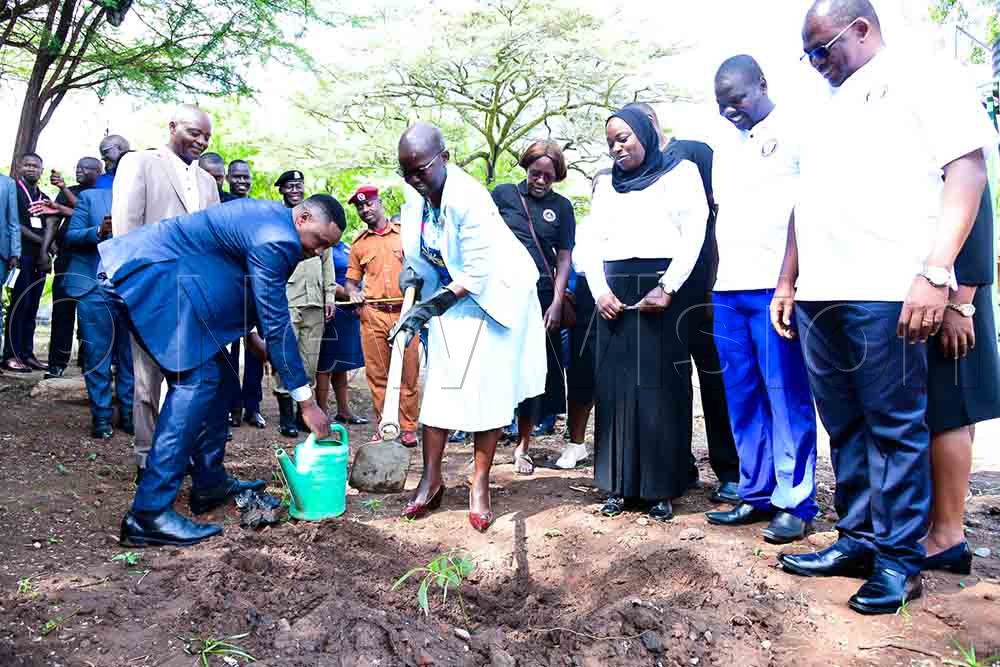
Principal Judge Jane Frances Abodo planting a tree at Moroto High Court on Tuesday, November 10, 2026. (Credit: Farooq Kasule)
She urged stronger collaboration among justice institutions, civil society, development partners, political leaders and the public, and reaffirmed the Judiciary’s commitment to better case management, technology, mediation, plea bargaining and inter-agency coordination.
Moroto Resident Judge Tom Chemutai said the open day was meant to take judicial services closer to communities and allow court users to assess their quality and accessibility.
He outlined the circuit’s challenges, including widespread poverty, recurrent drought, limited livelihood opportunities, long travel distances and intermittent insecurity.
Legal services, he said, remain concentrated in Moroto and Kotido, leaving other communities within Karamoja underserved.
According to Justice Chemutai, Moroto has no remand home, and, therefore, children in conflict with the law must be transported to facilities in other districts like Mbale. He appealed for support from the judiciary's top management to strengthen the circuit’s capacity.
Amudat Deputy Resident District Commissioner Gabriel Etesot described cattle rustling as a major challenge in his district, while his counterpart from Nabilatuk, Jimmy Tebanyang Lokur, asked for a magistrate and State Attorney to be deployed to the district, saying residents currently travel more than 40 kilometers to Nakapiripirit to access justice services.