
Irish ambassador calls on Karamoja to safeguard its cultural identity
Gaynor said culture not only connects people to their heritage but also helps shape a shared future, adding that traditions strengthen communities across borders.
Kjong women carry traditional foodstuffs to the venue at the just-concluded Karamoja annual festivities held in Moroto District. (Photos by Olandason Wanyama)
________________
The Irish Ambassador to Uganda, Mags Gaynor, has said traditions are an important source of identity and pride, while fostering unity that can link people for generations.
She said culture not only connects people to their heritage but also helps shape a shared future, adding that traditions strengthen communities across borders.
“I am encouraged by the way the Karamoja cultural festival brings together communities, leaders, women and young people,” Gaynor noted, adding that dialogue is significant for lasting peace.
She said such events as the festival provide a platform for strengthening bonds among communities.
Gaynor said Karamoja is blessed with exceptional natural and cultural assets, adding that the sub-region's landscapes, heritage and traditions offer significant potential for tourism.
She was speaking on September 12, 2026, as a guest at the closure of the week-long 11th chapter of the rotational Karamoja annual cultural festivities held at Naitakwae ground in Nadunget subcounty, Moroto district.
Gaynor further said Karamoja is a region of resilience and determination. Amid the challenges, the sub-region has preserved its culture and identity while continuing to build a better future.
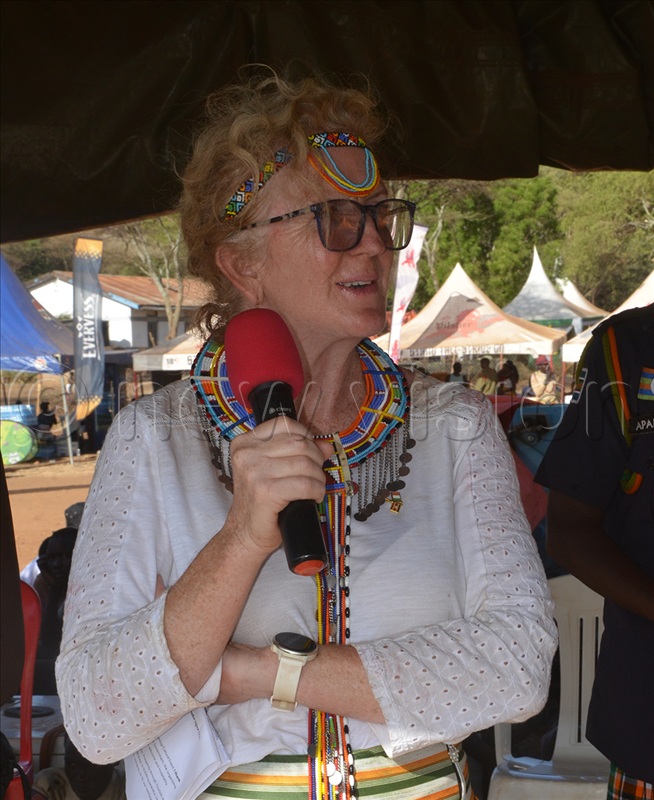
The Irish Ambassador to Uganda, Mags Gaynor, speaks at the just-concluded Karamoja annual festivities on September 12, 2026.
“The strength the people have in Karamoja is worthy of recognition and respect,” she noted.
The annual cultural festival was celebrated under the theme, “Unity in culture, strength in peace, prosperity through tourism and natural resources”.
Gaynor said the long-standing partnership with Karamoja had enabled Ireland to work with communities for two decades.
She said her country understands the importance of cultural heritage, adding that, like Uganda, the Irish value traditions, languages, music and storytelling.
“We believe that protecting culture is not only preserving the past,” she said, adding that it’s about providing a foundation for the future.
At the opening of the cultural week on September 9, 2026, President Yoweri Museveni urged the Karimojong to conduct a cultural audit aimed at identifying practices that should be preserved and those that undermine socio-economic development.
He also commended the Karimojong for positive cultural practices that have contributed to community resilience, including the relatively low HIV/AIDS prevalence in the sub-region.
On household income, Museveni urged the Karimojong to reconsider practices that hinder sustainable growth of families, citing nomadism as one that requires re-examination.
“I think you should do a cultural audit. There are some things in your culture which are good and others which are not good. Keep the good ones and abandon the bad ones,” he noted.
She added that Karamoja's heritage is vividly expressed through traditional knowledge, music, dance and oral traditions, among others.
Kamuli said she was optimistic that the resources can be safeguarded while also being responsibly developed for the benefit of present and future generations in the sub-region.
“There can be no meaningful development without peace. No sustainable investment without stability, and there can be no shared prosperity while the communities remain divided,” she noted in a speech delivered to the participants by Karamoja affairs state minister Esther Davinia Anyakun.
Kamuli advised locals to strengthen cultural enterprises and creative industries, and support crafts, fashion, music and performing arts as a way of translating cultural heritage into economic value.
“As we hold the annual festival, let's tap some of our most valuable heritage that exists in the memory and knowledge of our elders,” she observed, adding that if not documented for their preservation, the information may disappear from our lineage.
Kamuli said the Government will continue working with cultural institutions, local governments and partners to safeguard the transmission of Uganda's tangible cultural heritage.
“We equally expect communities to take ownership of development programmes provided by the government,” she further said, adding that Karimojong should be drivers of their own transformation.
Kamuli urged stakeholders to work together to make Karamoja a centre of cultural pride, saying the culture celebrated over the years becomes a regional investment to benefit the people.
“The youths in the sub-region should inherit not only a rich cultural heritage,” she urged, adding that it is also a peaceful, productive and prosperous region in which they can build a future.
Several dignitaries attended the closing ceremony, which highlighted various dances and traditional foods from the Ateker cluster, comprising the Turkana from Kenya, the Toposa from South Sudan, and the Iteso and Karimojong from Uganda.