
Investors urge govt to waive taxes on educational materials
“We are being taxed a lot of money on the educational material we import from China. The material that is being used for specifically hands on teaching practices for our students and nothing more,” Wang said, adding that, as an institute, some of the material can only be obtained from their country at a lower price.
Anothony Mula, the director general of Busoga Consortium, taking a look at some of the machinery as Wang Lihong, director of Luyanzi, and other officials look on. (Photo by Simon Peter Tumwine)
__________________
The Government has been asked to waive taxes on educational materials imported into Uganda, with proponents arguing that the charges are making it difficult for institutions to provide students with practical training.
The call was made during the groundbreaking ceremony for a state-of-the-art artificial intelligence centre at Luyanzi Institute of Technology in Kiira on August 13, 2026, where Chinese investors behind the technical institute raised concerns over the taxes imposed on educational materials imported from China.
Wang Lihong, the institute's director, said the institution is paying high taxes on materials used specifically for hands-on teaching and practical training.
“We are being taxed a lot of money on the educational material we import from China. The material that is being used for specifically hands on teaching practices for our students and nothing more,” Wang said, adding that, as an institute, some of the material can only be obtained from their country at a lower price.
Wang said the institute wants to know the proper channels through which it can obtain the tax exemptions, arguing that the taxes are frustrating its teaching efforts.
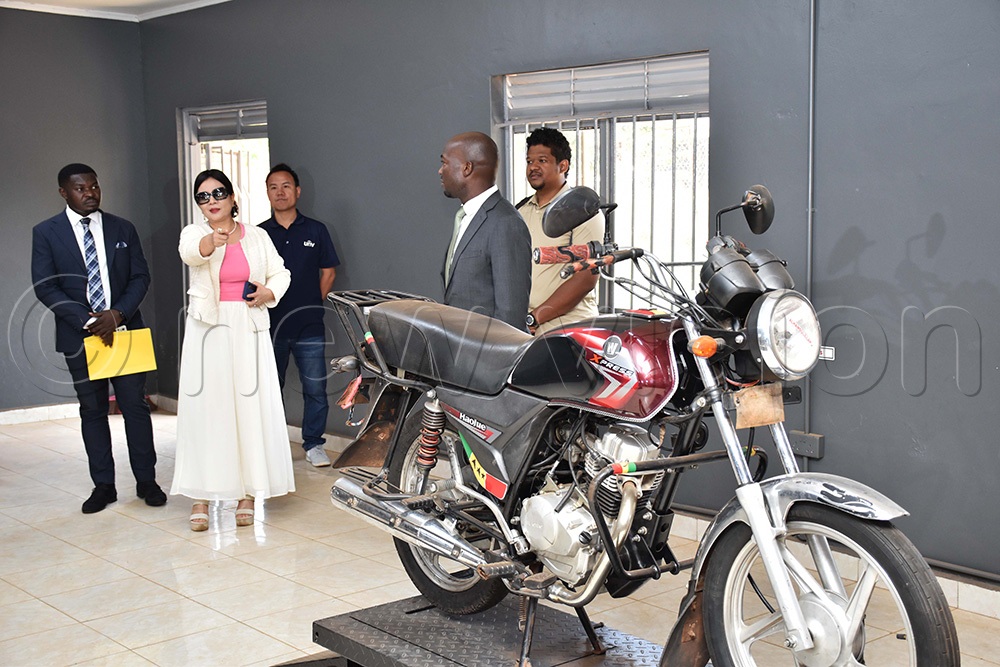
Wang Lihong, director of Luyanzi Institute of Technology (white), sharing a moment with Anthony Mula, the director general of Busoga Consortium (grey suit), as other officials look on. This was at Luyanzi Institute in Kiira (Photo by Simon Peter Tumwine)
Which proper channels can we go through to get these tax exemptions because these taxes are frustrating our teaching, Wang said.
She noted that under the new Uganda education system, students should acquire hands-on skills, adding that it would be difficult for them to develop such skills without equipment to practise with.
Anthony Mula, the director general of Busoga Consortium and an assistant to the Vice President of Uganda, commended the institute for partnering with people in Busoga whom it has educated and equipped with skills that have enabled them to earn a living.
He noted that Artificial Intelligence was the way to go as the world evolves, adding that there was still a need for further advancement in technology.
He noted that as young people gain skills in Artificial Intelligence, they will be able to adapt to emerging demands in the global job market.
He added that Artificial Intelligence would enable young people to go beyond their localities and provide solutions to emerging problems and demands around the world, making them more marketable and valuable.
Mula noted that it was important for schools to adopt Artificial Intelligence, adding that this would make young people with AI skills more marketable than those without such skills.
“There has been a question in the general public; that won't Artificial Intelligence replace human capabilities if introduced? Won't it destroy individual innovativeness? We need to emphasise to our youths that individual capabilities are very important because AI cannot do everything,” Mula said.
Mula noted that as Artificial Intelligence is introduced in schools, students should learn it with a purpose to improve their performance and catalyse creativity and leadership, among other skills. He added that there was still a need to orient young people and help them appreciate the transition.
Mula appealed to the director of Luyanzi to make the centre a hub for innovation, practical skills, entrepreneurship and industrial collaboration.