
Insurance promises, but accident victims say compensation never came
Kampala Mayor Eng. Ronald Balimwezo Nsubuga has called on insurance companies to ensure that accident victims receive compensation.
Kampala Mayor Eng. Ronald Balimwezo Nsubuga speaking during the event. (Photos by Jovita Mirembe)
________________
For Joshua Lubega, the consequences of a road accident extend far beyond the loss of his arm. The accident also ended his career as a taxi driver, leaving him without the livelihood he had relied on for years.
What makes his experience particularly frustrating, he says, is that he had consistently paid for third-party motor insurance throughout the decade he spent operating a taxi.
Lubega believed the policy would offer protection when an accident occurred. But when he was injured, he says, no compensation came.
“For the last 10 years I have been a taxi driver, I was paying promptly for the third-party insurance policy on my taxi, which I was told covers legal liability for accidental bodily injury or death with up to UGX 1 million per person per accident and UGX 10 million per insurance period, but when I got this accident I wasn’t compensated in any way.
“My family struggled to pay for my medical bills until I recovered and now I have one arm and can no longer drive a car, which has left me unemployed for some time because this is the job I had expertise in.”
His story raises questions about how effectively Uganda's Motor Third Party Insurance system serves people injured in road crashes, particularly those who depend on compensation to meet medical expenses.
Karim Jumba has a similar account.
He was crossing the road at the Nsambya traffic lights along Ggaba Road when a car struck him. Vehicles had stopped at the traffic lights, but as the lights turned green, Jumba found himself caught in the middle of the road, unable to move to safety before a speeding vehicle hit him.
“When I saw the lights had lit green, I had no option of going backwards or going forward, so I decided to stand in one place, thinking that the cars would dodge me, but it wasn’t possible.
“The fortunate bit about this is that the car which knocked me down was traced and taken to police. The police contacted my relatives, who sat in a meeting with the driver who knocked me, and he agreed to pay for my medical bills until I recovered through the third-party policy he had on his car.
“However, I wasn’t compensated under this policy in any way until I recovered. My parents and relatives paid my medical bills for the one year I spent in hospital,” Jumba said.
The experiences of Lubega and Jumba have brought renewed attention to the question of whether accident victims understand their rights under third-party insurance and whether the claims process is working as intended.
Kampala Mayor Eng. Ronald Balimwezo Nsubuga has called on insurance companies to ensure that accident victims receive compensation.
He said such payments could help bereaved families meet burial expenses when a crash results in death, while survivors could use the money to cover medical bills.
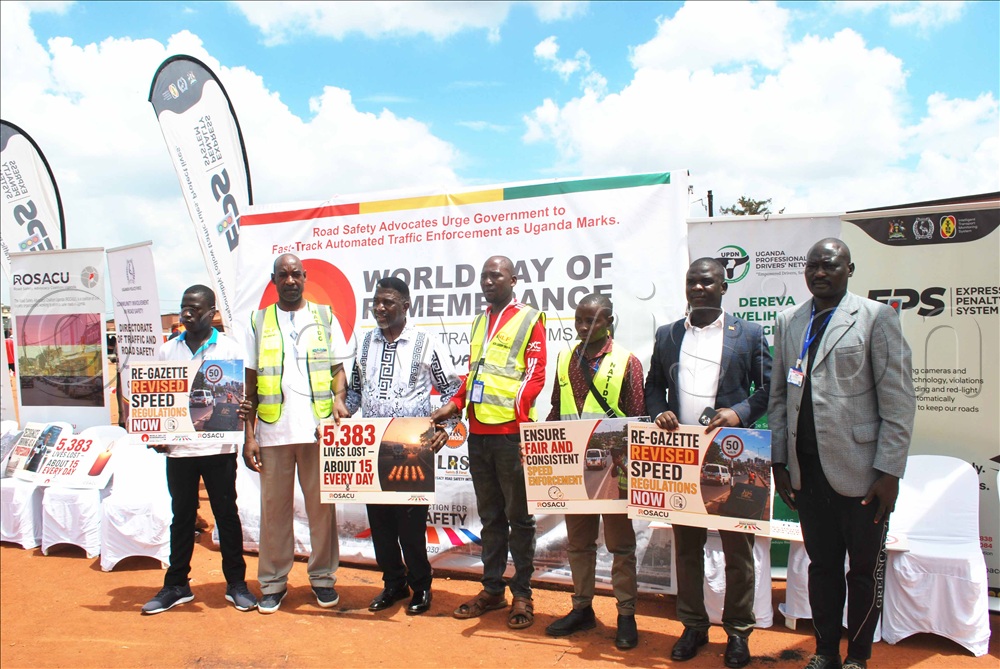
Balimwezo made the remarks during Uganda's national commemoration of the World Day of Remembrance for Road Traffic Victims, held at Bwaise Terminal on November 15.
Apollo Kashanku, the Assistant Commissioner for Road Transport Regulation and Safety at the Ministry of Works and Transport, said the ministry and drivers' associations had held consultations with officials from the Insurance Regulatory Authority (IRA) to discuss the operation of third-party insurance.
He said the consultations were intended to establish how the policy works in practice and whether changes were necessary.
“If it is discovered that it doesn’t work, it will be revised and replaced by a policy which works,” he said.
But the Insurance Regulatory Authority says the existence of an insurance policy does not automatically trigger compensation. Victims or their representatives must formally submit claims and provide the necessary documentation.
Mariam Nalunkuuma, the IRA's Manager of Corporate Affairs, said the Motor Third Party Insurance Policy is intended to compensate people who suffer bodily injuries or death arising from the use of a motor vehicle.
She said compensation depends on the submission, assessment and successful settlement of a claim.
“In the cases described, the fact that the families paid the medical bills does not necessarily mean that the injured persons were not entitled to compensation under the Motor Third Party Insurance cover. Please note that they may not have received compensation majorly because probably, a claim for compensation was not reported to the insurer responsible for the vehicle involved in the accident. Secondly, maybe the insurer did not receive any notification about the accident and therefore no documentation was shared or submitted,” Nalunkuuma said.
She explained that accident victims seeking compensation are expected to submit supporting documents, including a police report, medical reports, treatment records, proof of expenses and evidence of disability or permanent injury.
Without these documents, insurers may not be in a position to assess and process claims.
“You may also find that probably the claim may still be under assessment or may not have been formally lodged. Lastly, there may have been challenges of even identifying the insurer of the vehicle involved in the accident, especially if it was a hit-and-run accident.
“However, if a police report is secured, details of the insurer and the names of the affected persons (rightful beneficiaries) are all stated therein. Any person interested in securing the police report has to pay for it, and this is part of what the insurer further compensates,” Nalunkuuma said.
She advised affected persons or their representatives to establish whether a claim had been formally lodged with the insurer of the vehicle responsible for the accident and to seek an update on its status.
Where a claim has been submitted but no response has been received, or where the claimant is dissatisfied with how it has been handled, Nalunkuuma said victims could seek help from the Insurance Regulatory Authority's Complaints Bureau.
“If a claim was lodged and there has been no response or if they are dissatisfied with the handling of the claim, they may escalate the matter with Insurance Regulatory Authority’s Complaints Bureau. The Bureau helps in resolving any insurance-related dispute at no cost,” she said.
What accident victims need to know
Motor Third Party Insurance is designed to cover third parties who suffer bodily injuries or death as a result of an insured vehicle's use.
Under the law, compensation for an injured person with a genuine claim is limited to UGX 1 million per person, while the aggregate limit is UGX 10 million per insurance period, according to the limits cited in the policy explanation.
This means that people who suffer serious injuries, including the loss of a limb, may still pursue compensation through the established claims process if their claims have not already been settled.
However, the cover does not extend to the driver responsible for the accident under the current Motor Third Party Insurance framework.
The policy distinguishes between the parties involved in an insurance arrangement. The first party is the person who purchases the insurance policy, the second party is the insurance company providing the cover, and a third party is someone outside that insurance contract who suffers injury or death as a result of the use of the insured vehicle.
For people such as Lubega and Jumba, understanding these distinctions and navigating the claims process could determine whether they receive compensation after an accident.
But their experiences also raise a broader question: what happens when people who are supposed to benefit from compulsory insurance do not know how to claim, or do not receive the compensation they believe they are entitled to?