
Illegal, substandard nets threatening Lake Victoria fish stocks
Widespread use of substandard fishing nets is accelerating the depletion of fish stocks and threatening the long-term survival of the lake’s most valuable species. A 2020 fish stock assessment conducted by the Lake Victoria Fisheries Organisation revealed a dramatic decline in stocks, with Nile perch biomass falling from 1.44 million tonnes in 2006 to 0.55 million tonnes in 2008.
A heap of substandard fishing nets was surrendered by fishermen to be burnt as one way of saving fish stocks in Lake Victoria. The gear is being smuggled using porous borders. (Photo by Samuel Nkuba)
_______________
KALANGALA
While the Government, especially through the recently disbanded Fisheries Protection Unit, has fought against poor fishing methods, including the use of substandard nets, the vice persists on all water bodies in Uganda, including Lake Victoria.
Widespread use of substandard fishing nets is accelerating the depletion of fish stocks and threatening the long-term survival of the lake’s most valuable species. A 2020 fish stock assessment conducted by the Lake Victoria Fisheries Organisation revealed a dramatic decline in stocks, with Nile perch biomass falling from 1.44 million tonnes in 2006 to 0.55 million tonnes in 2008.
Even more concerning, breeding stock accounted for just 5.9 per cent, a development experts say raises serious sustainability concerns.
Tilapia catch rates have also halved, dropping from 1.36 kilogrammes per hour to 0.65 kilogrammes per hour, an indicator of declining lake productivity.
Lake Victoria with a surface area of 68,800 sqkm is the world’s second largest freshwater body and it supports one of the world’s most productive inland fisheries, with the estimated total fish landings from the lake for the period of 2011 to 2014 about one million tonnes with a beach value increasing from about $550 million in 2011 to about $840 million in 2014.
The lake supports over 220,000 fishers (Frame Survey 2016). However, Kalangala district fisheries officer Adrian Kavuma says the widespread use of illegal and substandard fishing gear has significantly contributed to the dwindling fish stocks. This threatens livelihoods in the long run.
“For example, the beach seine net, locally known as kokota, catches immature tilapia and Nile Perch. We end up having fewer mature fish that would otherwise reproduce and increase stocks,” says Adrian.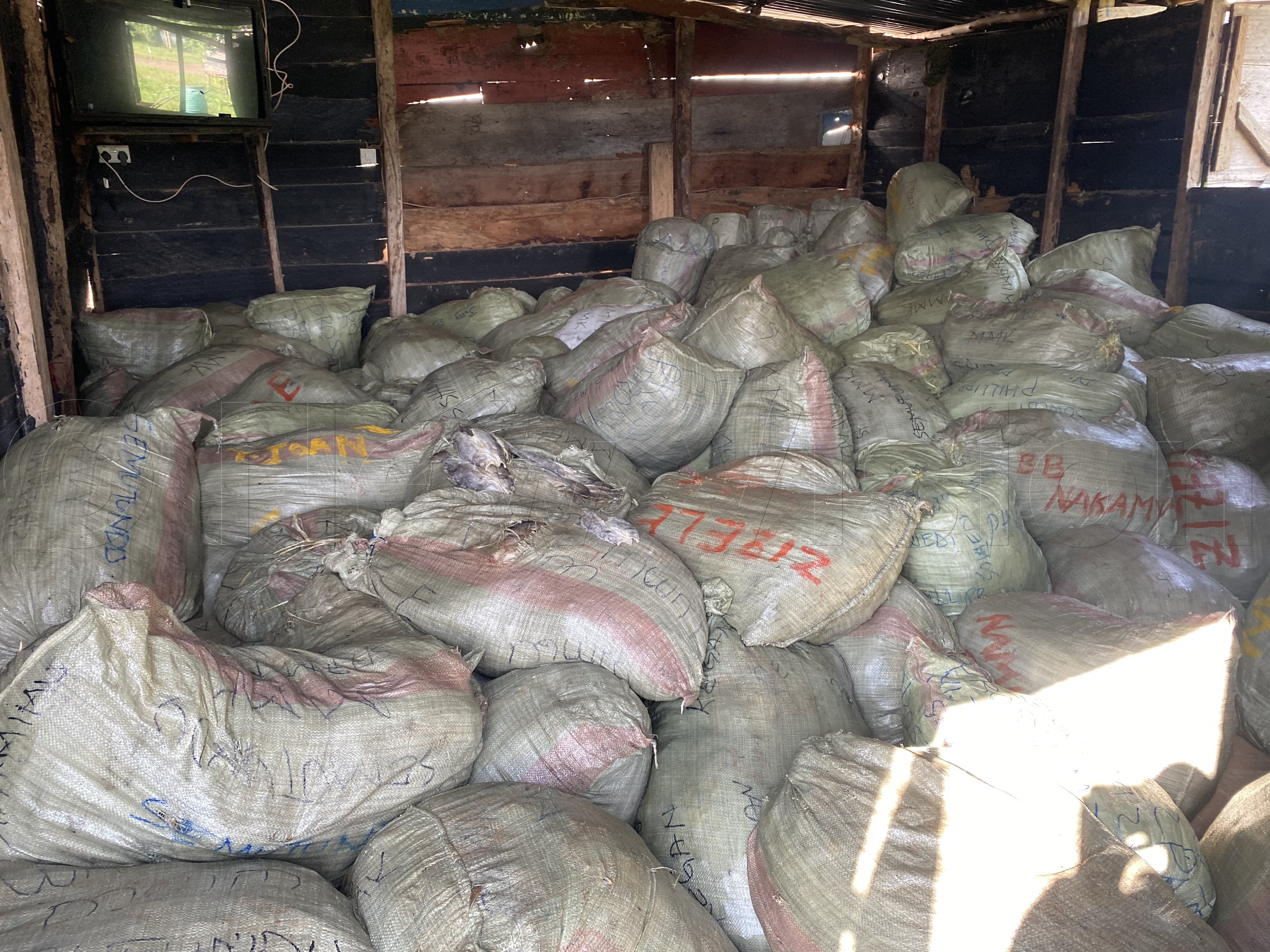
Over 9 tonnes of immature salted fish being transported from the Ssese Islands were impounded by security officials. These are caught on daily basis using substandard gear. (Photo by Samuel Nkuba)
Kavuma explains that a Nile perch weighing about two kilogrammes can produce over two million eggs. However, only between 4,000 and 8,000 of those eggs typically survive into fingerlings.
“If fishermen use beach seine nets that can catch more than 200 immature fish in a single haul, and they fish day and night, the entire surviving population from spawning could be wiped out within one or two days,” he said.
Records also indicate that a Nile perch measuring 20 inches is the recommended minimum size for harvesting, since it would likely have spawned two to three times before its first capture if left undisturbed.
Other illegal gear cited by fisheries authorities includes monofilament nets, trawling nets, cast nets, hooks smaller than size 10, and gill nets with undersized mesh.
Kavuma estimates that substandard gear used by silverfish fishermen alone results in the capture of up to 250 million immature fish daily, accelerating the decline of Nile Perch populations.
“The worst part is that some of these nets are sewn locally by fishermen who operate secretly, making enforcement difficult,” he adds.
Investigations reveal that most of the illegal nets are not only sold on the black market but are also affordable to low-income fishermen. Many are handmade, making them easily accessible to those targeting juvenile tilapia below five inches and Nile perch under seven inches.
Why turn to immature fish?
Alex, a route manager involved in cross-border trade in immature fish, says fishermen turned to illegal nets after fish became scarce.
“Initially, we used standard nets, but as fish stocks declined, we resorted to illegal ones. I supply immature fish to markets across borders and in return distribute illegal nets to fishermen in Kalangala,” he said.
Alex adds that immature fish is often salted and sun-dried before being exported to border-to-border markets, particularly in the Democratic Republic of the Congo, where demand remains high.
Salted fish, commonly referred to as makayabu, is a staple food in several central African countries. The trade does not discriminate based on fish size, fuelling illegal fishing practices across Uganda and neighbouring lakes.
“Sometimes we are not concerned about the destruction of the lake as long as we earn money through whatever fishing method one can afford,” Mukasa admitted.
Officials from the Uganda National Bureau of Standards (UNBS) say smugglers exploit porous lake borders and routes through Kenya, Tanzania, and the Democratic Republic of the Congo to bring substandard nets into the country.
Daniel Arwora, manager for market surveillance at UNBS, says Uganda has clear minimum standards for fishing gear, but enforcement remains a challenge.
“Some traders claim they paid taxes on these nets, yet neither the Uganda Revenue Authority nor UNBS would allow such illegal gear to be imported,” he said.
Kalangala Resident District Commissioner Fred Badda says authorities have intensified enforcement operations targeting illegal nets.
“Operations began on March 7, 2026, and we are seeing fishermen voluntarily surrendering substandard nets while some route managers are quitting the illicit trade,” he said.
Badda added that at least 25 fishermen have been arrested and more than 10 tonnes of fish impounded during the crackdown.
However, he noted that the lucrative market for immature fish continues to attract new entrants into the illegal business.
“We have information that a kilogram of immature fish can fetch up to sh20,000, while transporters earn about sh8,000 per kilogram delivered to the market. Such profits make it difficult for some people to abandon the trade,” he said.
Fisheries experts warn that unless illegal gear is eliminated and sustainable fishing practices adopted, the ecological and economic future of Lake Victoria’s fisheries could remain at risk.