
Hundreds join Tumwebaze to celebrate 14 years in Cabinet
Tumwebaze said the event was to thank God for life, family, and the grace to serve the country for 14 uninterrupted years in cabinet.
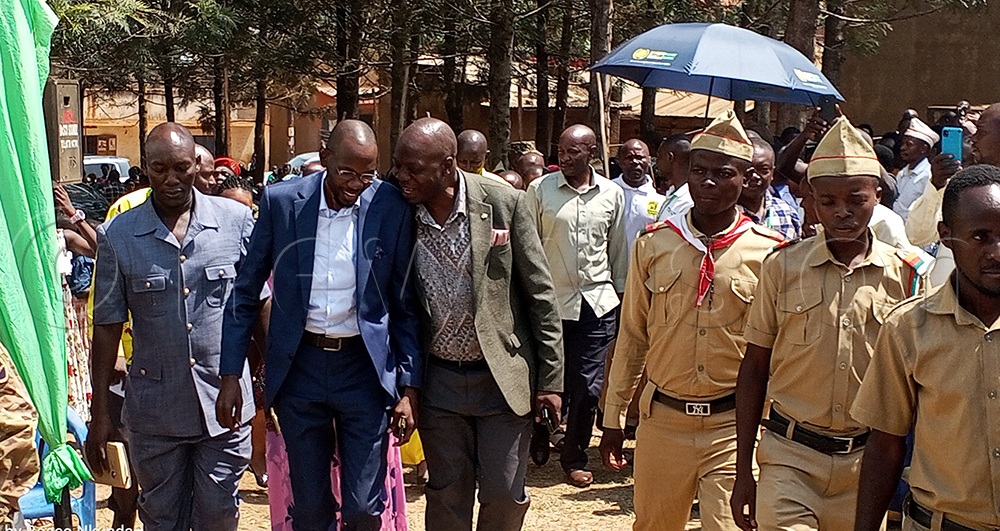
Hon. Frank Tumwebaze, the Minister of Agriculture, Animal Industry and Fisheries arrived to a jubilant reception by church leaders, local officials and hundreds of faithful from Kamwenge and neighbouring districts. (Photos by Hillary Abinsinguza)
________________
St. Peter’s Biguli Catholic Parish turned into a sea of worshippers and political leaders today as Hon. Frank Tumwebaze, Minister of Agriculture, Animal Industry and Fisheries, hosted a thanksgiving Mass to mark 14 years of service as a minister in the Government of Uganda.
Minister Tumwebaze arrived to a jubilant reception by church leaders, local officials and hundreds of faithful from Kamwenge and neighbouring districts.
He was flanked by senior government officials, including Rtd. Lt. Col. Bright Rwamirama Kanyontore, Minister of State for Animal Industry, Hon. Robert Miggade, Minister of State for Fisheries, and Hon. Jackson Karugaba Kafuuzi, Deputy Attorney General.
The presence of the top leadership of MAAIF together underscored government’s continued commitment to transforming the agriculture sector.
A decade and more of Public Service
The thanksgiving was held to give glory to God for Minister Tumwebaze’s life, family, and over a decade of service in different cabinet dockets. Since joining government, Hon. Tumwebaze has served in the ministries of ICT, the Presidency, and currently Agriculture.
Inside the packed church, choirs from different parishes led praise and worship as political and religious leaders took their seats. Prayers focused on unity, national development, and the welfare of farmers across Uganda.
Reason for thanksgiving
Tumwebaze said the event was to thank God for life, family, and the grace to serve the country for 14 uninterrupted years in cabinet. He revealed that God had protected him through different dockets and given him the opportunity to contribute to national development.
He also thanked the people of Kamwenge and Kibale for their support and trust over the years. The minister said the gathering was a moment of reflection, gratitude, and rededication to public service.
Work plan manifesto for his term at MAAIF
Turning to his current docket, Hon. Tumwebaze used the pulpit to present what he termed his work plan manifesto for the agriculture sector.
He said his focus for this term will be on five key pillars: increasing agricultural productivity through irrigation and mechanisation, expanding value addition and agro-processing, improving access to markets for farmers, strengthening disease and pest control, and promoting commercialisation of farming among the youth and women.
Leaders hail his service
Speaking during the service, Minister of State for Animal Industry, Rtd. Lt. Col. Bright Rwamirama, congratulated his senior minister for the milestone and for providing steady leadership in the agriculture sector.
“We are here to thank God for life and for the opportunity to serve. Minister Tumwebaze’s leadership at MAAIF has brought focus on commercial farming, food security, and farmer incomes,” Rwamirama said.
Deputy Attorney General Jackson Kafuuzi hailed the minister for humility and commitment to service, while Minister of State for Fisheries Robert Miggade praised the teamwork within MAAIF that is driving programs like irrigation, restocking, and value addition.
Local leaders and residents also thanked the minister for his support to Kamwenge District in education, health and agriculture interventions.
Community turns up in big numbers
St. Peter’s Biguli, one of the oldest Catholic parishes in Tooro sub-region, was filled to capacity. Clergy led the mass with calls for leaders to remain God-fearing and to serve with integrity.
After mass, guests were hosted to a reception at the parish grounds where cultural performances and speeches continued into the afternoon. Security was tight as more well-wishers arrived to celebrate with the minister.
District leaders said the thanksgiving was not only a celebration of one man’s journey, but also a moment for the community to reflect on God’s blessings and the role of leadership in development.