
How Rotary is changing life at Jjanyi Primary School
For years, learners have walked about a kilometre to a community well to collect water for school activities, while some carry drinking water from home. The situation has affected learning, with pupils spending valuable time away from classrooms in search of a basic necessity.
A water tank that was donated to Jjanyi Primary School in Kajjansi by Rotary clubs and partners. (Courtesy photo)
__________________
Every morning, before some pupils at Jjanyi Primary School in Kajjansi settle into lessons, they face the challenge of finding water, a routine that has become part of their school day.
For years, learners have walked about a kilometre to a community well to collect water for school activities, while some carry drinking water from home.
The situation has affected learning, with pupils spending valuable time away from classrooms in search of a basic necessity.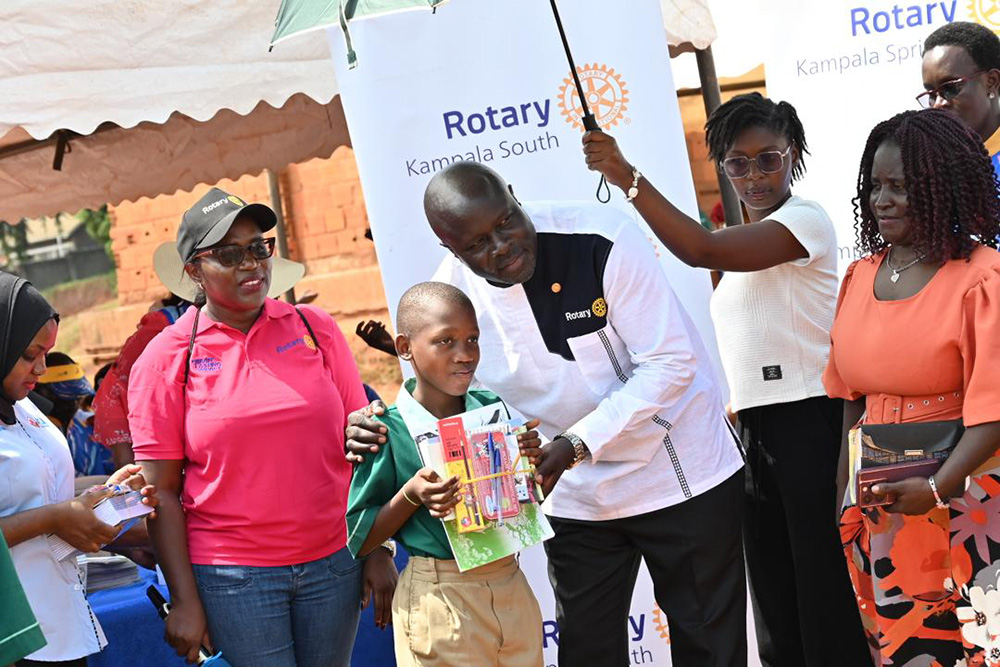
On July 25, 2026, Rotary clubs and partners brought a package of interventions to the school targeting some of the challenges affecting learners. (Courtesy photo)
At times, some learners have had to drink water from the same source teachers warn may expose them to illness because the school has had limited alternatives.
Christine Amongin, the school head teacher, said they have not had a reliable water supply because the small tank they have cannot sustain all the pupils.
Now, for the school community, a new chapter could be beginning.
On July 25, 2026, Rotary clubs and partners brought a package of interventions to the school targeting some of the challenges affecting learners, including access to water, reading materials, health education and child welfare.
The activities were part of the Rotary Mega Project held under the theme “Health. Community. Hope. Serving Together, Transforming Lives.”
The initiative was led by the Rotary Club of Kampala South in partnership with the Rotary Club of Kajjansi, other Rotary and Rotaract clubs, corporate partners and community leaders.
Beyond the medical camp, which attracted more than 800 residents from Kajjansi and surrounding areas, Rotary members focused on improving the learning environment at the school through literacy programmes, scholastic support, first-aid training, road safety awareness, emergency response education and menstrual hygiene training.
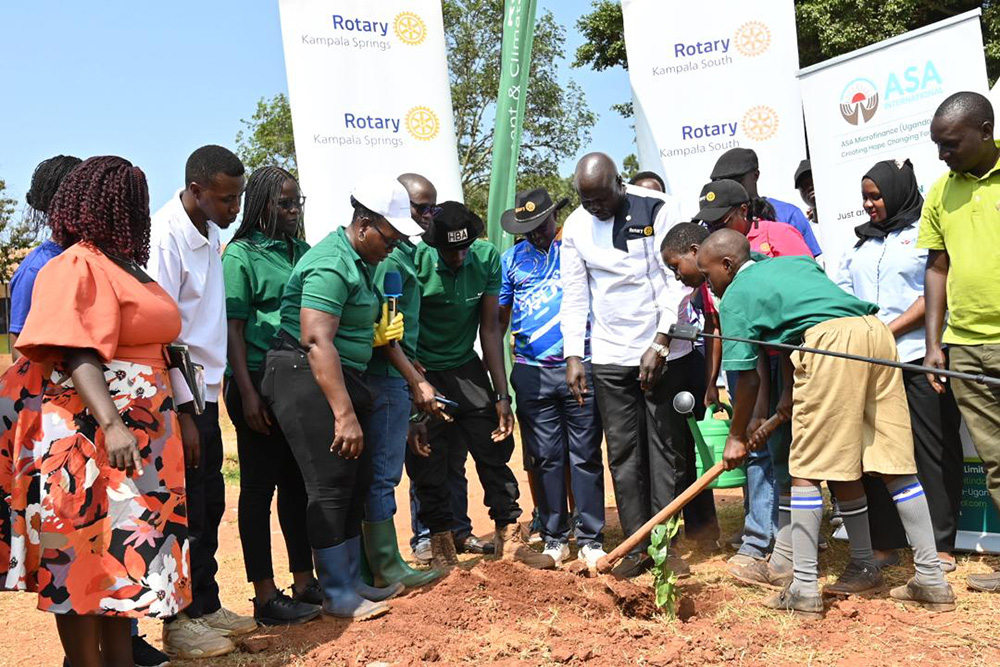
Environmental Conservation: Rotary leaders together with Jjanyi Primary School pupils plant a tree. (Courtesy photo)
District Governor Gerald Obai, who was the chief guest, said the initiative demonstrated the importance of partnerships in addressing community challenges.
"One of the key things Rotary focuses on is disease prevention and treatment. There are people who cannot afford even the simplest of services, and we come in to bridge that gap," he said.
School facing multiple challenges
The school, which has more than 300 pupils, also lacks a perimeter fence, a main hall and adequate teacher accommodation.
Although the government constructed a teachers' house, she said it accommodates only four teachers, leaving many staff members without housing support.
“We have a challenge of a water source, and the school is also open because we need a fence.”
The head teacher added that Rotary had committed to a 10-point programme aimed at supporting the school and addressing some of these long-standing needs.
She believes the water intervention, in particular, will have a direct impact on learning.
“It will help us greatly because children will no longer have to struggle to look for water, which will reduce the burden on pupils and teachers,” she said.
What pupils say
For Primary Five pupil Alosyous Sserwaniko, the planned water support means more time for academics.
“I have been carrying drinking water from home, but we also go to the well to collect water for school activities like cleaning and sometimes drinking,” he said.
Sserwaniko explained that teachers have often warned learners about the safety of the water, but they have had few options.
“After receiving the water tank, we shall focus more on our studies instead of fetching water from the well, which is far from the school.”
For some, the challenge has not only been water but also access to learning materials.
Primary Six pupil Robert Ariho said the scholastic materials provided by Rotary would support learners who struggle to get books and other classroom necessities.
“The materials we have received will help us in our studies because some of us have not had enough books to use,” he said.
Rotary also focused on improving health knowledge among pupils.
Primary Seven pupil Dorcas Nakimuli said girls were taught how to manage menstrual hygiene and were provided with sanitary pads.
“Some girls did not know how to use them before, and they were suffering from diseases because of poor hygiene.”
The intervention, she added, helped girls understand how to take care of themselves while remaining confident at school.
Long-term commitment
President of the Rotary Club of Kajjansi, Mary Nagganda Kasirye, said the support followed a community assessment that identified education, health and water as some of the biggest needs.
She said the Rotary Club of Kajjansi has maintained an immunisation centre in the area for 25 years, supporting child immunisation programmes every second week of the month.
“We realised there are many young mothers who need support to understand family planning and how to take care of their children.”
“After assessing the community, we found there was a lot of need, and that is why we organised this mega camp.”
Kasirye said the education support was designed after identifying literacy challenges among pupils.
“We noted that the school had challenges with reading and they did not have enough books. That is why we are supporting them with books and teaching them how to use library resources.”
The club donated 500 books as the first phase of a literacy programme expected to continue.
Francesca Kakooza, president of the Rotary Club of Kampala South, said the project was part of the Rotary South Family approach, where different Rotary and Rotaract clubs come together to respond to community needs.
She said Kampala South had supported Jjanyi in the past, including constructing classrooms and planting trees more than 20 years ago, but returned after a fresh assessment showed that several challenges remained.
“This is not just a one-day activity. Today is a launchpad where we meet the community, understand their needs and then return to implement longer-term interventions,” Kakooza said.
The project brought together Rotary clubs including Kajjansi, Kyambogo, Kampala Maisha, Mengo Pioneers, Kampala Springs, Upper Kololo, Kampala First Aid and Emergency Response, Uptown Kampala, Environment and Climate Action and Buwaate, alongside Rotaract clubs and partners including ASA Microfinance and PKF Uganda.
Alongside the school activities, residents from the surrounding communities accessed free healthcare services during the Rotary medical camp.
More than 800 people received medical support, including screening, treatment, eye care, HIV testing, maternal health services, family planning and referrals, while more than 100 children were immunised against preventable diseases.