
Govt to roll out child disability assistance programme in 27 districts
“The national child disability assistance programme starts this year in 27 local governments in different regions of the country and children with albinism will be beneficiaries,” Nampeera told participants.
Agnes Nampeera Bulega (seated third left), the principal rehabilitation officer at the Gender Ministry, assistant commissioner community health and rehabilitation Dr Moses Muwanga (seated right), the executive director of Albinism Umbrella, Olive Namutebi (seated third right), pose for a group photo with participants during the meeting on national action plan for persons with Albinism at Hotel Africana in Kampala on Tuesday July 21, 2026. (Photo by Francis Emorut)
________________
The government is planning to roll out the National Child Disability Assistance Programme during the 2026/2027 financial year in 27 local governments across the country as a pilot project targeting children with disabilities.
The revelation was made by the Principal Rehabilitation Officer at the Ministry of Gender, Labour and Social Development, Agnes Nampeera Bulega, who emphasised that children with albinism will also benefit from the programme.
“The national child disability assistance programme starts this year in 27 local governments in different regions of the country and children with albinism will be beneficiaries,” Nampeera told participants.
According to Nampeera, the 27 local governments, comprising districts, municipalities and cities, will serve as the pilot before the programme is rolled out to all local governments across the country. She did not name the districts.
Nampeera made the remarks during a meeting of ministries, departments and agencies, together with national organisations of persons with disabilities, at Hotel Africana in Kampala on July 21, 2026
The meeting aimed to assess the progress made by the government in implementing the National Action Plan for Persons with Albinism 2020-2025.
The meeting attracted participants from the National Union of Disabled Persons of Uganda (NUDIPU), the National Union of Women with Disabilities of Uganda (NUWODU), UNFPA, Christian Blind Mission and various organisations representing persons with albinism.
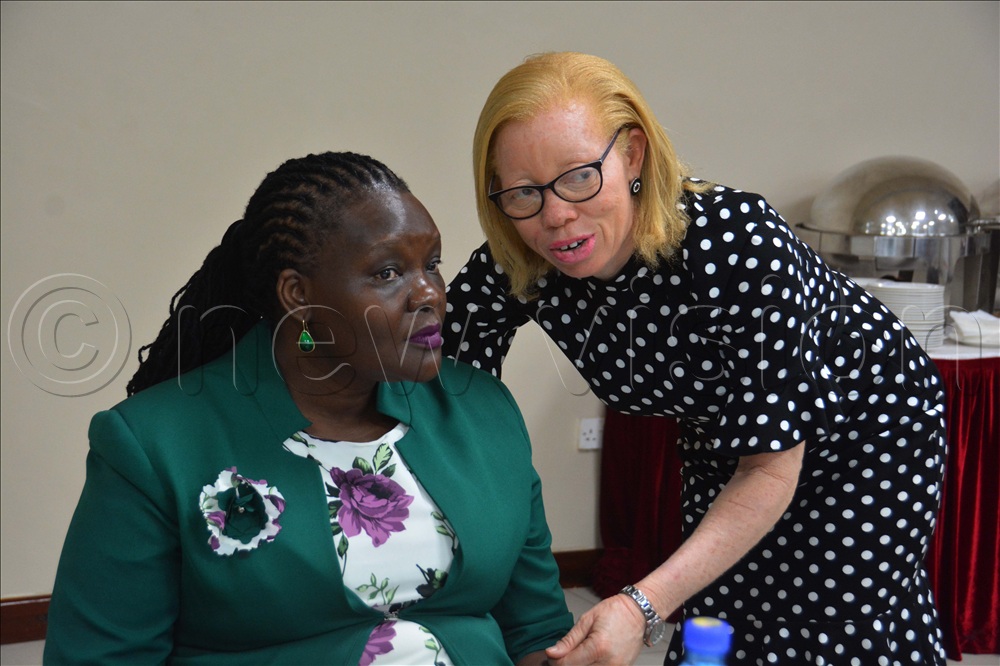
The executive director of Albinism Umbrella, Olive Namutebi (right), interacts with Agnes Nampeera Bulega, the principal rehabilitation officer at the Gender Ministry, during a meeting on the national action plan for persons with Albinism at Hotel Africana in Kampala on Tuesday, July 21, 2026.
The move to provide child disability assistance comes after persons with disabilities repeatedly called on the government through various forums to introduce special grants to improve the livelihoods of children with disabilities.
Nampeera informed participants that the government has made significant strides in implementing the National Action Plan for Persons with Albinism, saying 25 groups of persons with albinism have benefited from the Uganda Women Entrepreneurship Programme (UWEP).
She added that although implementation was delayed by the COVID-19 pandemic, the government ensured that persons with albinism were economically empowered and that service delivery was more purposeful.
Nampeera also revealed that the government plans to provide assistive devices to persons with disabilities across the country within the available resources.
She was supported by Dr Moses Muwanga, assistant commissioner for community health, disability and rehabilitation at the Ministry of Health, who said the supply chain for essential medicines required by persons with albinism, such as sunscreen, is critical and would be strengthened.
He asked persons with albinism to provide a list of essential medicines for consideration by the Ministry of Health. The list would then be submitted to the National Medical Stores, from where health facilities would place their orders.
“The Ministry of Health recognises the rights of persons with albinism and will provide access to health services, such as reproductive health, clinical, family planning without discrimination,” Dr Muwanga said.
The executive director of Albinism Umbrella, Olive Namutebi, highlighted the strategic objectives of the 2026-2031 National Action Plan for Persons with Albinism. These include strengthening public awareness, promoting social inclusion and positive attitudes towards persons with albinism, institutionalising equitable access to albinism-responsive health services, including sunscreen, dermatology, eye care, protective wear, counselling and early cancer detection, and improving access, retention, safety and learning outcomes for learners with albinism at all levels of education.
Other objectives include expanding access to decent work, livelihoods, entrepreneurship, social protection and economic empowerment for people with albinism, strengthening protection, justice and accountability mechanisms against discrimination, violence, abuse and harmful practices, addressing the specific needs of children, women, girls, refugees and other vulnerable groups with albinism, and strengthening national and district coordination, financing, data systems, monitoring, evaluation and learning for albinism inclusion.
The pogrammes manager at NUDIPU, David Nangosi, appealed to stakeholders to work together in unity to realise the National Action Plan for Persons with Albinism.
He proposed quarterly meetings to review the implementation of the national action plan.
Martin Lubwama, a manpower capacity consultant, outlined strategic pillars and interventions, including skin protection, eye care, psychosocial support, awareness creation, inclusive education, decent accommodation, economic empowerment, data collection, research, coordination, financing and institutional accountability.