
Govt pledges low-cost bone marrow transplants after historic first success
Beyond health, officials said the development carries economic significance. By reducing outbound medical travel, Uganda could retain millions of dollars previously spent abroad, while positioning itself as a regional hub for advanced cancer care.
The first bone marrow transplant patient, Stephen Sande (C), accompanied by Dr. Clement Okello and Sr. Hanifah Nabbanja, received warm discharge from the hospital after a successful bone marrow transplant. This was at Uganda Cancer Institute in Mulago. (Credit: Maria Wamala)
KAMPALA - The government has pledged to make bone marrow transplants more affordable following Uganda’s first successful procedure, a breakthrough that is already reshaping expectations around cancer care and access to life-saving treatment.
The commitment comes as the Uganda Cancer Institute discharged its first patient to undergo an autologous stem cell transplant, marking a major milestone in the country’s medical landscape.
For years, patients in need of the complex procedure were forced to travel abroad, mainly to India, at costs ranging between $30,000 (sh112 million) and $50,000 (sh186 million), excluding travel and accommodation.
Now, officials say that reality is set to change. Uganda’s first transplant cost about $15,000 (sh55 million), a figure health minister Jane Ruth Aceng said the government intends to maintain as services expand.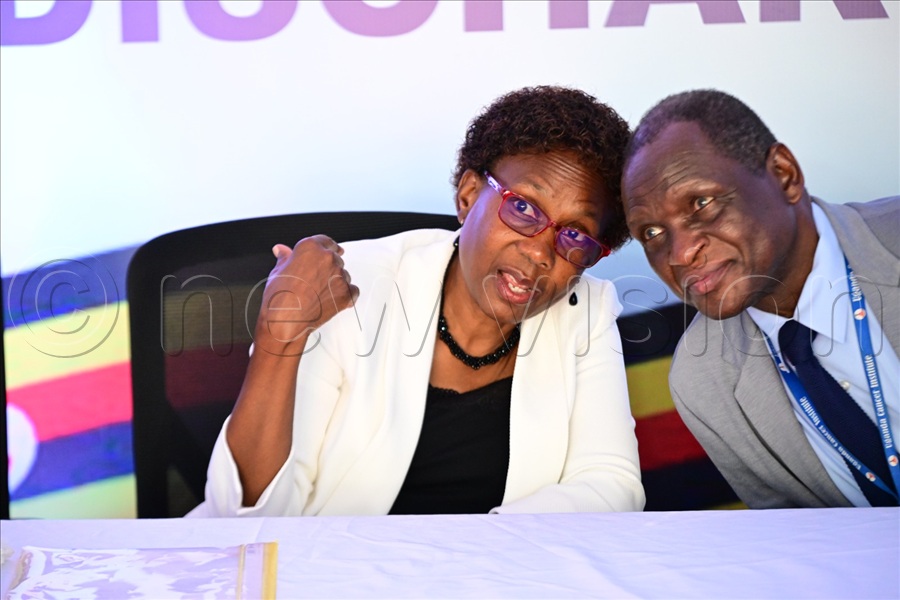
Health minister Jane Ruth Aceng interacts with Uganda Cancer Institute ED Dr. Jackson Orem. (All Photos by Maria Wamala)
“This marks the beginning of a new era in Ugandan medicine,” she said while officiating the patient’s discharge.
“For a long time, I have been signing documents to send patients abroad. If you reduce that burden, I feel proud. The first five or ten cases will be free courtesy of government, and after that, Ugandans will pay about $15,000, far less than what is spent overseas.”
The government’s focus, she noted, is now shifting towards ensuring more Ugandans can access the procedure locally at a fraction of previous costs.
Early estimates from clinicians suggest the cost could be reduced further as systems and infrastructure improve. Compared to the prohibitive costs abroad, this could open access to many patients who previously had no realistic chance of receiving treatment.
“This is not just a clinical success. It is an infrastructure and systems achievement,” said Clement Okello, who led the transplant team. “Once you build capacity, the cost begins to come down.”
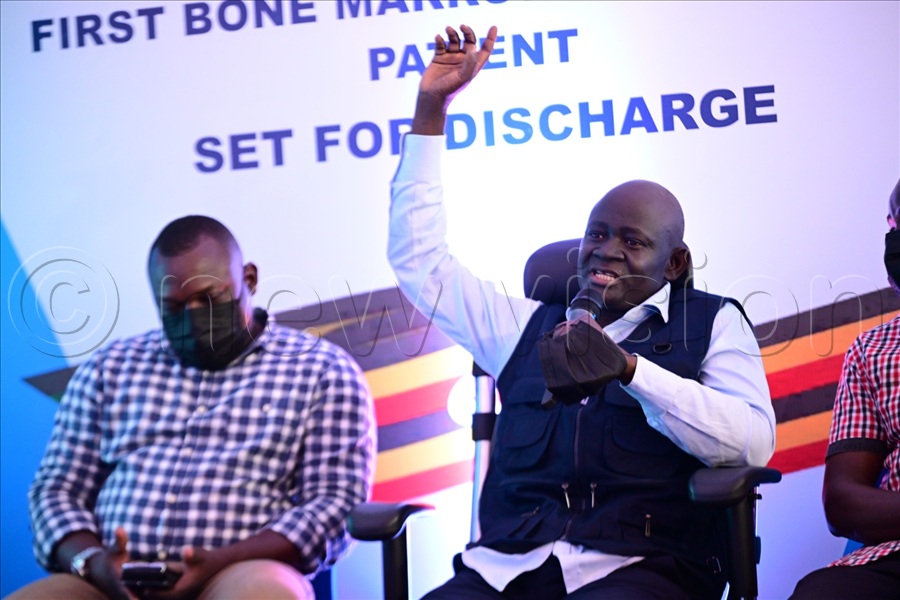
The first bone marrow transplant patient Stephen Sande accompanied by his caretakers Wilson Sande and Andrew Ayazika makes his remarks during discharge at Uganda Cancer Institute.
The procedure, known as autologous stem cell transplantation, is the global standard of care for eligible patients with multiple myeloma, a cancer that affects plasma cells.
It involves harvesting a patient’s own stem cells, administering high-dose chemotherapy to destroy cancer cells, and reinfusing the healthy cells to rebuild the bone marrow.
While the science is complex, the implication is clear that Uganda now has the capacity to treat a category of cancer that previously required referral abroad.
According to Dr Okello, preparations for the transplant began as early as 2017 after his return from specialised training abroad. Early efforts slowed when partnerships collapsed, but momentum picked up with government support.
The real breakthrough came in July 2023 when he was appointed to lead the programme, triggering intensified training, system development and team formation.
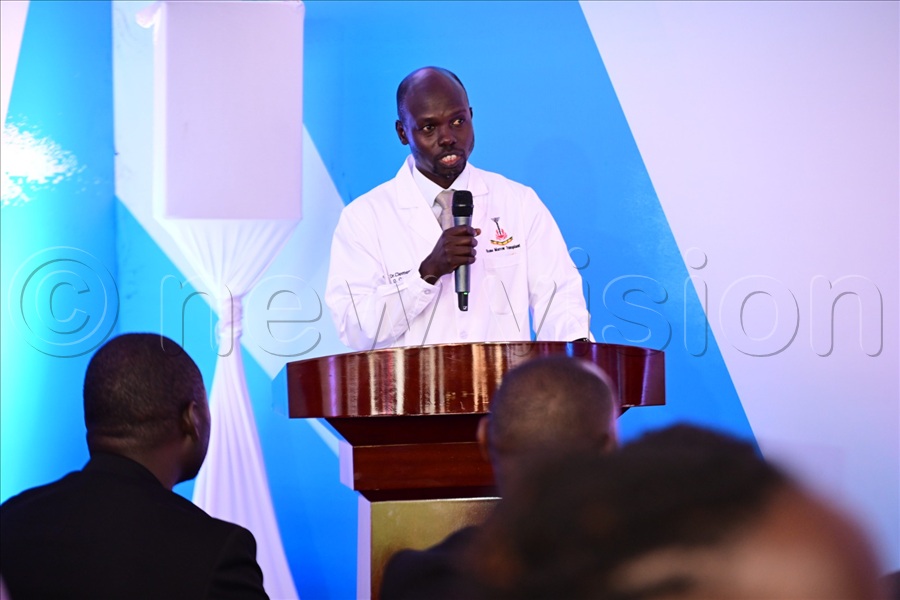
Dr. Clement Okello, a consultant hematologist and clinical researcher at the Uganda Cancer Institute remarks.
The first patient, Sande Stephen, a Uganda Revenue Authority staff member from Namayingo, was diagnosed with multiple myeloma in 2025.
Doctors said he was an ideal candidate, having responded well to initial treatment and presenting no major complications. After undergoing the transplant earlier this month, he spent 22 days in a controlled environment before being discharged in stable condition.
His treatment has been fully paid for by the government.
“This is exactly what we envisioned,” said Jackson Orem, Executive Director of UCI. “It proves that Ugandans can deliver advanced, specialised treatment locally.”
However, challenges remain. The transplant programme currently operates with a single-bed capacity, meaning only one patient can be treated at a time. Scaling up will require additional infrastructure, more trained personnel and sustained funding.
“There is demand, but we must expand carefully,” Dr Okello said. “This is a highly specialised service that requires precision.”
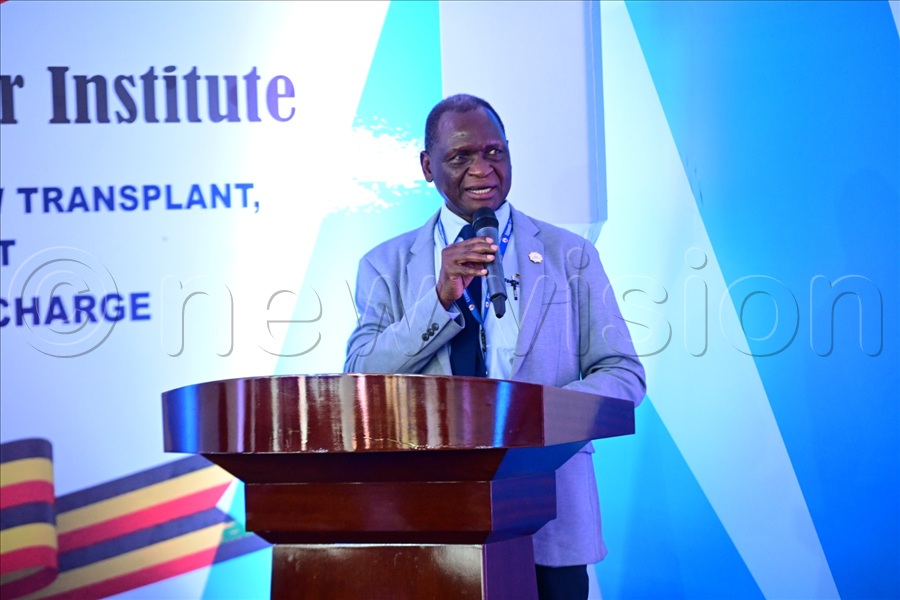
Uganda Cancer Institute ED Dr. Jackson Orem
Dr Henry Ddungu, head of the department, said plans are underway to establish a fully fledged transplant unit and train more specialists, with future expansion expected to include patients with conditions such as sickle cell disease.
Dr Okello added that about two to three in every ten cancer patients suffer from blood cancers that could benefit from such procedures.
However, given that each transplant takes about a month, the institute may only manage around five procedures this year, depending on funding and infrastructure readiness.
Beyond health, officials said the development carries economic significance. By reducing outbound medical travel, Uganda could retain millions of dollars previously spent abroad, while positioning itself as a regional hub for advanced cancer care.
“When this patient goes home, he carries the hope of the nation,” Dr Aceng said. “He shows that our doctors are capable and that our systems can work.”
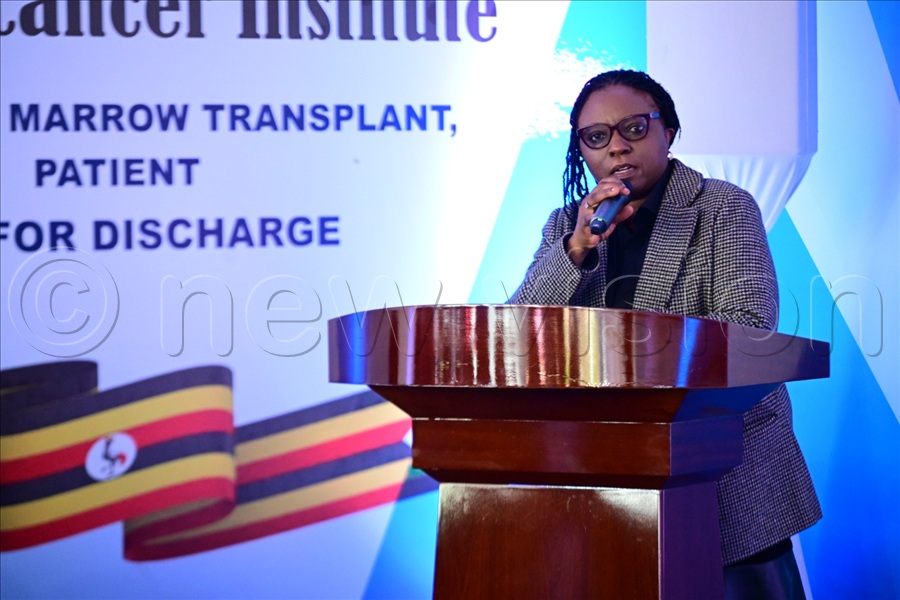
Uganda Cancer Institute Board Chairperson Prof. Damalie Nakanjako
Sande will continue to be monitored and will undergo re-vaccination, as the transplant effectively resets the immune system.
A bone marrow transplant is a highly specialised treatment used for certain cancers and blood disorders.
Bone marrow is the soft tissue inside bones that produces blood cells, including red blood cells, white blood cells and platelets. In diseases like multiple myeloma, this system breaks down, making transplantation one of the few effective treatment options.
The milestone comes at a time when Uganda is facing a growing cancer burden. In 2025, the country recorded an estimated 35,968 new cancer cases and more than 20,000 deaths annually, many linked to late diagnosis and limited access to treatment.
Cervical, breast and prostate cancers remain the most common, with nearly 80 percent of patients dying within the first year of diagnosis.