
Ggoobi backs local governments’ drive to turn public assets into revenue
“I am impressed that local governments can come up with these projects. They look well informed and have potential to generate revenue for local governments,” Ggoobi said.
MoFPED permanent secretary and Secretary to the Treasury (PSST) Ramathan Ggoobi said the ministry would seek funding for feasibility studies to help local government projects reach the bankability stage and attract private investment. (Courtesy Photo)
The Ministry of Finance, Planning and Economic Development (MoFPED) has pledged to support local governments in developing projects under the Public-Private Partnership (PPP) framework, saying the proposed investments could generate revenue, create jobs and improve service delivery.
MoFPED permanent secretary and Secretary to the Treasury (PSST) Ramathan Ggoobi said the ministry would seek funding for feasibility studies to help local government projects reach the bankability stage and attract private investment.
Ggoobi made the remarks on September 19, 2026, during the 43rd PPP Committee meeting at the finance ministry headquarters, where local governments presented conceptualised projects in education, waste management, markets, commercial facilities, sports infrastructure and staff accommodation.
“I am impressed that local governments can come up with these projects. They look well informed and have potential to generate revenue for local governments,” Ggoobi said.
He committed to ensuring that MoFPED secures funding for feasibility studies to support project development to the bankability stage and final delivery.
“These are good projects that fit into our overall tenfold growth strategy and the National Development Plan,” Ggoobi said.
Bushenyi moves to commercialise public assets
Bushenyi district is among the local governments seeking to transform public assets into income-generating ventures under the Local Economic Development (LED) programme and the PPP framework.
The move follows a stakeholders' meeting held at the district headquarters on May 31, 2025, where stakeholders resolved to have identified public assets developed into economic ventures under the PPP framework as part of the LED programme.
The district has identified several public assets it wants to develop into commercial and recreational facilities to generate revenue, create employment and support service delivery.
The process began with district leaders and stakeholders considering how the identified assets could be turned into PPP projects under the LED programme.
During the stakeholders' engagement meeting at the district headquarters on May 31, 2025, the district discussed the proposed investments and resolved to develop the assets into economic ventures.
Other proposals include turning the district multipurpose hall into a recreational centre, developing the district parking yard into a shopping mall, commercialising Ruhandagazi fish farm into a fish fry centre, and developing Nshumi PDA land in Kyamuhunga into a market.
Speaking during Saturday's PPP Committee meeting, Bushenyi Chief Administrative Officer (CAO) Sanyu Phionah said the programme would enable the district to generate additional revenue from its public assets while creating employment and improving service delivery.
She said the district was looking at ways of making its assets economically productive instead of leaving them underutilised.
“The main objective is to ensure that these assets can generate revenue for the district. This will help us to improve service delivery and also create opportunities for our people,” Sanyu said.
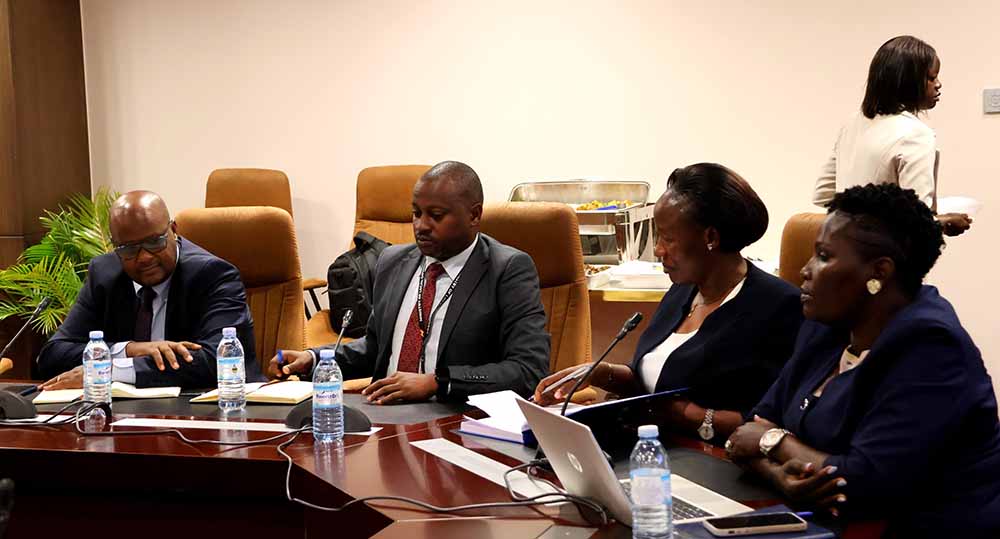
Bushenyi district officials during the meeting at the finance ministry offices. (Courtesy Photo)
She said the district was preparing the necessary documents for submission to the relevant ministries before engaging the public on the proposed projects.
Sanyu said the district was seeking to work with the private sector and communities to unlock the economic potential of its public assets.
The LED programme encourages local governments to identify and develop economic opportunities within their jurisdictions while working with the private sector and communities.
Western Ankole Civil Society Forum (WACSOF) chief executive officer Apollo Kakonge urged district leaders and other stakeholders to embrace PPP arrangements to attract investment into the proposed projects.
“There is a need for the district leadership and stakeholders to fully embrace and implement LED projects under the PPP model to enhance local revenue generation, develop tourism and improve infrastructure,” Kakonge said.
He said increased local revenue would enable local governments to improve roads, health facilities and other public services.
Other projects presented
The university has identified more than 3.2 hectares of titled land for the project.
Iganga Municipal Council presented a proposed sh12 billion waste processing plant to be established in Buluuza, Nakigo subcounty.
The facility will support waste collection, materials recovery, recycling, composting and re-manufacturing.
Kyotera District Local Government presented a proposal to redevelop the central market under a build-operate-transfer (BOT) model.
Meanwhile, Bushenyi-Ishaka Municipality presented a proposed sh1.8 billion project to construct 66 lock-up shops around Ishaka Taxi Park under a build-own-operate-transfer (BOOT) model.
The projects are expected to mobilise private capital, create jobs, expand local services and establish long-term revenue streams for local governments.
Ggoobi said feasibility studies and further project preparation would be critical in determining the viability, bankability and sustainability of the proposed investments.
Funding challenge
PPP executive director Jim Mugunga presented a report on ongoing efforts to strengthen the implementation of PPPs.
Mugunga said clear guidelines, increased awareness and support were beginning to produce results in project development.
However, he said project preparation had been affected by inadequate funding for feasibility studies, limited resources under the Project Preparation Facility and rationalisation, among other challenges.
To address the challenges, the PPP Unit proposed increasing resources for project preparation, ring-fencing priority projects for quick delivery of results and operationalising the Project Development Facilitation Fund, among other measures.
The proposed projects are expected to enable local governments to mobilise private capital and make better use of public assets while creating jobs, expanding services and establishing sustainable revenue streams.