
Gen. Otafiire urges on environmental preservation, wetland vacation
“The country's wetlands are under threat, with over 70,000 hectares lost in the past two decades, equivalent to nearly a quarter of Uganda's wetland cover,”Otafiire said during the National Environment Management Authority (NEMA) third annual sustainability awards 2026 at Serena Hotel in Kampala over the weekend.
The Minister of Water and Environment, Maj. Gen (rtd) Kahinda Otafiire addressing the congregation on environment protection at Serena Hotel in Kampala on Friday June 19, 2026. (Credit: Isaac Nuwagaba)
KAMPALA - In a significant call to action, the Minister of Water and Environment, Maj. Gen. (rtd) Kahinda Otafiire, has called out those who constructed structures in gazetted wetlands to vacate them before the Government evicts them.
“The country's wetlands are under threat, with over 70,000 hectares lost in the past two decades, equivalent to nearly a quarter of Uganda's wetland cover,”Otafiire said during the National Environment Management Authority (NEMA) third annual sustainability awards 2026 at Serena Hotel in Kampala over the weekend.
“There are people making noise that we are evicting people in wetlands, but nature licenses only hippos, frogs, fish, crocodiles to stay in wetlands. If you are not a frog, a hippo, fish and a crocodile, what are you still doing in wetlands?” Otafiire asked, adding; "When we tell you that you are misplaced, get out by all means, why do you complain? Do you think that God was stupid to put you on dry land and reptiles in water? Why are you draining the wetlands?”
He said the National Water and Sewerage Corporation (NWSC) is now drawing water for drinking from Katosi and not in Luzira due to the fact that water filters (wetlands) in Luzira were damaged, with plastics and other residues from Kampala city now going directly into Lake Victoria.
“The swamp between Bugolobi and Luzira that were filtering water was destroyed by those who constructed in the wetland. Now, you find people with boats catching fish which have eaten poison and you eat poison with it,” he noted.
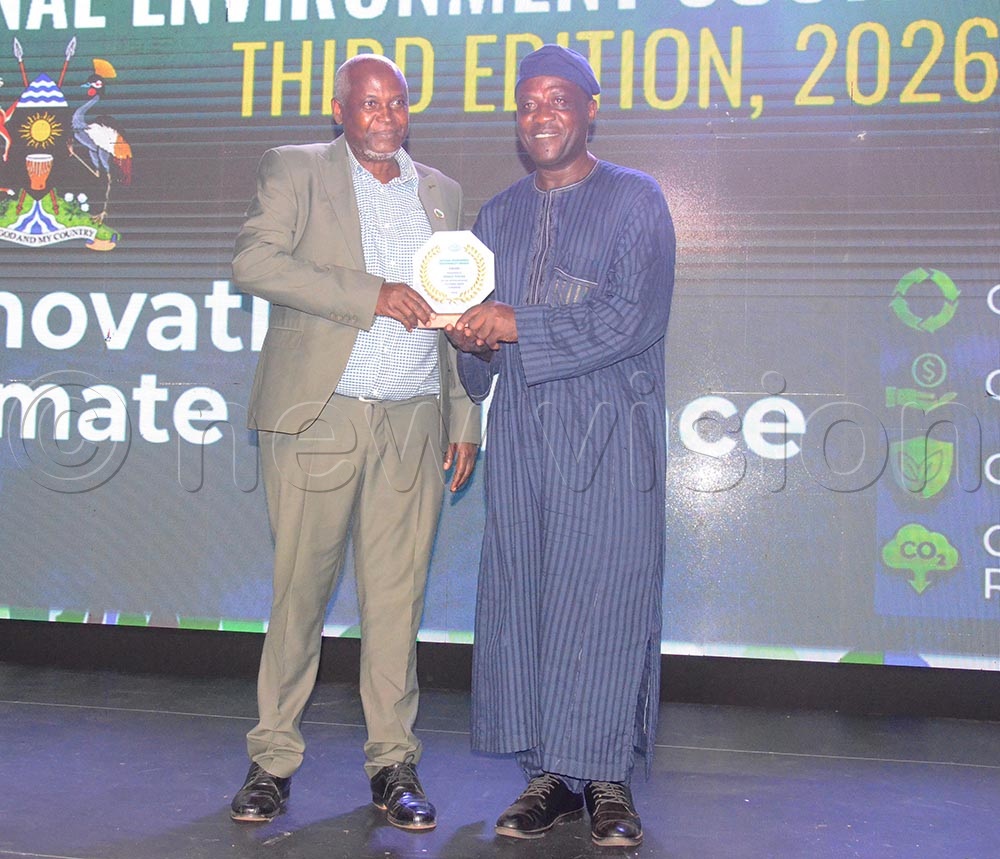
Executive Director Pio Vision Africa, Geoffrey Kamese handing over the NEMA award to Vision Group Multimedia Journalist Gerald Tenywa during the event at Serena Hotel on Friday June 19. (Credit: Isaac Nuwagaba)
Wetlands are essential for Uganda's ecosystem, providing numerous benefits, including water purification, flood control, and acting as habitats for diverse wildlife.
The Bank of Uganda Governor, Micheal Atingi-Ego, warned that environmental degradation is posing a significant threat to Uganda's economic stability if not addressed in the near future.
Atingi-Ego pointed out that climate change is affecting agro-based exports, such as coffee, maize, milk, honey, and timber, leading to loss of foreign exchange earnings.
Presenting a paper as a keynote speaker, the central bank governor said environmental degradation has led to devastating floods in Eastern Uganda, which has caused landslides that have damaged properties, especially crops, and claimed lives.
To mitigate these effects, Atingi-Ego urged financial institutions to adopt climate-smart financial products and services such as insurance schemes covering weather-related crop failure and credit facilities tied to sustainable land use practices.
Atingi-Ego noted that climate-related risks could reduce Uganda's Growth Development Product (GDP) by up to 3.1% by 2050, stressing the need for financial institutions to integrate environmental, social, and governance principles into their core business strategies.
“The mindset of viewing environmental, social, and governance factors as well-intended add-ons or burdens on the balance sheet is economically obsolete,” he insisted.
Ating-Ego noted that the country's heavy reliance on climate-sensitive sectors, such as agriculture, makes it highly vulnerable to climate change. “Agriculture accounts for 40% of Uganda's GDP and employs 80% of the country's labour force, making it a critical sector for the economy.”
He said the sector is mainly rain-fed, with only 1% of agricultural production supported by irrigation, increasing its vulnerability to climate variability and change.
To mitigate these effects, Atingi-Ego recommended integrating climate policy into macro-fiscal frameworks, prioritising emission tax revenues for climate adaptation projects, and investing in climate-resilient infrastructure.