
Forensic Police boss seeks decentralisation of services at regional commands
“If a suspect is arrested in Masaka, Mbarara or as far as Kisoro, we take a DNA sample, put it on a rapid system and within 90 minutes, they can get a DNA profile, submit it to the database, and can quickly identify and conclude the person behind the crime and bring them to book for prosecution rather than spending more resources in jail while consuming public resources during remand without charge sheets,” Mubiru said.
Mubiru (C) said that, at times, police were unable to bring certain formal charges against suspects who remained on remand while evidence was being gathered because of the challenges of not having the right tools closer to frontline officers. (Credit: Jackie Nambogga)
Uganda Police Director of Forensic Services Andrew Kizimule Mubiru has called for the establishment of forensic laboratories across regional police commands to enable frontline officers to advance law enforcement in remote areas.
Mubiru said the police currently have forensic laboratories only in Kampala, which remains one of the department’s biggest challenges, as officers from areas as far as Moroto and Kisoro have to transport samples to the capital for testing.
He made the remarks during a one-day DNA workshop for government analysts from the East African Community at the National Forensic Sciences University (NFSU) India-Uganda campus, located at Gaddafi Barracks in Jinja, on September 16, 2026.
The workshop was organised by NFSU in conjunction with Thermo Fisher Scientific Inc., a scientific technology and software company, which unveiled its latest Rapid DNA system capable of producing results within 90 minutes.
While the police have some machines, Mubiru said they needed greater capability, particularly in dealing with incidents involving sexual and gender-based violence, where rapid DNA solutions could play a key role.
Mubiru, who was among participants from Kenya, Tanzania, Rwanda, Zanzibar and Uganda, including NFSU students, appealed to the Ministry of Internal Affairs and the Government to equip the 186 regional policing commands with the necessary tools and take services closer to communities.
Since the institution was undertaking the subcounty or division community policing approach in consultation with President Yoweri Museveni, Mubiru said having more tools in the hands of frontline officers would put them in a better position to guide their personnel.
Mubiru said that, at times, police were unable to bring certain formal charges against suspects who remained on remand while evidence was being gathered because of the challenges of not having the right tools closer to frontline officers.
“If a suspect is arrested in Masaka, Mbarara or as far as Kisoro, we take a DNA sample, put it on a rapid system and within 90 minutes, they can get a DNA profile, submit it to the database, and can quickly identify and conclude the person behind the crime and bring them to book for prosecution rather than spending more resources in jail while consuming public resources during remand without charge sheets,” he said.
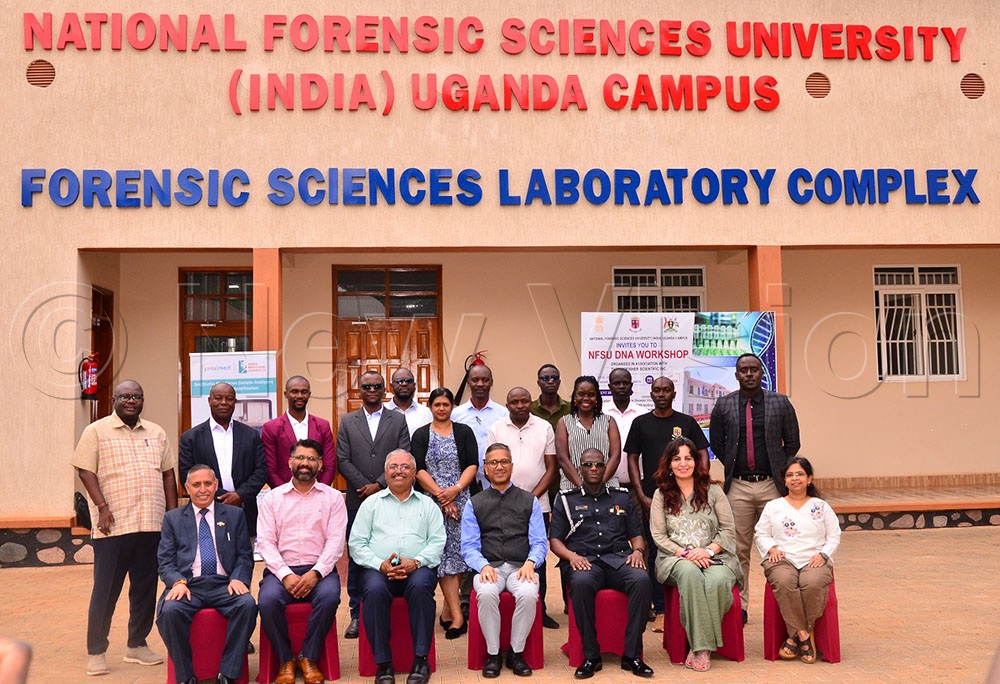
The NFSU Jinja campus director, Air Commodore Kedar Thaakar, said this was their first DNA workshop organised for government experts and expressed confidence that it had equipped participants with knowledge they could use to advocate for improved forensic services in their respective countries. (Credit: Jackie Nambogga)
Like other countries, Mubiru said the technology remained important, with its primary role being to identify possible offenders whose DNA profiles could later be relied upon in courts of law, particularly in criminal matters.
He said such residuals could include blood, saliva and sweat, which can help link suspects to offences for possible prosecution.
Meanwhile, Suleiman Masoud Suleiman, a DNA analyst from the Government Chemistry Laboratory Agency in Zanzibar, said the training was timely as the region prepared for heavy rains characterised by landslides and disastrous floods, which can result in people being swept away and killed.
He said that in such mass disasters, bodies can be destroyed beyond recognition, but the latest technology could be used to speed up DNA identification.
Prof. Dr Satisu Kumar, the dean of NFSU and director of the NFSU Gopal campus in India, said the process allows forensic experts to conduct tests on teeth and bones because bodies decompose quickly, in addition to the problems caused by decomposition.
“On the first day, the body looks fresh, but as time passes, due to temperatures and micro-organisms, it starts decomposing, smelling, and tissues are no longer intact. We may not get forensic samples in that case; the best with the rapid DNA solution is on teeth and bones,” Kumar, who was the chief guest, said.
The NFSU Jinja campus director, Air Commodore Kedar Thaakar, said this was their first DNA workshop organised for government experts and expressed confidence that it had equipped participants with knowledge they could use to advocate for improved forensic services in their respective countries.