
Family Court launches mediation fortnight to tackle case backlog
Launching the initiative on Monday, July 6, 2026, Principal Judge Jane Frances Abodo underscored the importance of mediation in resolving family-related disputes, saying, “to think that you can go to court and solve your disputes is a joke.”
Principal Judge Jane Frances Abodo speaking during the launch of a two-week mediation drive aimed at resolving more than 400 cases. (Photos by Mpalanyi Ssentongo)
________________
The Family Division of the High Court in Kampala has launched a two-week mediation drive aimed at resolving more than 400 cases as part of efforts to reduce the court's case backlog while empowering parties to settle disputes amicably.
According to the court's assistant registrar, Juliet Komugisa, 70% of the pending cases relate to the renewal or extension of letters of administration and probate, 20% involve new applications for grants of letters of administration or probate, while 10% are divorce matters.
“We are going to handle 400 cases in two weeks. We have about 10 committed mediators, and we are hopeful that all of them will be successful,” Komugisa said.

“Even in cases where mediation has not been successful, we consider it a success because we would at least have facilitated the parties to talk because most of them actually don’t talk at all,” Komugisa said.
During the launch on Monday (July 6), Komugisa explained that the surge in applications for the extension or renewal of letters of administration and probate followed the amendment of the Succession Act in 2022, which resulted in all individual grants issued before the amendment expiring on May 31 last year.
She said the adoption of quarterly mediation sessions has helped reduce the court's backlog to 170 cases.
A case is considered a backlog if it has remained unresolved in the judicial system for more than two years.
Komugisa said the court would like to refer all old cases to mediation but noted that many litigants remain reluctant to embrace the process despite it being less costly and quicker.
Launching the initiative on Monday, July 6, 2026, Principal Judge Jane Frances Abodo underscored the importance of mediation in resolving family-related disputes, saying, “to think that you can go to court and solve your disputes is a joke.”
Abodo said mediation is the most appropriate way to resolve family disputes because their effects often extend across generations.
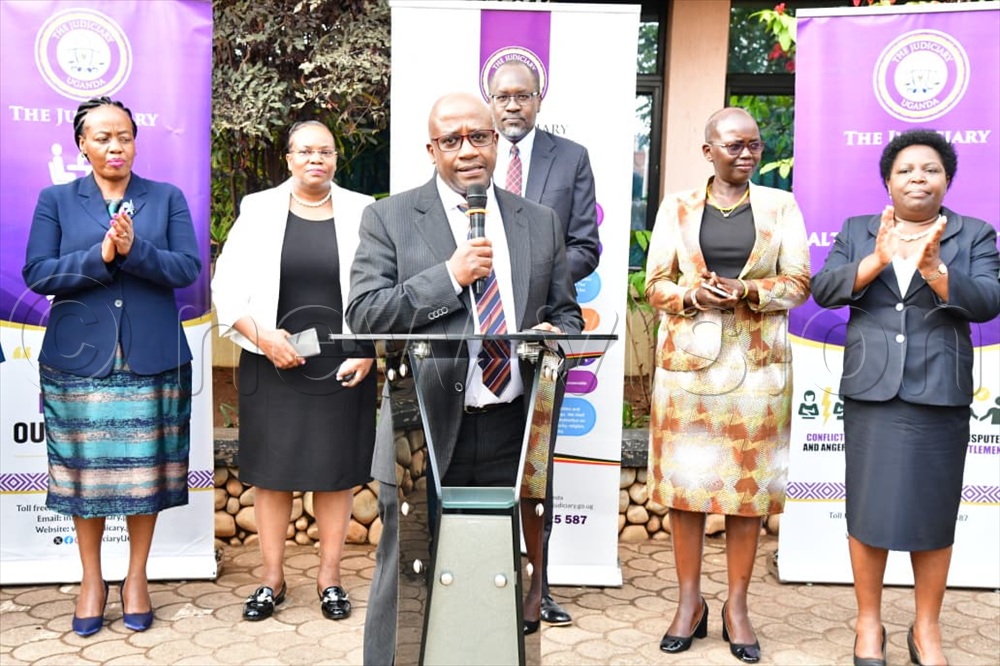
“Yes, courts can solve disputes, but mediation brings lasting solutions. We shouldn’t pass this to the next generations,” Abodo said.
Citing the country's growing population, Abodo appealed to the public to embrace mediation, noting that the judiciary can never have enough judges to handle every dispute through litigation.
She also urged advocates to support the judiciary by explaining the benefits of mediation to their clients.
“We call upon the advocates to talk to your clients about the advantages of mediation. When they bring their disputes before you, listen to them and take a decision on whether the matter can be resolved through mediation. If yes, please advise and support them to reach a settlement,” Abodo said.
John Eudes Keitirima, the head of the Family Division of the High Court, said the court's philosophy is to preserve family relationships because a family unit is like a necktie that can bend but cannot break.
“Therefore, we have resolved that the best mechanism of resolving family disputes is through mediation. So, before the matter comes to court, the parties first make an attempt to resolve it by themselves,” Keitirima said.
Keitirima commended High Court judge Prof. Andrew Khauka, who is also the Executive Director of the Judicial Training Institute (JTI), for promoting mediation, saying it has significantly reduced the judiciary's case backlog.
Khauka thanked the mediators at the Family Division for their dedication to helping parties resolve disputes amicably.
“We still have invoices that are yet to be paid, but I thank the mediators at this court for their commitment to mediation. We need to use the little resources we have, and I think you have demonstrated this. This is the best performing court when it comes to mediation, and please keep it,” Khauka said.