
News
Ex-minister Nakiwala roots for refugee support as aid shortfalls deepen
Nakiwala Kiyingi says there is an urgent need to prioritise support for refugees to help them attain self-reliance, freedom and dignity as they seek refuge in Uganda.
Sanusi Tejan Savage (fourth from right), the International Organisation for Immigration (IOM) Uganda Chief of Mission, handing Hon. Florence Nakiwala Kiyingi (Centre), the former minister of youth and children affairs and founder of Lisa Supporting and Sustaining Lives (LSSL), a vehicle key as other guests look on. This was during a handover ceremony of a Land Cruiser vehicle that was donated by the IOM to LSSL to support their programs implementation. This was at the IOM offices in Naguru on Tuesday. (Photo by Lawrence Mulondo)
By: Lawrence Mulondo, Journalists @New Vision
_______________
Former youth and children affairs state minister Florence Nakiwala Kiyingi has urged individuals and corporate entities to partner with humanitarian organisations and increase donations to support vulnerable populations, particularly refugees, to promote a safer, more dignified world.
Nakiwala Kiyingi says there is an urgent need to prioritise support for refugees to help them attain self-reliance, freedom and dignity as they seek refuge in Uganda.
She warns that the worsening shortage of food in refugee settlements and among displaced communities has reached critical levels and can no longer be ignored.
She cautions that failure to address food insecurity could trigger instability within settlements.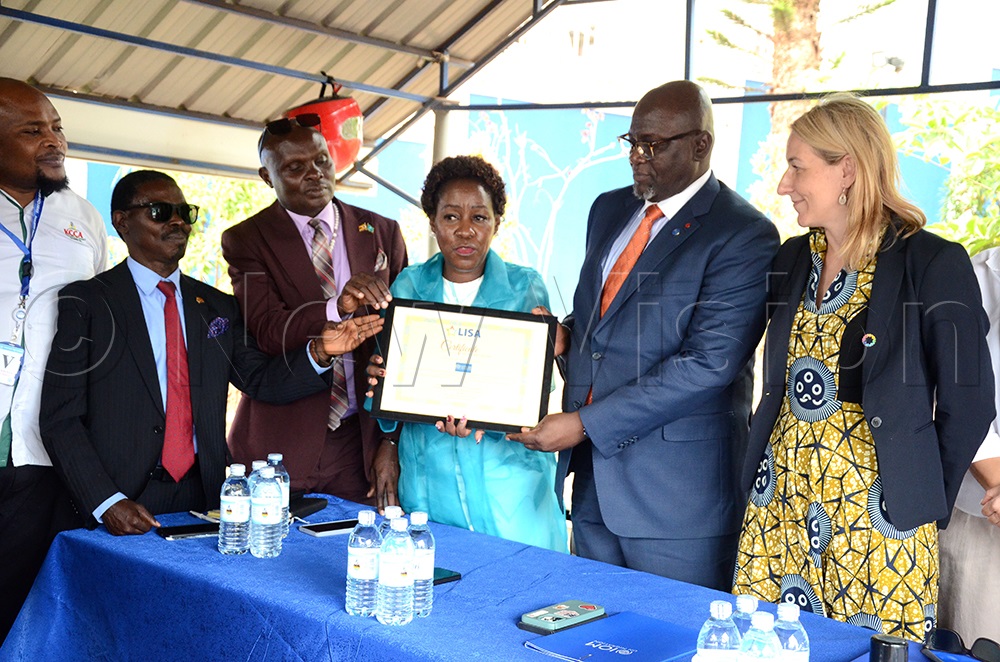
(Credit: Lawrence Mulondo)
According to her, prolonged neglect may lead to unrest, renewed displacement, and heightened insecurity, which would, in turn, strain humanitarian agencies already operating under strained conditions.
“If this situation is ignored, even those who have already settled may be attacked, security could deteriorate, and people may be forced to move again. This will only increase the burden on humanitarian organisations dealing with an already persistent problem,” she warned.
Uganda currently hosts over 19 million refugees and asylum seekers, mainly from the Democratic Republic of Congo and South Sudan.
In July 2023, the United Nations scaled back its assistance to a targeted system that groups refugee households by vulnerability.
Under this arrangement, the most vulnerable households receive 60% of monthly food rations, moderately vulnerable families receive 30%, while many others receive no food assistance at all.
Humanitarian work and transport challenges
Nakiwala, also the founder of Lisa Supporting and Sustaining Lives (LSSL), a non-governmental organisation specialising in child welfare and refugee protection, made the remarks on February 10, 2026, during an event where the International Organisation for Migration (IOM) handed over a Land Cruiser to support LSSL’s humanitarian programmes.
She explained that access to reliable transport is critical for a timely humanitarian response. She cited one of LSSL’s ongoing programmes in which the organisation has so far supplied food to more than 10,000 families in Kiryandongo Refugee Settlement and surrounding communities, in partnership with Muslim Charity UK and other partners.
Although funding was secured for food distribution, she said the organisation could not afford to divert resources to hire vehicles to access hard-to-reach areas. As a result, staff were at times forced to use an ambulance to transport personnel involved in food distribution activities.
Nakiwala added that transport is not only essential for food delivery but also for other humanitarian interventions such as life-skills training and programmes aimed at promoting self-reliance among refugees.
She thanked IOM for the vehicle support, saying it will enhance monitoring, accountability and timely response, while also safeguarding the dignity of the people they serve.
She also appreciated IOM for supporting LSSL through the process of standardising its internal systems to meet international partnership standards.
She committed to using the vehicle strictly for programme delivery and ensuring it translates into measurable impact on the ground.
IOM reaffirms commitment to national partnerships
Addressing guests at the handover, IOM Uganda chief of mission Sanusi Tejan Savage said the continued collaboration reflects a shared commitment to advancing the protection, dignity and self-reliance of refugees, returnees and host communities across Uganda.
He said the vehicle donation is intended to strengthen LSSL’s operational capacity and improve service delivery to vulnerable populations, particularly in refugee-hosting and hard-to-reach areas.
Savage noted that the partnership is anchored in the government-led refugee response framework coordinated by the Office of the Prime Minister, which ensures national and local organisations play a central role in implementing refugee protection and assistance programmes.
He added that the handover symbolises more than the transfer of an asset, but a shared commitment to transparency, accountability and sustainable humanitarian and development outcomes in Uganda.