
EU, Uganda celebrate 50 years of partnership through photo exhibition
EU Ambassador to Uganda, Jan Sadek, said the exhibition demonstrates how partnerships are ultimately reflected in the lives of ordinary people.
EU Ambassador to Uganda, Jan Sadek, (Third left), Minister of State for Microfinance Haruna Kasolo Kyeyune (Centre) , Permanent Secretary in the Ministry of Foreign Affairs Vincent Waiswa Bagiire (right), pose for a group photo with other officials. (Courtesy)
__________________ (Courtesy)
A smiling electric boda-boda rider from Kampala, a midwife from Lamwo, a coffee farmer from Nakaseke and a fisherman from the shores of Lake Victoria stared back at visitors from large photographs displayed at the Ministry of Foreign Affairs offices in Kampala.
They were among 12 Ugandans whose photographs and personal stories formed an exhibition celebrating 50 years of Uganda-European Union cooperation.
Titled Together Tukola: Built by Uganda, backed by the European Union, the exhibition, launched on September 24, puts human faces to a five-decade partnership that has stretched across different parts of Uganda and generations of Ugandans.
Moving from one photograph to another, visitors encounter people whose everyday work tells a bigger story of cooperation.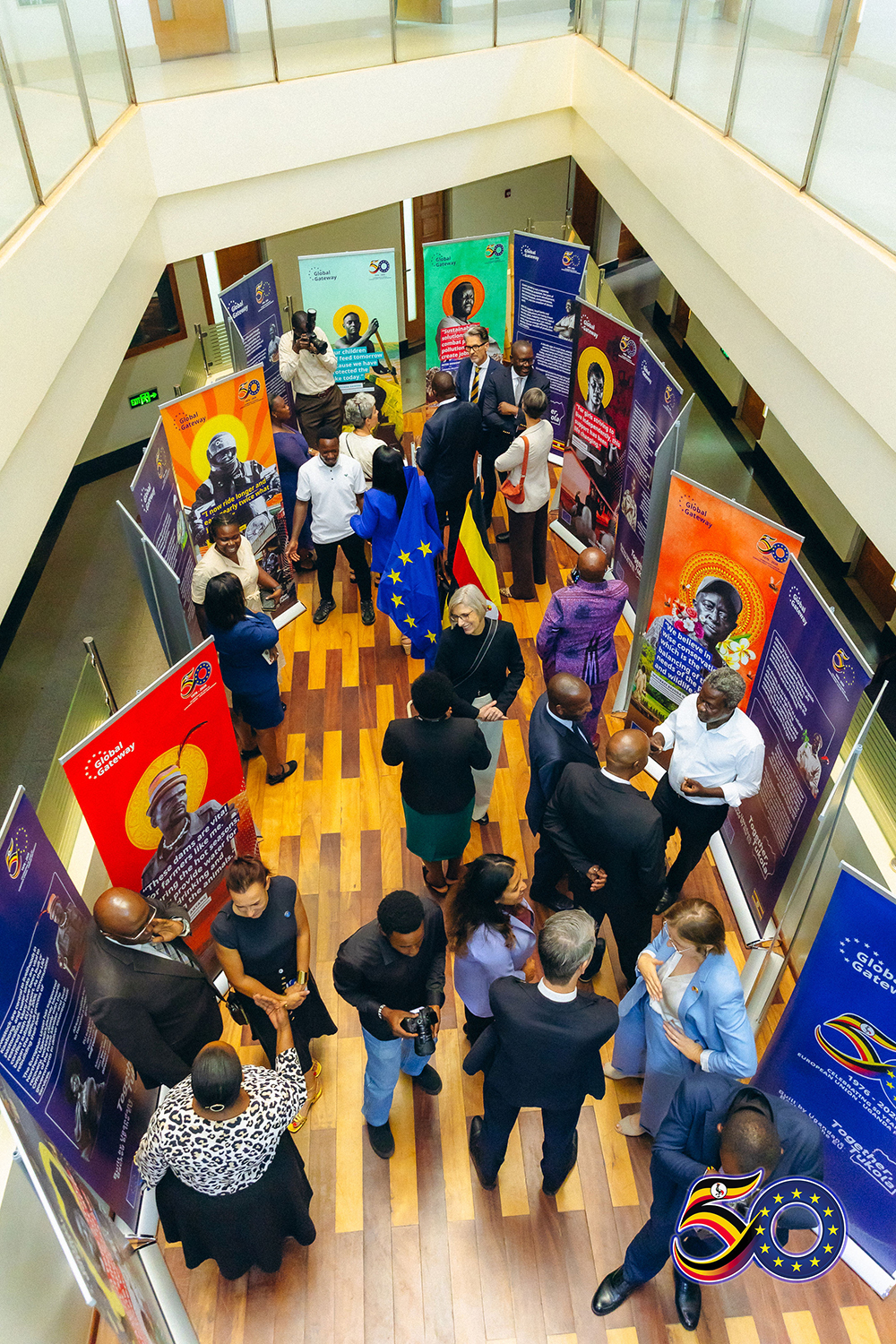
There is a Ugandan film star representing the creative economy, a human rights defender from Adjumani, a refugee teacher from Yumbe and a young female engineer who helped build the Kampala Northern Bypass.
A farmer from the Karamoja sub-region and other Ugandans feature in the exhibition adding real life stories from communities where cooperation has supported livelihoods, services and opportunities.
The photographs cover areas including renewable energy, education, health, gender equality, the creative economy, human rights, environmental conservation, agriculture, infrastructure and private-sector development.
Permanent Secretary in the Ministry of Foreign Affairs Vincent Waiswa Bagiire welcomed the EU delegation and appreciated the past and current generations of EU officials for their efforts to strengthen the relationship.
In the same tone, the EU Ambassador to Uganda, Jan Sadek, said the exhibition demonstrates how partnerships are ultimately reflected in the lives of ordinary people.
“A partnership is ultimately measured not only in years, but in lives changed. These twelve stories remind us that behind every programme, investment or policy, there are Ugandans whose determination, talent and enterprise are helping shape the country’s future,” Sadek said.
Minister of State for Microfinance Haruna Kasolo Kyeyune said the partnership had become part of Uganda’s development story.
“For 50 years, the Uganda-European Union partnership has been part of Uganda’s development story. From rebuilding infrastructure and expanding essential services to supporting education, livelihoods, innovation and sustainable growth, this cooperation has touched the lives of many Ugandans across generations,” Kasolo said.
Early cooperation focused largely on rebuilding infrastructure, supporting rural development and expanding access to essential services. Today, the partnership places greater emphasis on sustainable development, climate action, decent employment, innovation and opportunities for young people.
Kasolo said Uganda wanted the next phase of cooperation to respond to the country's changing priorities.
He cited accessible and additional climate finance, trade that rewards quality and value addition, and stronger links between universities and enterprises in education and innovation as areas for closer cooperation.
He also called for continued collaboration on multilateral issues where Africa and Europe can work with complementary voices.
“Uganda remains firmly committed to a practical, comprehensive and mutually beneficial partnership with the European Union to build on the strong foundations of the last fifty years and to expand cooperation into new areas that will benefit both peoples,” he said.
For visitors, the exhibition offers a different way of looking at five decades of cooperation. The story is no longer only about infrastructure, funding or policy documents, but about a boda boda rider, a teacher, a farmer, a health worker, an engineer and others whose individual journeys illustrate the broader relationship.
As Uganda and the EU look towards the next 50 years, the photographs serve as a reminder that the success of any partnership is ultimately experienced by people in their daily lives.
The exhibition was organised by the Ministry of Foreign Affairs and the EU Delegation to Uganda as part of activities commemorating 50 years of EU-Uganda relations.