
EA corporate leaders tipped on governance, digital transformation amid global challenges
“So, technology uptake is still largely not where you would say we are at 90% or 100%. I would probably say we are at about 40% in most businesses,” Niyitegeka said.
(L-R) Michael Niyitegeka, Board Member Vision Group; Peter Mungoma, Capital Radio Group; and Evelyn Namara, Board Member, KCB Bank remark during the session. (Credit: Simon Peter Tumwine)
KAMPALA - Corporate leaders across East Africa have been urged to strengthen board governance, embrace digital transformation, and invest in human capital to remain resilient amid global disruptions.
The call was made on April 30, 2026, during the League of East African Directors (LEAD) Convention, which attracted over 200 corporate leaders from across the region and beyond at Kampala city-based Arirang Hotel.
Vision Group board member Michael Niyitegeka,said technology adoption in most businesses remains below optimal levels.
“So, technology uptake is still largely not where you would say we are at 90% or 100%. I would probably say we are at about 40% in most businesses,” Niyitegeka said.
He noted that while finance functions are often automated, other areas lag behind.
“When you look at procurement and logistics, you still see a lot of manual processes, largely due to the investment required,” he explained.
Niyitegeka also cited limited digital skills among staff as a key barrier.
“A lot of people can use computers, but they don’t have the level of proficiency required,” he said, urging companies to invest in local solutions and warning against reliance on manual systems.
“If it is both manual and digital, the easiest thing is to default to manual,” he noted.
On artificial intelligence, he added: “AI can only go up to a certain limit; you need a human being to humanise what it produces.”
Niyitegeka emphasized that transformation must begin at the top.
“That conversation needs to start in the boardroom, not in the tech room,” he said.
Youth key to future markets
UNFPA [United Nations Population Fund] country representative Kristine Blokhus urged private sector players to tap into Uganda’s youthful population.
“This country has a very large youthful population, and I want to mobilise the private sector to help shape that future market,” she said.
She noted that 51% of young people are not in education, employment, or training.
“They must be given opportunities to become part of building the country,” Blokhus said, describing Uganda as a market with immense potential.
“Uganda is a market that’s about to explode, but only if young people are educated, healthy, and employed,” she added.
Boards must focus on impact
Corporate governance expert Alfred Brian Agaba, a board member at Nation Media Group (NMG) Uganda, urged boards to look beyond financial performance.
“Boards must look beyond numbers to understand the real human and societal impact they create,” Agaba said.
He challenged organisations to assess their relevance. “The true test of sustainability is what society would lose if that organisation ceased to exist,” he noted.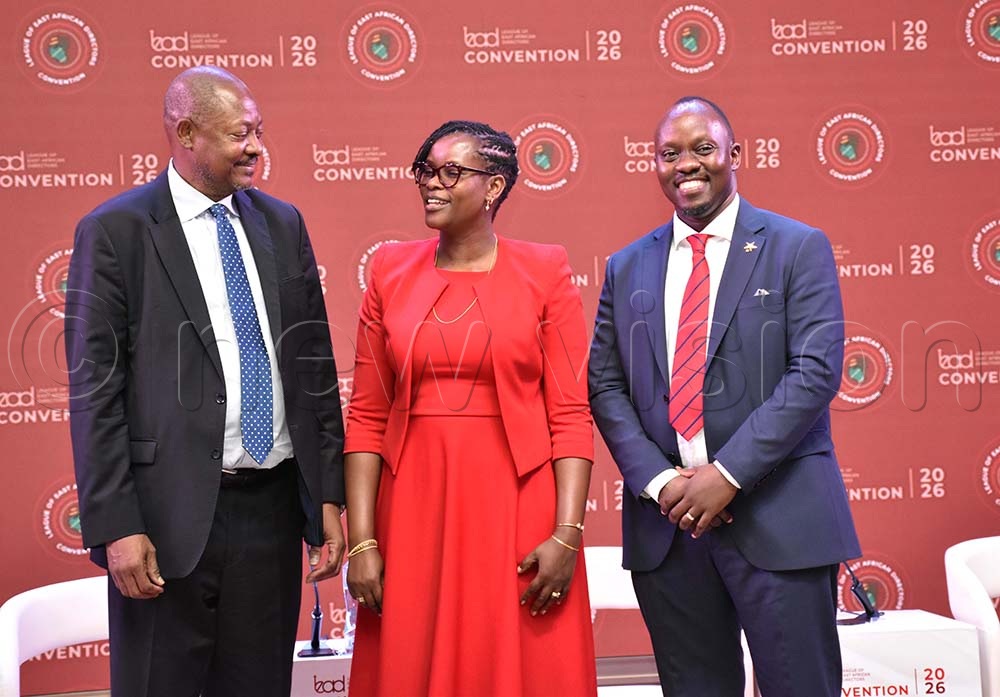
Dr. Martin Oduor-Otieno interacting with Gertrude Karugaba chairperson League of East African Directors (LEAD) as Trevor Ariho, the Chief Executive Officer of LEAD looks on during the LEAD convention at Arirang Hotel. (Credit: Simon Peter Tumwine)
Leadership harmony critical
Brian Arineitwe, the head of sales at Vaal Real Estates, stressed the importance of unity between boards and management.
“If there is a rift between the Managing Director and the board, it creates uncertainty across the organisation,” he said, warning that such conflicts affect employee confidence.
“If the MD can be fired instantly, even the lowest employee starts worrying about job security,” Arineitwe added.
Adapting to global shifts
Gertrude Wamala Karugaba, Chairperson of LEAD, said organisations must adapt to a rapidly changing world.
“We’ve asked ourselves what is required to operate in the world we are facing today,” she said.
She cited geopolitical tensions and technological disruption as key concerns.
“There are internal factors we can control, including how we respond to artificial intelligence,” she noted.
Keynote speaker Dr Martin Oduor Otieno, whose book is titled “The Humanised Leader” emphasised the importance of leadership and strategy.
“It all boils down to the right leadership, the right vision, and a strategy that enables delivery,” he said.
He urged organisations to define their purpose clearly.
“They must understand why they exist and what will make them grow,” he added.
Oduor said people and customers remain central to success.
“At the root of everything are people and the customer those who buy our products and sustain us,” he noted.
MTN Uganda CEO Sylvia Mulinge and Absa Uganda managing director David Wandera also contributed to the discussion.
“People will follow your example, which is why it is important to set a good one as a leader,” Wandera said.
The convention also featured contributions from Peter Mungoma of Capital Radio Group and Evelyn Namara of KCB Bank. Other corporate leaders who spoke at the convention included Patrick Ayota, MD at the National Social Security Fund (NSSF) and Dr Eng. Silver Mugisha, the Managing Director and CEO of National Water and Sewerage Corporation.