
District development officers cautioned over diverting funds
With the new government payment systems, funds are no longer sent to the district through commercial banks, making it easy to be tracked using the measures in place,” Omene revealed.
Faridah Kimbowa (left), Chairperson of the National Women Council Uganda, and Hillary Asiimwe, Secretary of the National Youth Council, during a consultative meeting on the Institutional Support Fund for Women Council chairpersons and District Development Officers (DDOs) in Kampala. (Photo by Wilfred Sanya)
______________
The District Development Officers (DDO) have been warned over diverting funds to other uses, but instead play a technical role only, said Emmanuel Omene, Planner, Ministry of Gender, Labour and Social Development (MOGLSD).
“We have discovered that some money sent to the districts has been diverted by technical district officers to other activities, taking advantage of the ignorance of communities not being aware when money was received at the districts,” Omene said.
With the new government payment systems, funds are no longer sent to the district through commercial banks, making it easy to be tracked using the measures in place,” Omene revealed.
“In our tours, we have found diversion of money sent into unauthorised activities because the communities are not aware of it when generifies come asking about the money they offered transport refund,” Omene said.
Omene made the remarks during the consultative meeting on the Institutional Support Fund for the chairperson of women council and District Development Officers (DDO) in Kampala.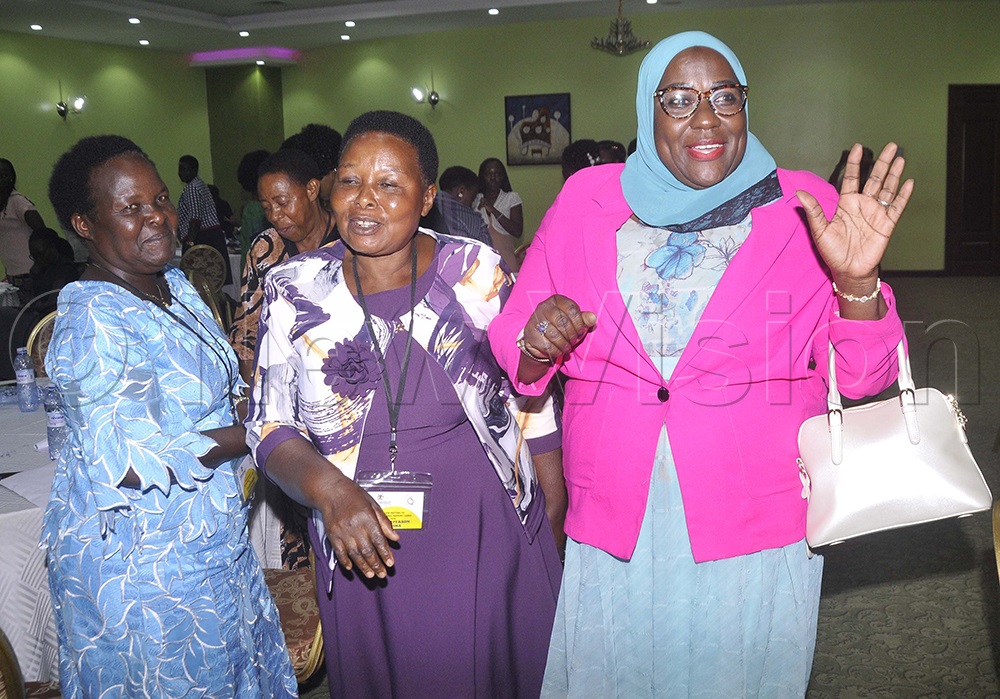
L–R: Josephine Namulindwa, Kalangala District Women Council Chairperson; Sherry Kyaleebara, Wakiso District Women Council Chairperson; and Faridah Kimbowa, Chairperson of the National Women Council Uganda, during a consultative meeting on the Institutional Support Fund for Women Council chairpersons and District Development Officers (DDOs) in Kampala. (Photo by Wilfred Sanya)
He told the district women chairpersons to follow up on all funds sent to the districts that include national poverty-alleviation and empowerment funds, Parish Development Model (PDM), Uganda Women Entrepreneurship Program (UWEP), Emyooga and Presidential Initiative on Operation Wealth Creation (OWC).
“You should highlight women's rights and governance in your work plan to promote women leaders and to increase women's governance districts through orientation,” he said.
“Before signing any document, authenticate it before you fall victim to accountability. I know once you empower a woman, you have empowered a nation,” he alluded.
Faridah Kimbowa, chairperson of the women's District council, hailed President Yoweri Museveni for championing the women’s agenda despite the fact that he is not a woman.
Kimbowa hailed President Museveni for empowering women socially and politically, and that is why they hold governance positions, as evidenced during the Presidential, Parliamentary and local elections.
She said district councilors and District Development Officers had taken over their roles, but with women structures, the situation was saved.
“When we came in office, the budget was sh800 million annually, today our budget is sh7 billion, and we would like the budget to be increased to cover all parishes” she said.
With PDM meant for more than 3 million Ugandans, credit goes to the women council structures across the country, who have received sh1.6 billion, and each district gets sh8 million.
She explained that since the government has stopped funding public functions, they plan to switch that budget to mobilise more for Women's Day because that is where they discuss issues affecting women.
Program manager National Women Council, Emily Akullu, said the council was created in 1993 to promote the social, economic, cultural and political development of women.
She said institutional funds have strengthened women's participation in governance, community planning, and local government structures, which have empowered them to take government roles.
She said over the years, women's councils have become an important bridge through which they get to know about government programs, and it has enticed them to participate in governance.
The women's councils play a key role in mobilising women, monitoring government programs, advocating gender response, policies and promoting women's participation in leadership positions, she said.
She alluded that when PDM was introduced, we asked the President to specify a share for women, and President Museveni pronounced a 30 percent of PDM be received by women councils directly.
“In our eight years of service, we have tried to know the challenges, effectiveness, accountability and impact of the funds to improve the women council structures' linkage with the grassroots,” she asserted.
The Mukono Community Development officer, Mukono Miser Namukose, said communities need to be trained on how to handle Gender Based Violence (GBV) among themselves. Namukose said once a case happens, people fear reporting it to the police.
Namukose said they face challenges of transport to reach out to the victims to get justice in time and create awareness.
Namukose said some people in the communities are not aware of the legal procedure to handle the GBV issue and appealed to district authorities to provide motorcycles which they can fuel.
The big challenge in some districts is that people with low education levels hold leadership positions, and this prevents them from participating in government programs linked to politics, she asserted.