
Contractor given 30-day ultimatum to fix Fort Portal-Bundibugyo Road
Byamukama issued the ultimatum on November 13, 2026, while inspecting the road, which has developed numerous potholes, making travel difficult for motorists and other road users.
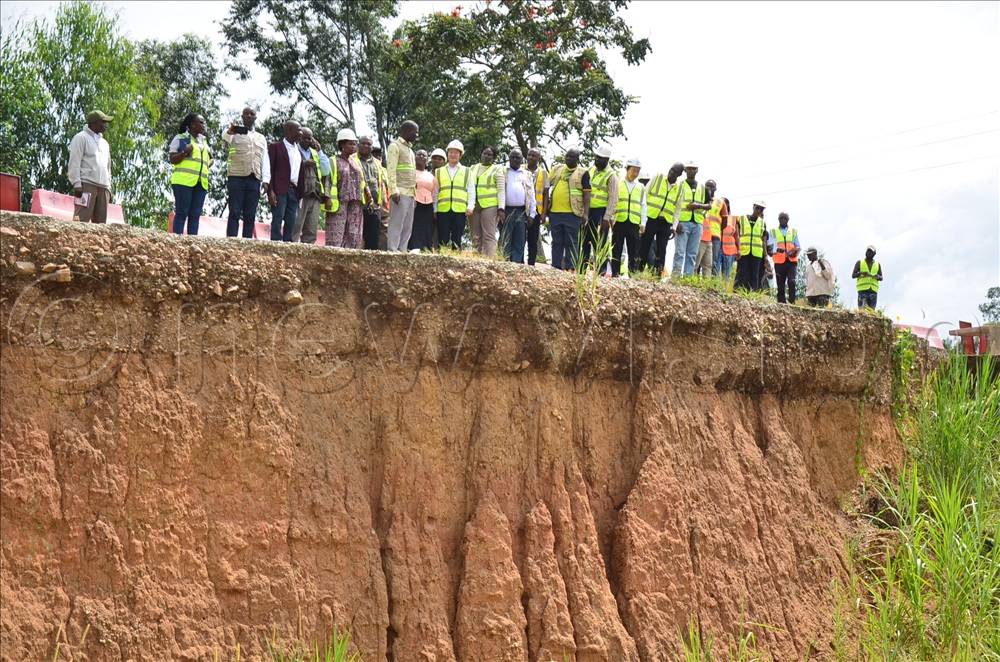
Section of Fort Portal-Bundibugyo Road that curved in. (Photos by Jonan Tusinmgwire)1))
________________
Works and transport minister Fred Byamukama has given China Communications Construction Company (CCCC) 30 days to begin rehabilitation works on the 103-kilometre Fort Portal-Bundibugyo road following public complaints about its deteriorating condition.
Byamukama issued the ultimatum on November 13, 2026, while inspecting the road, which has developed numerous potholes, making travel difficult for motorists and other road users.
The government awarded CCCC a contract worth sh118 billion in August to undertake periodic maintenance and rehabilitate sections of the road, which connects Uganda to the Democratic Republic of Congo (DRC) through Bundibugyo district.
However, Byamukama expressed concern about the slow progress of the project despite the government releasing an advance payment of about sh20 billion to the contractor.
He directed the company to mobilise its equipment and personnel and begin filling potholes along the road within 30 days.
“We gave this road to a contractor in August at a cost of sh118 billion for about 103 kilometres. The road is in a poor state despite awarding the contract and releasing about sh20 billion as an advance payment,” Byamukama said.
He added: “They are supposed to undertake periodic maintenance, but there has been little progress on the ground. I have given them 30 days from now to come and fill all these potholes.”
Byamukama said the road was strategically important because it serves as a major trade route connecting Uganda to the DRC.
He noted that agricultural produce, particularly cocoa from Bundibugyo district, as well as goods imported from and exported to the DRC, are transported along the road.
The road's poor condition has for several years been a concern among residents, traders and transport operators, who say the potholes increase travel time and the cost of transporting goods.
The Bundibugyo District Woman MP, Josephine Babungi, welcomed the government's intervention, saying the road's poor state had negatively affected businesses and transport in the region.
Babungi said the road was the main route connecting Bundibugyo district to the rest of the country and also serves as a vital link between Uganda and the DRC.
She noted that it supports significant business activities, including the transportation of agricultural produce and other goods between Bundibugyo, other parts of Uganda and the DRC.
The deteriorating condition has also increased vehicle maintenance costs for motorists and transport operators.
“There are a lot of businesses that move along this road, and its deteriorating state has been a thorn in the flesh of many businesspeople in the region,” Babungi said.
Minister faults property valuation
Before inspecting the Fort Portal-Bundibugyo road, Byamukama visited the ongoing Kyenjojo-Kamwenge road project, where he blamed questionable property valuations for delays in upgrading the 106-kilometre Kihura-Bwizi-Rwamwanja-Kahunge and Mpara-Bwizi roads.
The government is upgrading the 68-kilometre Kihura-Bwizi-Rwamwanja-Kahunge road and the 38-kilometre Mpara-Bwizi road to bituminous standards, alongside the construction of 20 kilometres of town roads.
The roads traverse Kyenjojo, Kyegegwa and Kamwenge districts and are expected to improve connectivity, facilitate trade and ease the transportation of agricultural produce.
However, the project has been affected by delays in land acquisition, with only 35 percent of the required land secured and handed over to the contractor, despite the expectation that all the land should have been acquired by now.
Byamukama accused officials of engaging an Australian company to value properties belonging to project-affected persons, arguing that Uganda has qualified valuers who could undertake the exercise.
He said the valuation exercise had been poorly handled, prompting some residents to reject compensation offers and refuse to surrender their land and houses.
“We have Ugandans who have studied valuation and can do the work before submitting the assessments to the Chief Government Valuer for approval,” Byamukama said.
He questioned why the government had to rely on a foreign company to assess properties when local professionals were available.
“How can you bring someone from Australia who does not know what a brick looks like or where you get your sand from? When he sees Uganda iron sheets, for him it is history. When he looks at a plot of land, he does not know how much it costs. That was corruption, and we shall investigate it to ensure it does not happen again,” he said.
Byamukama cited the valuation of a three-roomed house at sh17 million as an example of what he described as gross undervaluation.
He questioned whether the amount was sufficient to construct a similar house, arguing that affected residents were justified in rejecting such compensation offers.
“If I gave you Shs17m, can you build such a house? You cannot value such a house and its plot at Shs17m. That is the madness we need to stop, and the residents are right to refuse,” he said.
The minister said he would investigate the circumstances surrounding the engagement of the Australian company and the valuation exercise.
Residents demand fair compensation
Agriculture minister Frank Tumwebaze, who accompanied Byamukama during the inspection, urged the Ministry of Works and Transport to urgently address complaints raised by project-affected residents.
Tumwebaze said the ministry should follow up on the grievances and ensure that the compensation process was handled promptly to prevent further delays to the project.
Some residents said they had lost their homes after receiving compensation they considered inadequate.
Christine Kabasinguzi, a resident of Bwizi village, said her house was demolished after she received sh3 million in compensation, which she said was insufficient to enable her to secure another home.
“My house was demolished after they paid me only sh3 million. I even failed to get another house because the money was not enough to build another one,” Kabasinguzi said.
James Kyarimpa said residents supported the road project but wanted the Government to ensure that affected people were fairly compensated.
“While we appreciate the project, we want people to be compensated fairly. They did not even approach local leaders to get the actual information before proceeding with the compensation,” Kyarimpa said.