
Catholic Church commemorates former chief justice Ben Kiwanuka
“Ben Kiwanuka was a genuine nationalist. He was a man of faith"
Catholic Church commemorates former chief justice Ben Kiwanuka
________________
As part of the activities to celebrate the Month of Justice and Peace, the Catholic Archdiocese of Kampala, through its Department of Justice and Peace, organised a memorial function for the late Benedicto Kiwanuka.
Kiwanuka, Uganda’s former chief justice and pioneer chief minister, was abducted and killed by security operatives during the regime of Idi Amin Dada in 1972.
Activities started with a pontifical Mass presided over by the Archbishop Emeritus of the Archdiocese of Gulu, the Most Rev. John Baptist Odama, who, in his homily, praised Benedicto Kiwanuka for his commitment to justice, human rights, equality and peaceful coexistence among Ugandans.
The family members led by Maxensia Zalwango Kiwanuka proceed to light memorial candles.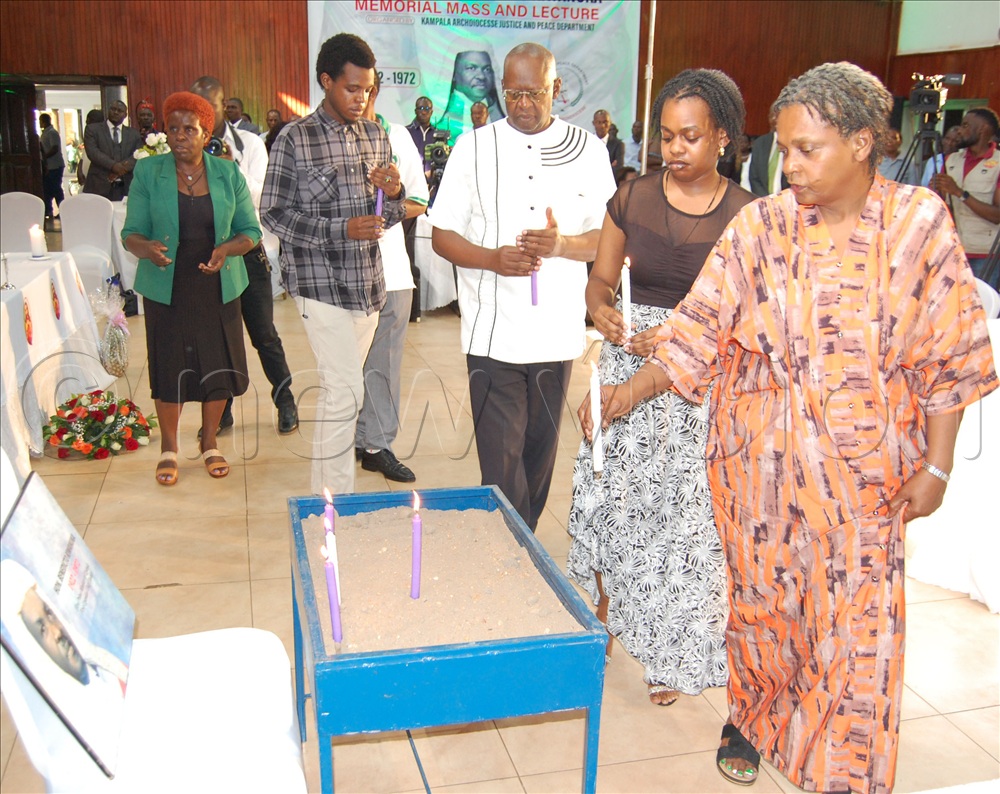
“He was one of the key-persons in the building of this country His views on democracy, human rights and justice were incomparable. His ideas cut across ethnic, religious and political lines. He did not see himself as belonging to a particular tribe. His tribe was humanity. He was a man of no revenge, a champion of justice and peace. He wanted to see Uganda stand on a better footing than before,” Odama said.
Odama urged Ugandans to strengthen their commitment to faith and the principles of justice and peace by rejecting all ways that could polarise the country. He also called for the strengthening of the institution of the family, which he said was the first school where children are taught the faith and human values.
“Why did Ben Kiwanuka succeed? He had a solid moral foundation from the family. Why should we have street children when their parents and relatives are still there? Can we really fail to discipline these young children? Parents, take charge of your family. Form the children into worthy citizens and we shall not have many of the problems we are having today as a country.”
The Vicar General of Kampala archdiocese, Msgr. Rogers Kabuye Mukasa delivers the message of archbishop Paul Ssemogerere.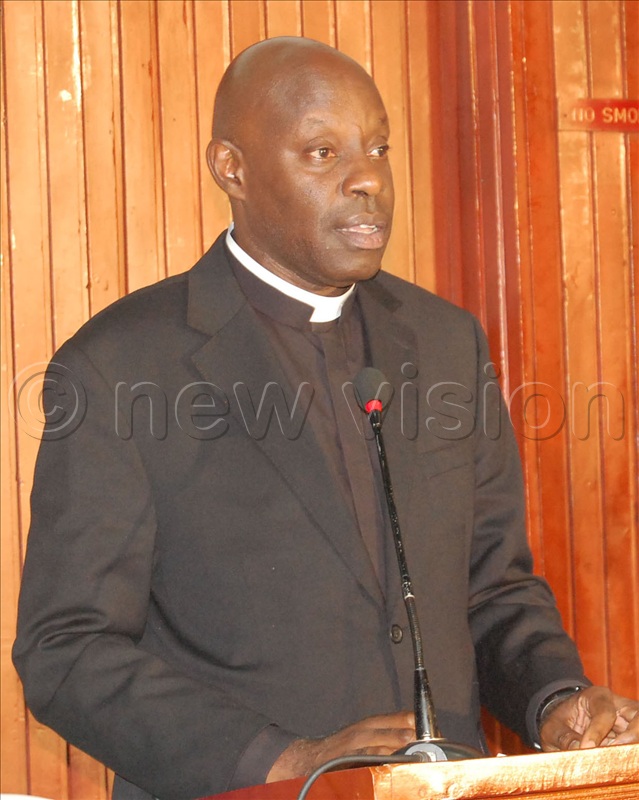
“Those in charge of laws, keep reminding people of conscience because many of them don’t have it. Schools should also promote proper formation that will help our young people to live together as brothers and sisters. Avoid violence and together, let us promote that unarmed and disarming peace right from our families,” he said.
“Ben Kiwanuka was a genuine nationalist. He was a man of faith. He was removed from his chambers, in his regalia. A man of truth to be treated as if he was a liar, to be killed so mercilessly, is the most diminishing of humanity. That should not continue anywhere in Uganda, although sometimes it happens. Fellow Ugandans, we should not be treating each other as if we are strangers to each other.”
Archbishop John Baptist Odama (wearing a mitre) shares a photo-moment with the dons from Makerere University, who include Fr. Dr. John Bosco kamoga (left), Dr. Patrick Lumumba, Dr. Jacqueline Nakayiza and Dr. Charlotte Mafumbo.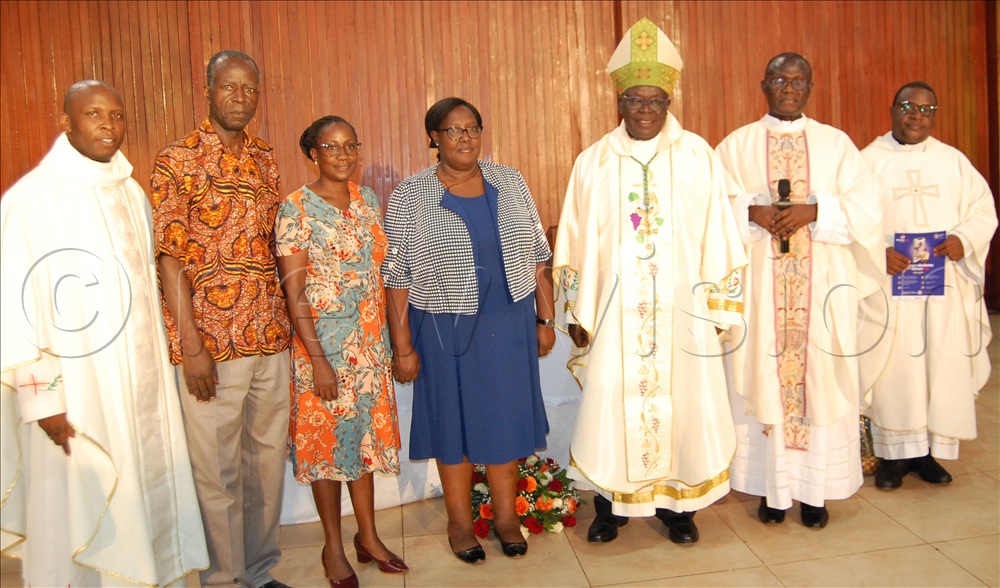
“Let us look at each other as children of God, imitating our Lord Jesus Christ who promoted peace. Let us strive for that unarmed and disarming peace. Let’s learn to settle our issues in our families and communities and the country through dialogue and reconciliation. Yes, dialogue is the way forward.,” Odama said.
MUK dons honour Kiwanuka
The function, held at Pope Paul Memorial Hotel in Lubaga on September 8, 2026, climaxed with a memorial lecture, during which Ben Kiwanuka was eulogised with even greater admiration by a number of university dons.
The keynote speaker, Dr Charlotte Mafumbo, referred to Ben Kiwanuka as one of Uganda’s most respected statesmen, who deeply believed that all Ugandans were equal before the law. She further praised him for his deep assimilation of the notion of servant leadership.
“He saw leadership as an obligation to serve others. He believed that political authority had to be exercised within the limits of the constitution. For him, leadership was not for status, power, or personal security, but for defending the rights of others.”
Like Odama, Mafumbo also encouraged the strengthening of the family institution and the promotion of responsible parenting so that young people can learn the virtues of honesty, love, diversity and mutual coexistence. She credited Kiwanuka for his diaromatic modus operandi and assimilation of the principles of inclusivity and fraternity.
Dr. Charlotte Mafumbo delivers the Benedicto Kiwanuka Memorial Lecture at Pope Paul Memorial Hotel, Lubaga on Tuesday, September 8, 2026.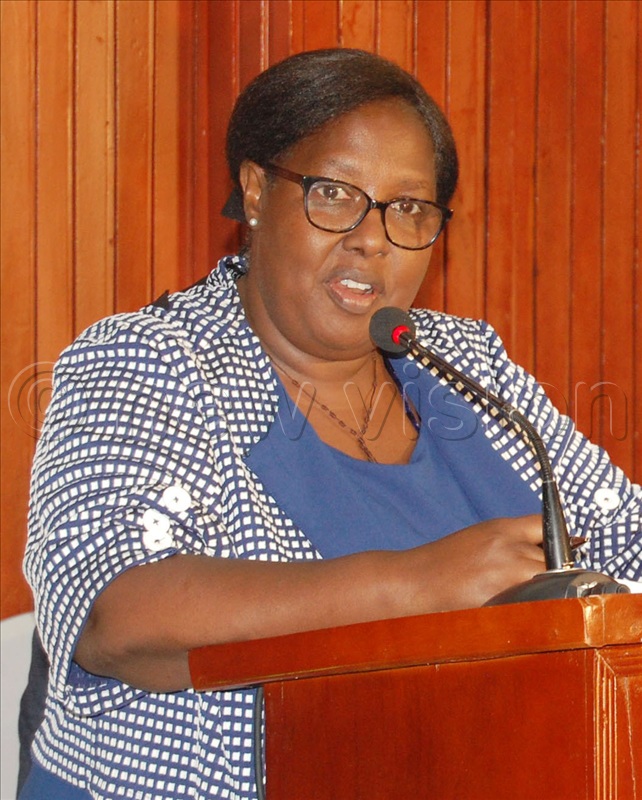
Rev. Fr. Dr John Bosco Kamoga, a discussant, called on Church leaders to remain the prophetic voice they have always been known to be. He expressed deep concern that religious leaders were being silent on various socio-economic and political irregularities, yet they are mandated to be the voice of the voiceless.
Dr Jacqueline Nakayiza, another discussant, called for greater involvement of the youth in dialogue on issues of national concern because they are the majority and are even more affected when things go wrong.
She also asked parents to find time to talk to their children and teach them the values that will help them to live in unity in diversity.
Dr Patrick Lumumba, another discussant, said diversity was a reality of humanity, which was why people had no alternative but to embrace the culture of living together in diversity. Apart from North Korea and South Korea, Lumumba said, no country was homogenous.
Canonisation proposal
Maurice Kagimu Kiwanuka, who spoke on behalf of the family, surprised people when he said that a Catholic researcher and former head of the laity of Kampala Archdiocese, Robert Ssempa, had done research and written a book on his father, Ben Kiwanuka, which they had taken to the late Archbishop Dr Cyprian Kizito Lwanga as a basis for him to start the process of his beatification and eventual canonisation.
He said they were later told that it was not a practice of the Church to canonise a person whose remains or burial place could not be traced, an argument that did not convince him because there were some saints who were canonised when their burial locations were not known.
The choir from Ndeeba Catholic parish leading the singing during mass.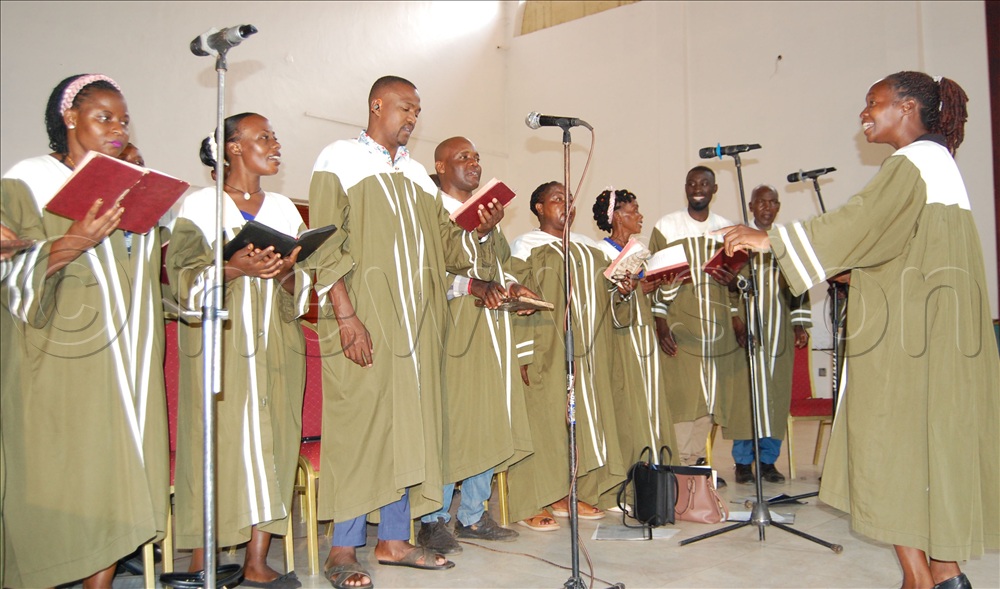
But in his closing remarks, Archbishop Odama encouraged those who believed Kiwanuka led a saintly life to petition the bishop of the diocese where he was born, lived or worked so that he could create a committee and initiate the beatification process. He asked the faithful to pray for the process to start and get concluded.
The lecture was one of the activities of the Month of Justice and Peace organised by the Department of Justice and Peace of Kampala Archdiocese, headed by Fr Emmanuel Sita, who also graced the function.
Parliament portrait query
The lecture also featured a call for greater recognition of Ben Kiwanuka's contribution to Uganda's history.
Kennedy Mutenyo, chairman of the DP's electoral commission, questioned why Kiwanuka's portrait had not been placed at Parliament alongside those of other leaders, including Obote.